
Dr Nick Dempsey, PhD
Dr Nick Dempsey, PhD
The analysis of skeletal trauma in medicolegal contexts: Issues, novel approaches, and future directions
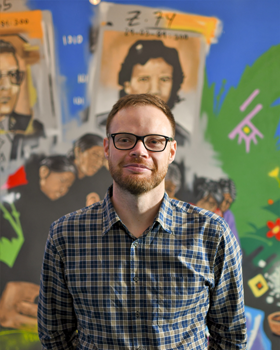
 I knew I wasn’t done with study, so I got in touch with the Victorian Institute of Forensic Medicine, who took me on as a PhD student through Monash's Department of Forensic Medicine. It was deeply challenging, but hugely rewarding, and I’m really excited by some of the opportunities I’m now starting to have.
The lush, raw beauty of Guatemala is a far cry from the wilds of south east Melbourne suburbia, where recent PhD graduate Dr Nick Dempsey first picked up a book whose impact would one day see him analysing human remains as part of forensic investigations into genocide in Central America.
"I had not long left high school, a high school not exactly renowned for producing the next generation of high-flyers, and I was armed with leaving results that reflected that. I was leafing through an autobiography of forensic anthropologist Robert Mann, and recognised some of myself in the first few pages – he was a poor performer in high school, wanted something bigger, and through years of hard work found himself advising on victim identification after the twin towers disaster, and international crimes against humanity. It made me realise my leaving results didn't have to define the rest of my life."
After a couple of dedicated years of hard study to gain entry to La Trobe University as a mature age student, Nick made the move to Canberra's Australian National University, the country's only institute to offer forensic anthropology at an undergraduate level. An Honours year followed, before moving back to Melbourne.
"I knew I wasn’t done with study, so I got in touch with the Victorian Institute of Forensic Medicine (VIFM), who took me on as a PhD student through Monash's Department of Forensic Medicine (DoFM). It was deeply challenging, but hugely rewarding, and I’m really excited by some of the opportunities I’m now starting to have."
Supervised by Associate Professor Soren Blau and Professor Richard Bassed, Dr Dempsey's project explored the possibilities of incorporating machine learning / artificial intelligence (AI) into skeletal trauma analysis, which is undertaken during death investigations featuring severe blunt force trauma injuries. It's a complex science and it can be challenging to apply theory to real-world cases, where bone breakage patterns and severity can be influenced by the force and direction of impact, anatomical variations in the individuals involved, and their posture at the time of the event and after impact.
The project harvested the voluminous existing datasets housed in VIFM's CT scan repositories, using machine learning to review the scans to see if it could complement human analysis to improve our detection of patterns in bone injuries.
"It was a bit of an outlier in that image analysis and object detection are still very much emerging areas in forensic medicine, but I think there's a lot of scope for introducing new technologies to help understand how people have died or been injured. Doing that can definitely improve how skeletal trauma is reported as well as provide a better understanding of how to avoid accidental death and injury."
The researchers focussed on injury to the femur (thighbone) occurring across two planes – horizontal and vertical.
"As a for instance, when a deceased person has fallen from a great height, compression injuries to feet and leg bones can indicate whether they made impact horizontally or vertically, which in turn can suggest whether a fall was intentional or accidental. In motor vehicle accidents involving pedestrians, modern cars tend to impact quite low on the body in the horizontal plane, flexing the femur as the person bends over the bonnet."
They found that the technology shows serious promise, but still needs work before it can serve as a reliable accompaniment to forensic practitioners.
Dr Dempsey has continued to work at VIFM since graduating, in a role supporting the UN Special Rapporteur on extra-judicial summary or arbitrary executions, Dr Morris Tidbal-Binz.
"I’ve always been attracted to the human rights and international humanitarian applications of forensic medicine, so this is just an amazing opportunity for me. We're working to improve the protection of human remains arising from unlawful killings, with a focus on lone individuals who are captured, killed and buried in unmarked graves.
"It’s well known that in Mexico as an example, the rate of violence has often prevented the State from carrying out functions including retrieving and identifying these remains, and investigating the cause of death – it is often the families of victims left to do this. We're working on recommendations to improve and assist these situations, and have remains treated in a respectful way."
He's also continuing his work in emerging technology, working with VIFM and DoFM researchers on applications of AI to facial reconstruction and disaster victim identification via passport/drivers licence/family photos.
And most recently, he's getting more of a feel for the humanitarian and human rights work that really inspires him, through a two-month secondment to Guatemala.
"Dr Tidbal-Binz participated with the Abuelas de Plaza de Mayo (Grandmothers of Plaza de Mayo) in the creation of the first-ever genetic database to locate victims of enforced disappearances and their relatives, in Argentina. He also co-founded the Argentine Forensic Anthropology Team (EAAF), an organisation that pioneered the application of scientific methods to investigate serious violations of human rights and crimes against humanity.
"I am in Guatemala as part of a similar team to investigate claims of genocide inflicted on Mayan peoples here between the 1960s-1990s. For me, this is real 'pinch me, I’m dreaming' stuff. I've wanted to contribute to this sort of activity for so many years, I've studied hard, I've learnt Spanish so I can communicate with local teams in places like this.
"For anyone thinking of doing a PhD, I'd say spend time vetting your supervisors. You'll spend a lot of time with them, you need to make sure they are invested and interested in your project and you. I was fortunate I had a great match with mine. I'd also tell you to remember that a PhD is not your whole life. It's important – but hard – to protect time to eat well and exercise, look after yourself and nurture those relationships with family and friends, because you'll need them.
"I sure feel a very long way from that bookshop."
Find out more about our PhD program.
Find out more about the Department of Forensic Medicine's education program.