
Dr Reena Sarkar, PhD
Dr Reena Sarkar, PhD
Tackling the scourge of family violence homicide
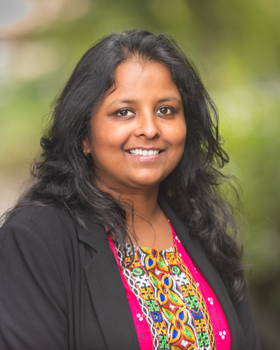
 It’s been a busy few years, but I’ve loved my time here in Melbourne and with DoFM and VIFM. I’ve learnt so much, and it’s incredibly rewarding to be using that new knowledge in a way that helps and protects others.
Dr Reena Sarkar moved to Melbourne six years ago with her husband and five-year old son from Chandigarh in India, in order to undertake her PhD studies with our Department of Forensic Medicine. An oral pathologist with 12 years of clinical and teaching experience, she left behind a secure and desirable role as Professor and Head the Department of Oral Pathology and Microbiology at the National Dental College and Hospital in Mohali, in India’s northern reaches.
“I was always attracted to academia. The Victorian Institute of Forensic Medicine and Monash’s Department of Forensic Medicine (DoFM) are globally very well-known as trailblazers in forensic research and training, so despite the upheaval, I was very keen for us as a family to make the move. I don’t think any of us regret it.”
Dr Sarkar was interested in pursuing projects that could build on her substantial knowledge in oral histopathology and clinical dentistry, sub-fields that play a crucial role in contemporary Forensic Medicine. Having approached our School’s then PhD coordinator in 2016, she was introduced to two potential supervisors within DoFM: Professor Emeritus Joan Ozanne-Smith, and Professor Richard Bassed.
“From there it was fairly simple to select a topic. Victoria’s Royal Commission for Family Violence had just concluded, and my supervisors have experience in forensic dentistry and epidemiology. It made sense to do something relevant to the issues of the day, so I investigated orofacial injuries among victims of family violence homicide in Victoria.”
Family violence is a complex public health issue in Australia and globally. Dr Sarkar’s PhD adopted an epidemiologic and forensic approach to determine temporal trends and injury patterns, with a major focus on orofacial injuries. Her supervisors taught her the technical skills needed to interpret CT scans from autopsies to better understand facial and dental injuries, and how to apply biostatistics and epidemiological methods to specific research questions.
Under their mentorship, she undertook extensive systematic and legal reviews of relevant medical papers and legal cases, a standardisation/pilot study, population studies, and observational research (multi-dataset comparison).
Aided by statistical tools such as joinpoints regression, two step clustering, and a comprehensive injury classification system, the studies established the problem size and complex patterns of abusive orofacial injuries.
Having calculated family violence homicide rates using data from the Coroners Court of Victoria, the National Coronial Information System, and the Australian Institute of Criminology, she found wide variance between the rates, and that two of the three showed un upward trend over the past 16 years.
“It’s really important that we get better at capturing harmonised statistics around family violence (observatorial study design), so we can picture the true rate.
An important improvement will be to build in additional coding functionality into vital statistical systems, such as the International Classification of Diseases (ICD). The coding available in current ICD version 10 didn’t represent FV-specific data on interpersonal relationships, and orofacial injuries (reported in coronial and autopsy reports). Version 11 has improved capacity to overcome these shortcomings.”
Populations studies and image analyses indicate that orofacial injuries are present in 78 per cent of adult cases of family violence homicide, and 90 per cent of children.
She further found lack of standardisation of mandatory reporting guidelines of child physical abuse via dentists across Australia’s states.
By the time she completed, Dr Sarkar had six peer-reviewed papers under her belt, and had presented her findings at three international conferences.
She says, “Despite legal protective measures and increased media and social scrutiny of family violence, homicides in this setting are sadly still trending upwards in Victoria. I’m proud that my work is contributing towards us better understanding that trend, so we can protect vulnerable partners and children.”
The findings from her PhD are already informing a report on femicide from the United Nations Office of the High Commission for Human Rights (OHCHR), due to be presented in the UN General Assembly in late 2023.
Since graduating, she’s settled into a role as a postdoctoral fellow with DoFM, and building her own profile as a researcher across two main projects. The first aims to prevent injury in one-punch assaults (‘coward punches’) in Australia. For this, Dr Sarkar investigated trends in fatalities from such assaults, legal outcomes for perpetrators, and the impacts on survivors. The second is a mixed-methods project on behalf of the Special Rapporteur of Unlawful Killings within the OHCHR, a challenging project that has seen her expand her skills across legal database research, and qualitative methods.
She’s also working with Departmental colleagues to spin her PhD study topic into Honours projects that investigate skeletal injuries in gender-based violence, and is in discussions with international research institutes for an interjurisdictional comparison of family violence outcomes.
“It’s been a busy few years, but I’ve loved my time here in Melbourne and with DoFM and VIFM. I’ve learnt so much, and it’s incredibly rewarding to be using that new knowledge in a way that helps and protects others.”
Her advice for others considering a PhD?
“Plan, plan and plan! PhD is an exciting and challenging time. A PhD student should a choose a topic that resonates with their academic and professional background. Student-supervisor matching is a strategic make or break event, so thorough and careful consideration should be in order.”
Find out more about our PhD program.
Find out more about the Department of Forensic Medicine's education program.