
Margaret Kartomi Gallery of Musical Instruments and Artefacts
CURRENT EXHIBITION
The Place of Indian Music and Dance in Australia
This unique exhibition delves into the vibrant history of Indian music and dance in Australia through three pivotal moments of cultural exchange. It invites visitors on a journey through time and space, celebrating the artistic encounters that have enriched Australia’s cultural landscape.
Recordings
Location
Ground Floor Foyer,
Sir Zelman Cowen School of Music and Performance,
55 Scenic Boulevard,
Monash University, Clayton 3800
Opening hours
Monday to Friday, 9.00am – 5.00pm
For tour inquiries call 03 9905 5519
EVENTS IN 2026
Lecture notes - Indian Singing and Dance: Mental and Physical Health Benefits, 21 May 2026
ABOUT US
The Gallery is the public face of the Music Archive of Monash University (MAMU), which is hosted by the Sir Zelman Cowen School of Music and Performance. Managed by a dedicated team of volunteers and housed in the Menzies Building/Building 11, MAMU contains some of the finest and rarest collections of the world’s sound and material arts.
Its collections and bequests focus mainly on the arts of Southeast and South Asia, the Asia-Pacific, Australia, Baghdadi and Ashkenazy Jewry, and Europe. The Gallery is named after Margaret Kartomi AM, FAHA, an ethnomusicologist who has published many books and articles on Indonesian and other music, and was employed in Monash University’s School of Music from 1969 to 2020, including as its Head throughout the 1990s.
Interview with Margaret Kartomi
PERMANENT DISPLAY
The Gamelan Digul
Browse this unparalleled ensemble of gamelan instruments built from any materials at hand by Indonesian anti-colonialists in the Boven Digul Dutch prison camp in 1927.

PAST EXHIBITION
Artistic Treasures from Sumatra and Java
Discover a selection of MAMU’s rare music recordings, musical instruments, theatrical puppets and masks, images, costumes, and textiles. Collected by Margaret and Hidris Kartomi, and Karen S. Kartomi Thomas on field trips in Sumatra and Java from the 1970s to the present time, the objects are explored further in a series of documentaries and audio-visual samples. Objects from other donors and researchers tell the story of how the collection was formed and its significance today.
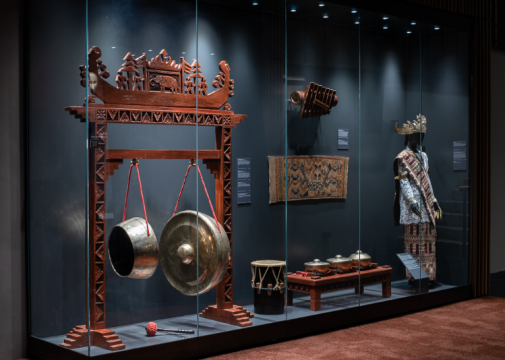
Exhibition Catalogue
CONTACT US
- Kerryn Morey: Kerryn.Morey@monash.edu 03 9905 5519
- Margaret.Kartomi: Margaret.Kartomi@monash.edu
- Bronia.Kornhauser: Bronia.Kornhauser@monash.edu