Impact Themes
The Centre to Impact Antimicrobial Resistance (AMR) brings together experts from a wide range of disciplines, spanning microbiology, engineering, and the social sciences. Our interdisciplinary approach allows us to tackle antimicrobial resistance from multiple perspectives from fundamental laboratory research to real-world implementation and policy impact.
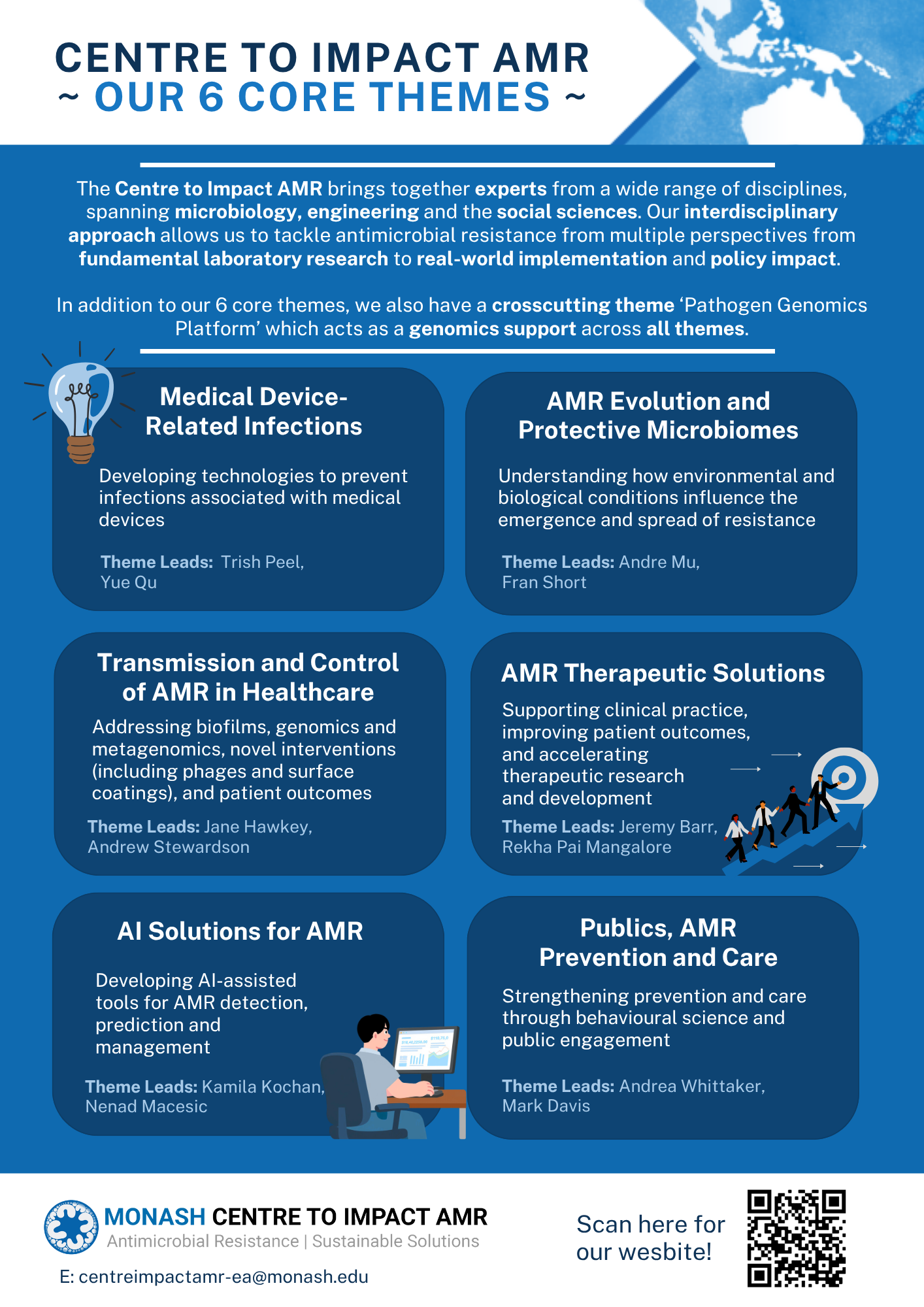
Our research programs are organised into 6 core themes, with one crosscutting theme. Read on for more information or check out the graphic below to explore our themes and see how our team is driving innovation across AMR research.
Medical Device -Related Infections
Theme Leads: Prof Trisha Peel and Dr Yu Qu
Theme Members: A/Prof Simon Corrie, Prof John Forsythe, Prof Laurence Meagher, Prof Anton Peleg, Prof Ben Rogers, A/Prof Tim Scott, Prof Nicolas Voelcker.
Medical device-related infections are serious, often biofilm-mediated complications, where microorganisms colonise implanted devices (catheters, prosthetics, valves), causing a significant number of hospital acquired infections annually.
This theme will focus on developing technologies to prevent infections associated with medical devices, and we are working to develop diagnostic tools and sampling methods for early detection of threat organisms in humans, as well as natural and built environments.
AMR Therapeutic Solutions
Theme Leads: Dr Rekha Pai Mangalore and Prof Jeremy Barr
Theme Members: Dr Iain Abbott, Prof Philip Andrews, Prof John Boyce, Prof Catriona Bradshaw, Prof Max Cryle, Prof Tan Hock Siew, A/Prof Cornelia Landersdorfer, Prof Jian Li, Prof Dena Lyras, Prof Anton Peleg, Prof Ben Rogers, A/Prof Hsin-Hui Shen, Prof Nicolas Voelcker.
AMR Therapeutic Solutions is a strategic theme focused on advancing clinical practice, improving patient outcomes, and accelerating therapeutic research and development.
It brings together innovative, evidence-based approaches to optimise antimicrobial use, combat drug resistance, and unlock new and existing therapies. By integrating precision medicine, novel diagnostics, and alternative strategies such as phage therapy and immune-based treatments, the theme aims to translate scientific discovery into impactful, real-world solutions for complex infections.
Transmission and Control of AMR in Healthcare
Theme Leads: Prof Andrew Stewardson and Dr Jane Hawkey
Theme Members: Prof Philip Andrews, Prof Allen Cheng, Dr Adam Jenney, Dr Margaret Lam, Prof Dena Lyras, Dr Nenad Macesic, Prof Laurence Meagher, Prof Anton Peleg, Prof Ben Rogers, Prof Philip Russo, Prof Rhonda Stuart, Prof Nicolas Voelcker.
This theme is focused on understanding and interrupting the spread of antimicrobial resistance within clinical settings. It integrates cutting-edge genomics, metagenomics, and biofilm research with innovative interventions, including phage-based approaches and advanced surface technologies, to inform effective control strategies.
With a strong emphasis on global collaboration, the theme aims to define and address multidrug-resistant organisms in healthcare environments, ultimately improving patient outcomes worldwide.
AMR Evolution and Protective Microbiomes
Theme Leads: Dr Fran Short and Dr Andre Mu
Theme Members: Prof Sam Forster, Dr Rebekah Henry, Dr Tan Hock Siew, Prof Karin Leder, Dr Simone Li, Prof Dena Lyras, Dr Mike McDonald, , Prof Orla Morrissey, A/Prof Thomas Naderer, Prof Anton Peleg, Prof Ana Traven, A/Prof Kelly Wyres, Dr Polly Yap.
Our team is studying the genetic basis of AMR to understand how antibiotic resistance evolves, so evolution can be taken into account for the development of new strategies. Bridging classical molecular microbiology, biochemistry, genomics, and computational modelling, this theme will examine the genetic basis of resistance, bacterial adaptation, and responses to antibiotics.
This theme also considers AMR within the human gut and the role of microbiomes in colonisation resistance, The human gut is home to trillions of microbes that support digestion, regulate the immune system, and help protect against harmful bacteria. However, the crowded nature of this ecosystem also makes it easer for harmful bacteria to acquire AMR) genes, increasing the risk of multidrug-resistant infections.
Artificial intelligence (AI) Solutions for AMR
Theme Leads: Dr Kamila Kochan and Dr Nenad Macesic
Theme Members: A/Prof Victor Cardarso, A/Prof Simon Corrie, Prof Laurence Meagher, Prof Anton Peleg, Prof Jiangning Song, Dr Sonika Tyagi, Prof Nicolas Voelcker.
Artificial intelligence (AI) is transforming the fight against AMR by accelerating drug discovery, improving diagnostic speed, and enhancing surveillance capabilities. AI tools, including machine learning and deep learning, can process vast, complex datasets to identify resistance markers, predict drug susceptibility, and optimize antibiotic treatment regimen
Work in this theme will focus on research and development of AI-assisted tools for AMR detection, prediction and management.
Publics, AMR Prevention and Care
Theme Leads: Prof Mark Davis and Prof Andrea Whittaker
Theme Members: Dr Iain Abbott, Prof Catriona Bradshaw, Dr Nenad Macesic, Prof Trisha Peel
Preventing AMR requires that individuals understand how to avoid and manage common infections and use antimicrobials carefully and only when they are needed.
This team of social scientists, clinicians and biomedical researchers are working together to generate new data and analyses of community engagement with AMR guidance, communications and education. We are analysing AMR news media and public health campaigns, personal experience narratives on infections and antibiotics, policy discourse, and the social and economic drivers of AMR.
Pathogen Genomics Platform (Crosscutting Theme)
The Centre provides genomics capability and support across all research themes.