
Information for hosts
The information below references the following document: Host Placement Guide.
What duties/work tasks are appropriate for students?
Students are not able to undertake work as a qualified psychologist on placement. While students may work within a clinical psychological practice or with a registered psychologist, students are not registered or suitably trained for delivering clinical services themselves. Hosts therefore are also not required to be Board approved supervisors.
Placements should provide students with the opportunity to demonstrate and develop professional skills and competencies expected in professional work settings including communication and interpersonal skills, critical thinking and problem solving, organisation, and reliability and responsibility. Further examples of these attributes are provided in Appendix B. At the end of the placement we will ask supervisors to assess students' proficiency in these areas so it will be helpful for students to have the opportunity to demonstrate their capabilities.
- The structure and activities involved in each placement will differ based on the host organisation and can vary across the duration of the placement. Below are only a few ideas for activities during a professional placement.
- Design and develop resources. A placement could develop educational, health promotion or marketing resources in the area of psychological health and wellbeing e.g. video and digital materials including infographics.
- Data collection and analysis. Focused research placements, for example running a survey on staff which would involve data collection, data analyses, statistics, visualisation and reporting.
- Literature review. A placement could include conducting a review of the literature in an area of your choosing and a summary report of the findings for your organisation.
- Services aligned with mental health. Placement students could provide assistance with allied health and disability services. This could range from assisting the patient liaison officer or support with admin and daily tasks.
- Professional communication roles. The placement could be focused on client/customer engagement e.g. scheduling, record keeping, admin support and communication tasks.
Duration of placement
Students will complete a research or experience-based program of work jointly defined by the host organisation and the unit coordinator. The placement requires that the student completes a maximum of 96 hours of relevant, voluntary work.
There are 12 weeks in Semester 2 which runs from July - October. Therefore, we envisage this to take the form of 1 day per week for 12 weeks but alternative time configurations are acceptable, should they suit your needs, as well as the student’s requirement to manage any existing work/study commitments. It is up to the host to decide the distribution of 96 hours of engagement across the course timeline of the placement student they would ideally like. For example, 1 day a week at 8 hours, or 2 days a week at 4 hours. The unit coordinators will try to place students in conjunction with these schedules.
We are also supportive of students undertaking placement via a hybrid format of on-site and remote hours, with a minimum of 50% of their dedicated hours on-site.
Students are asked to log the hours involved in placement including any related hours which may be completed remotely if mutually agreed by you and the student. We ask that you sign off on the log book entries to confirm authenticity.
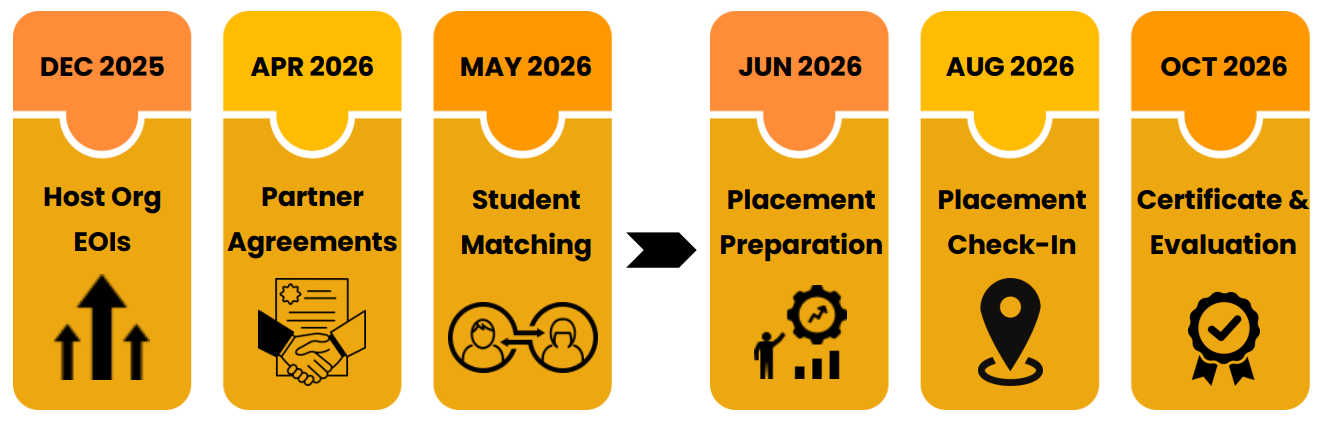
Timeline of placement
-