
News and events
Community engagement news and events
News
Here we will add updates from our CaRE program.
Do you have any news you would like to share with our network? Send your news to stm.cares@monash.edu.
Our newsletters
-
Looking back
Watch the webinar recording: Video (56:35) Understanding Autoimmune Encephalitis - personal stories and medical insightsFor many, it takes a visit to the emergency department suffering from hallucinations or seizures, to discover that they have Autoimmune Encephalitis. This little known autoimmune condition is often mistaken by both clinicians and patients for others which show similar symptoms. A correct diagnosis often happens months or years later, if at all, requiring a specialist neuroimmunology and multidisciplinary input. In an effort to boost awareness, our free panel event features members of the Australian Autoimmune Encephalitis Consortium, including researchers and people with lived experience.
|
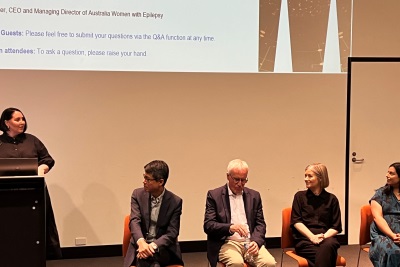
The brain webinar series - EpilepsyThis seminar will provide an overview of the state-of-the-art treatments for epilepsy, including new medications, surgery, dietary therapy and neuromodulation. We will also highlight novel approaches under intense research, including medical technologies, artificial intelligence, and human stem cells in personalising the approach to treatment. The inclusion of consumers in the research team, and future opportunities for consumer engagement in epilepsy research will be discussed.
|
Hear from our consumer advocates and researchers on stroke: Video 1:32:03 hours The brain webinar series - StrokeThe brain is one of the most complex organs. It controls all functions of the body, interprets information from the outside world, and embodies the essence of the mind and soul. Intelligence, creativity, emotion, and memory are a few of the many things governed by the brain. The brain controls our thoughts and speech, movement of our arms and legs, and the function of many organs within our body. What happens if it fails? Stroke occurs when blood cannot get to your brain, due to a blocked or burst artery, and can have a devastating effect on your brain. Join us to find out more about the brain, and the effect stroke can have on it’s function, in the first installment of our webinar series. The webinar will include information about novel diagnoses and therapies from bench to bedside and back!
|
 Hear from our consumer advocates and researchers on community engagement: Video 59:44 mins can be seen by CCS staff and students via CCS intranet Engaging consumers for grant successThe CCS’s Consumer and Researcher Engagement (CaRE) program committee hosted an informative webinar entitled "Engaging consumers in grant success”. Are you a researcher interested in working with consumers to write compelling grant applications?
|
Myeloproliferative neoplasms – towards precision medicineMyeloproliferative neoplasms (MPNs) are a rare, difficult to treat group of blood cancers. Understanding the genetic lesions in MPNs can transform diagnosis, prognosis and treatment.
|

Hear from our consumer advocates and researchers on dementia: Video 1:30:21 hours What we know about the brain and how it changes with dementiaWith dementia being one of the leading cause of death and a significant cause of disability in Australia, particularly in older populations, most of us will—at some stage, and in some way—be touched by the disease. This webinar will cover a range of relevant topics and perspectives relating to dementia, from the perspectives of those affected by the disease, clinicians, and researchers. Short presentations will be followed by a panel discussion.
|
Hear from our consumer advocates and researchers on rare diseases: Video 11:54 mins Rare Disease Day 2022The Central Clinical School’s Community and Researcher Engagement (CCS CaRE) program is participating in a global Rare Disease Day, to raise awareness of rare diseases and showcase some of the research that goes into rare diseases now being undertaken across the school. |
Hear more about our 7 Oct webinar on new developments in multiple myeloma research: Video 1:05 mins 'Blood not bone marrow? The potential role for blood testing to improve multiple myeloma diagnosis and therapy'
|
 Dr Helen Mitchell and consumer Ken Young We offer lab tours for interested members of the public - please contact us at stm.cares@monash.edu. |