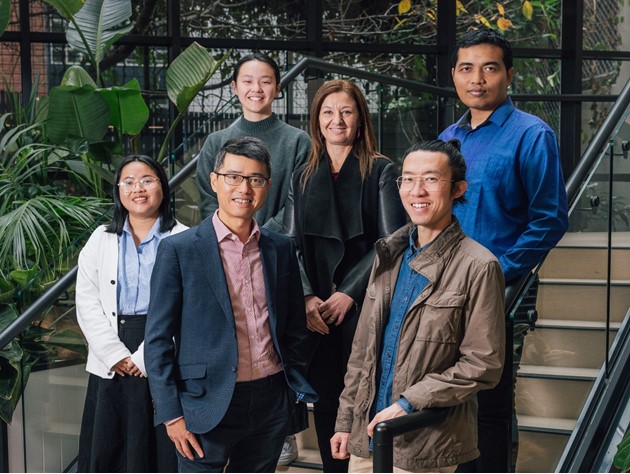
Genetic variants can cause epilepsy as well as how patients respond to drug treatment. Our study focuses on the genetic variants in a cohort of patients with epilepsy and explore the genetic basis for adverse drug reactions. We also focus on the development of medical technology, such as wearables, mobile apps, and other digital tools to improve patient outcomes and overall health and wellness.
-
Genomics & Medtech theme group. (L - R) Front row – Miss Thanh Xuan Le, Prof Patrick Kwan, Dr Jianxiong Chan, Middle row - Miss Susanna Chen, Dr Marian Todaro, Mr Putu Gede Sudira (Absent – Dr Alison Anderson, Dr Neha Kaul, Dr John Paul Nicolo, Dr Zikri Abdul Halim, Dr Mohammad Mosarof Hossain, Dr Yaoyao Jia, Ms Seema Thowfeek, Mr Robert Zeibich)
Research projects
Project Lead - Dr Alison Anderson Mainstream anti-seizure medications (ASMs) that are used to treat epilepsy and some other conditions are associated with a range of cutaneous side effects. Genetic analyses that compare the genomes of those who develop an adverse reaction with those that are tolerant to AEDs has identified specific genetic markers that increase susceptibility in some but not all individuals. It is increasingly understood that multiple genomic and /or environmental factors contribute to drug sensitivity. A better understanding of the underlying molecular mechanisms will enhance capacity for personalised treatment and the design of safer drugs. This project represents a unique opportunity to investigate the underlying molecular mechanisms by integrating genomic analysis with transcriptomics (gene expression) approaches. The transcriptome, derived from T-cells, will be used to identify genes that are differentially expressed or that change their pattern of co-expression in cells from drug-exposed cases as compared to those from drug-tolerant controls.
Project Lead - Dr Alison Anderson and Prof Patrick Kwan Genetic variants have been found to cause epilepsy and affect how people respond to treatment. Whole exome sequencing (WES) is a new method of genetic testing that has the advantage of being able to screen all of the genes in a person. Currently, its use is mainly for research purposes only due to the high cost associated with performing the technique.
Project Lead - Dr Neha Kaul The ketogenic diet is known to be an effective treatment for people with drug resistant epilepsy, however high discontinuation rates remain a significant issue. This project involves evaluation on the effectiveness of incorporating mulitple digital health technologies, e.g. a new at-home saliva ketone testing device developed by MX3 Diagnostics, and digital seizure and food diaries. This can be an alternative innovative technology-driven treatment to bring relief to those with drug-resistant epilepsy.
Project Lead - Prof Patrick Kwan Point-of-care (POC) testing provides diagnosis at the site of patient care, i.e. in real-time. It is used with patients conveniently and immediately to allow them and doctors to receive the results quicker for faster clinical decisions to be made.
The aim of the project is to develop a novel rapid, ultrasensitive real-time POC platform targeting molecules in blood or saliva. Our study is divided into three separate areas - 1) DNA-based, 2) Protein-based, and 3) Whole cell detection, from whole blood and saliva. This will be integrated on a single chip platform to facilitate a small, low-cost and reliable test device.
Project Lead - Dr Shobi Sivathamboo The development of reliable, accurate, non-invasive methodologies for continuous, long-term seizure monitoring is a critical part of the precision medicine approach in epilepsy management. While the gold standard for diagnosing and detecting seizures remains inpatient EEG and video recording, it is costly and impractical for extended use outside the hospital setting.
Conventional outpatient seizure monitoring relies on a self-completing seizure diary which is inexpensive but highly inaccurate. There is a need for novel technologies that combine low cost, non-invasiveness with reliability for extended seizure monitoring. This project aims to develop an integrated wearable sensor system for the clinical management of seizures in patients with epilepsy. The device will be tested in patients admitted for inpatient video-EEG monitoring.
Project Lead - Dr Hugh Simpson People with epilepsy suffer not only from the effects of their chronic and disabling condition, but also from the uncertainty surrounding when and how it will affect them. New Australian technology, currently under investigation, the Epiminder system, is designed to allow continuous recording of brain activity 24/7, using an implant under the scalp. This allows monitoring of disease activity in patients with epilepsy promising the ability to provide insights into the condition that are not possible today. This technology has the potential to offer unprecedented insights and certainty for patients and the clinicians who care for them. This project will evaluate this promising new 'subscalp' monitoring technology, to see how it can improve the lives of people with epilepsy. The Epiminder system is for investigational use only and it’s not approved in any geography.