The exhibition invites you to reflect on the histories and cross-cultural exchange of Tibetan and Zen Buddhism, Confucian, Zen and Yoga practices, and Western approaches to self-cultivation.
It does so as a way of understanding our common humanity and shared need to maintain inner peace, harmony and balance.
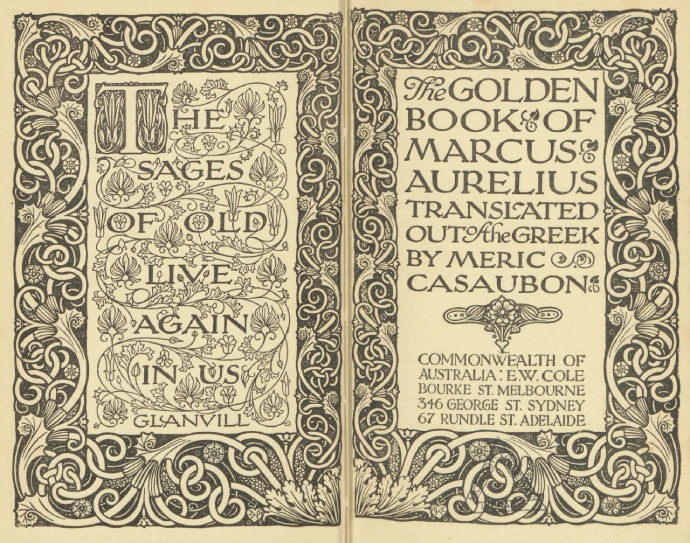
Image: The Golden Book of Marcus Aurelius
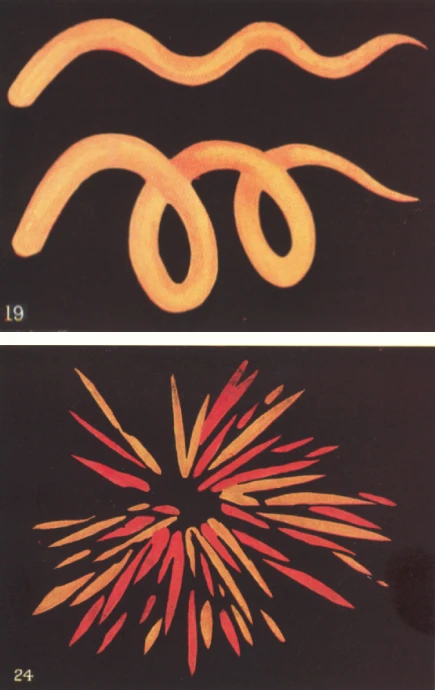
Image: Thoughtforms
What is self-cultivation?
You cannot bring the mountain-top to the valley. If you would attain to the mountain-top, you must pass through the valley, climb the steeps, unafraid of the dangerous precipices.
Whether using a mindfulness app, practicing martial arts, attending a yoga class, or simply sitting in nature, many of us are touched by some aspect of self-cultivation in our daily lives.
Self-cultivation in the abstract is a millennia-long practice found all over the world. At the most basic level, it is a type of systematic exercise that seeks to develop a best self. Depending on the tradition, self-cultivation can be based on moral discipline, with reflection on one’s behaviour. For many, the development of the physical body is interrelated and they prescribe good habits of exercise and diet.
In addition to the above practices are the schools of self-cultivation found in Asia. The self-cultivation found in Buddhist, Hindu, Confucian, Daoist traditions interpret the spirit/soul as energetic, adding practices that include breath control, visualisation and states of concentrated calmness. These systems have been introduced to Western cultures in which there were no equivalents.
Three-thousand years of yoga
The origins of Yoga (योग) date back some 3,500 years. Little physical evidence of this history remains, however, Yoga seems to have been primarily a practice connecting the body, mind, and soul to obtain liberation (mokṣa) from the cycle of rebirth and death. Practitioners cultivated their best spiritual selves.
From around the 5th-1st centuries BCE, textual evidence appears in the Vedic texts, which are the oldest written spiritual texts of Hinduism: the Rigveda, Yajurveda, Samaveda and Atharveda. Each Veda is divided into four: Saṃhitā, Brāhmaṇam, Araṇyaka, and the Upaniṣad (or Upanishads). The Upaniṣads focus on meditation, philosophy and spiritual knowledge. It is here, in the Kaṭhopaniṣad from Yujurveda, we first see the use of the word ‘Yoga.’
By the first-century CE there is greater detail of what self-cultivation through Yoga looks like, illustrated in the Yogasūtras - attributed to the sage Patañjali somewhere between the second century BCE and fifth century CE. Patañjali’s Aṣṭāṅgayoga, or eight limb practice, was drawn from earlier Jain, Buddhist and Samkhya Hindu cultivation. The eight limbs are defined as yama (abstinences), niyama (observances), āsana (postures), prāṇāyāma (breath control), pratyāhāra (withdrawal of the senses), dhāraṇā (concentration), dhyāna (meditation), and samādhi (absorption).
If you were to see an early Yoga practitioner, they would have been in a posture designed to support their cultivation: the body maintained in a static posture - seated, standing, or lying in meditation - and the mind brought under control by the restraint of their breath. Yoga has been a key influence on other self-cultivation disciplines throughout Asia.
EXHIBITION HIGHLIGHT
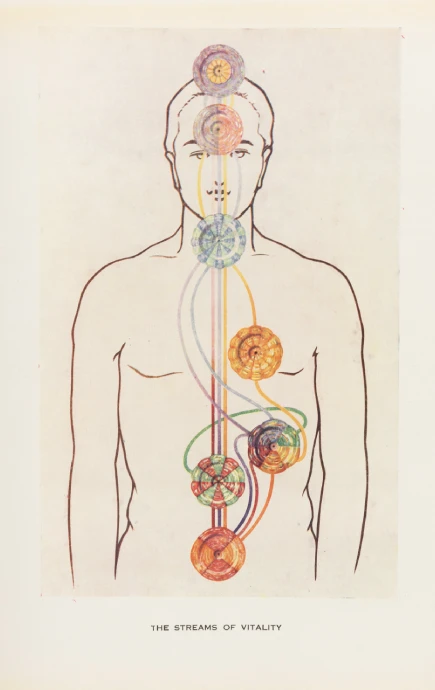
The chakras: a monograph
The twentieth century saw a convergence of yogic practice, connecting the body to natural elements and expanding the concept of inner energy ‘chakras’ as energy healing grew in popularity.
Charles Leadbeater’s Chakras (1927) presents traditional South Asian chakras in a modern colour palette. Leadbeater, a British theosophist, took his readings of Sanskrit texts, European mysticism and developed his own concepts of these ‘wheels’ of energy and how they could be transferred through one body to another.
The East-West dichotomy is defined by sociology as being a division between cultures rather than geography. However, this division creates a simplistic vision of our world which ignores not only diversity, but also the way in which humans have migrated and shared throughout history. There is no greater example than when we look at the function of Sufism and its relationship to self-cultivation.
The Arabic word Sufi (صوفي) or darwīsh (درویش ), came into use in the eighth century CE to designate a pious, usually ascetic individual. Present across Sunni, Shi’a and many other branches of Islam, it is one of several terms used to describe Islamic thought and practice focusing on the inner, rather than the outer, domain of the human spirit.
Sufi ‘orders’ or ṭarīqa (طريقة ) develop around a Walī (لي, saint). Each order traces its transmission back to Muhammad, teaching specific ritual practices which are adapted to local areas. These rituals include invocation (ذِكْر;) of the divine name, recitation of the Qur’an, samā (listening - the end result can be ecstatic whirling), reflections at the stations of the prophets, and visiting sites of prior Sufis and notables.
Although historically practiced by Muslims, Sufism went beyond the boundaries of Islam to include anyone who seeks to submit to God study and cultivation of one’s actual experience with God. Integral to the Indian subcontinent, Sufi orders also travelled to Sub-Saharan Africa, China, Russia and Indonesia.
Self-cultivation: European style
In the West, ‘self-cultivation’ was not understood or practised as the combined search for individual health, social harmony and environmental concord. Instead of interpreting the spirit energetically, Western traditions primarily understood soteriology - the study of salvation - as a moral quest. Over a thousand years Western understanding of cultivation has incorporated many practices, from Buddhism to the mystical traditions of the Jewish Kabbalah.
While there had always been a transfer and sharing of knowledge across the world, the colonisation of the world from the sixteenth century by the European powers led to a very specific type of cultural domination and extraction. One marked by fascination, misunderstanding, exoticism and appropriation. Engagement with practices such as Yoga, Buddhist meditation, and other forms of self-cultivation were (and are) sanitised and stripped of their deeper, spiritual dimensions to fit Western desires for personal transformation and exotic spiritualism.
It is important to recognise and understand these dynamics, in particular the inferior and submissive position colonisation placed the Eastern ‘other’ into. The distortions introduced continued to inform the development of self-cultivation practices through to today. There are still many valuable lessons about the complexities of cultural exchange, respect, and understanding to be learned.
EXHIBITION HIGHLIGHT
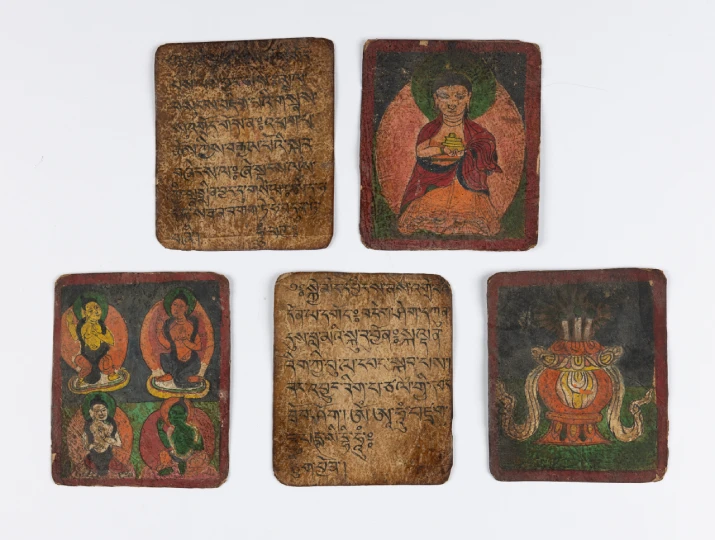
Tsakali cards
These five Tibetan tsakali are part of a larger pack, likely created by students and used in a life-lengthening ceremony. Each hand-coloured image is symbolic in a manner akin to western tarot cards. They could be used in a similar way to the much more complex Thangka paintings that are used as focal points for devotion and meditation.
In Chinese tradition, philosophy, education, ethics, and metaphysics are closely interwoven. Before the introduction of Buddhism to China in the first century BCE, the local practices were either Dào (or Tào 道) and Confucianism (Rújiā 儒家). Dào (道) originated in early China somewhere between the eighth and third century BCE. Lǎozǐ (老子), the author of the Dào Dé Jīng (道德经), is traditionally seen as the founder of most of the modern practices, although there is no real consensus as to whether he existed. Kǒngzǐ 孔子 (Confucius c. 551 – c. 479 BCE) - was the author or editor of the Five Classics, forming the basis of Confucianism.
Both traditions have over the millennia shared many ideas about humanity, society, heaven and the universe, often borrowing from each other and influencing the trajectory each took. However, unlike Confucianism, Dàoism developed institutions and religious practice, with leaders and schools. Dàoist self-cultivation practice also includes offerings, recitation of scripture, chanting, philosophy, purification, martial arts and breathing practices that use the vital force of qì (气). Some of the more famous practices are Bāguà zhǎng (八卦掌) and Tàijí quán (太极拳 Tai Chi).
For both schools, aesthetic education plays an important role for the cultivation of self and is a particular characteristic of Chinese cultivation. In the display cases are representations of the historical practice of self cultivation through quiet, careful meditative activities. Theseactivities could be as elevated as calligraphy, playing the qin, or could be unique to women’s spaces as in embroidery.
Buddhism
Around the year 563-483 BCE, Siddhārtha Gautama turned away from worldly life to become a seeker. He took up a life of meditation, study, and asceticism in the search for truth in the world, to find complete freedom from suffering. Deep in meditation he unlocked the ability to ‘see things the way they really are’: impermanent and conditional. That in truth, all suffering comes from trying to fix things, to hold on so they don’t break up and cease to be. The goal then is to be able to let go, at the deepest possible level, of our body and mind, to reach our inner energy. Only then can we be free from the cycle of life.
After Buddha nuns and monks congregated in monasteries (Saṅgha), their conduct regulated by rules to promote peace and harmony. There were many different monastic traditions, one of the oldest being Theravāda (the way of elders) and the Pāḷi canon of scripture.
Around 100 BCE, Mahāyāna (the Great Vehicle) arose. This form of Buddhism did not follow a monastic tradition, nor a doctrinal school. Instead, this practice believes in distinguishing between being free from all suffering and being a Buddha. A Buddha is perfectly compassionate with miraculous abilities. Those who vow to do this as bodhisattvas - ones who are capable of awakening.
Under the patronage of Ashoka the Great (c. 304-232), Buddhism spread first to Sri Lanka, then in 50 BCE to China before going to Korea in 372, Japan in 552 and Tibet in c. 630. Because of the widely varied geography there are many different cultivation methods within Buddhism depending on tradition and region. Some of these include: yoga, seated meditation, chanting, prostrations, circumambulation, movement based actions similar to Tai Chi, and both performative and meditative arts.
EXHIBITION HIGHLIGHT
Shan folding manuscript
A rare example of a traditional Theravada Buddhist manuscript from the Shan State of Myanmar, bordered by China (Yunnan), Laos and Thailand. Written in Shan script, it recounts the return of the Buddha to Kapilavastu. Kapilavastu was the capital of the Shakya clan, and it was where Siddhartha Gautama (the historical Buddha) was born and raised as a prince before he left to seek enlightenment.
Western perceptions of Buddhist and Eastern self-cultivation practices were distorted by rationalising them into a Christian framework while at the same time treating them as exotic Oriental curiosities. This is especially true of Tibetan and Zen Buddhism.
Even within the self-cultivation world, Tibet is a place that preserves many early Tantric practices that have often been changed or reformed elsewhere. It had long captured the popular imagination of the West as an exotic Shangri-la. A place promising immortality, a primitive shamanistic wisdom and an enlightened society that holds the answers to all modern ills, from environmental destruction to poor mental-health. Such a vision of Tibet abounds in the writings of explorers, missionaries and portrayals by Theosophists and colonial Tibetologist scholars, who write about it as an ‘archaic survival’ filled with ‘harmless and happy people.’
In contrast, at the beginning Zen or Chan (Chanzhong 禪宗) practice was seen in the West as inferior to more traditional Theravada practices. This continued to be the case until the Chicago World Fair of 1893, where a Parliament of World Religions was planned by a number of North American Protestant groups. The Parliament featured representatives such as Swami Vivekananda, Annie Besant and Virchand Gandhi. Japan’s Meiji government sent Abbott Shaku Sōen釈宗演 and a number of other Zen practitioners, including Suzuki Daisetsu Teitarō.
Many in the West now equate Zen alone with eastern Buddhism.