
Connecting mind, science, and humanity
When Martin Hosking first imagined what would become the Monash Centre for Consciousness and Contemplative Studies (M3CS), his motivation was personal. He had experienced the transformative power of contemplative practice in his own life, and it had become very important to him.

“But I was also aware how difficult it was for younger people to access high-quality programs,” he says. “During Covid-19, it became clear that Australia didn’t yet have an academic centre exploring contemplative practices – meditation, mindfulness, reflection – in a rigorous, evidence-based way. It was time to change that.”
That vision led to a $12 million philanthropic grant from Hosking’s charitable organisation, Three Springs Foundation – co-founded with his wife Loreto – to establish M3CS at Monash in 2021.
It enabled the creation of Australia’s first academic centre dedicated to integrating philosophy, neuroscience, medicine and contemplative practice under one banner – an initiative now recognised as world-leading. And today, Hosking is eager to invite fellow philanthropists to explore how they might also contribute.
“Bringing in more funders, more people and more perspectives is incredibly important,” he explains. “And there are many different angles. Perhaps you’ve tried contemplative practices, and you know how valuable they are.
“Perhaps you’re interested in the nature of the brain. Perhaps you’re interested in consciousness and what it means to be human.
“Perhaps you have a passion for student welfare and mental health, and you’d like to talk about the Centre’s educational component. Or maybe you’re interested in contemplative practices themselves: how they can be more effective, or how they relate to AI.”
Back to the beginning
Bringing philanthropists together is vital, says Hosking, because it was through connections that M3CS became reality. His teacher and longtime friend Dr Ian Gawler OAM helped to inspire it.
And Monash’s then Dean of Arts, now Vice-Chancellor Professor Sharon Pickering, brought together philosopher Professor Jakob Hohwy and mindfulness expert Professor Craig Hassed OAM to shape its foundation.
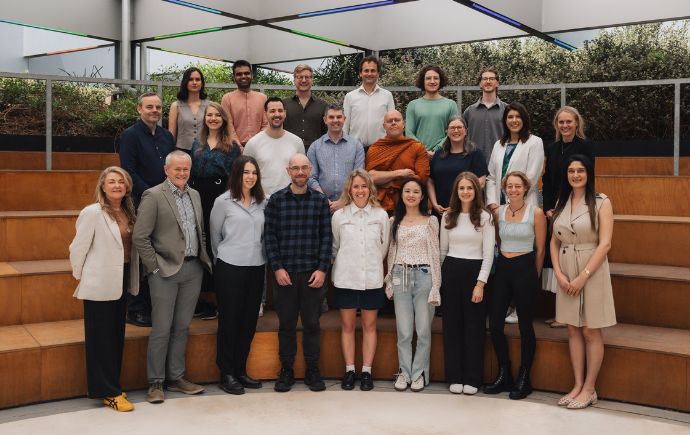
“Monash put together the initial proposal, and we went through a number of iterations as we worked out what it was specifically that we were looking to achieve and how the funding would be used,” recalls Hosking.
“For us, the value of working within the university was the combination of both the education component and a compelling research component.”
The collaboration merged two long-established Monash strengths: world-class research into consciousness science and decades of mindfulness education for medical students and professionals.
From that intersection came something genuinely groundbreaking: a high-quality research and teaching environment that bridges scientific precision with contemplative wisdom.
Improving lives
And, of course, it’s thanks to philanthropic support that M3CS has already achieved remarkable reach. Its educational programs, including the popular undergraduate course, True Happiness: The Art and Science of Living Happily, now engage hundreds of students each year, giving them practical tools for wellbeing and resilience.
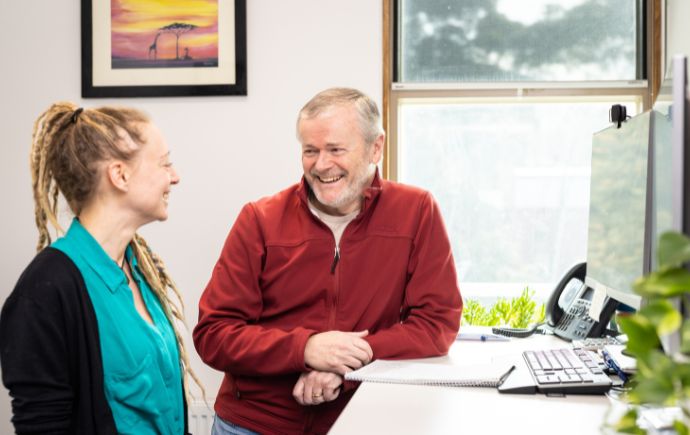
Martin Hosking’s philanthropic grant made something possible that simply wouldn’t have happened otherwise – the marriage of contemplative practice and consciousness science.”
– Professor Jakob Hohwy
“We’ve managed to gently change the course of the supertanker that is the university, showing that there’s room in modern academia for contemplative studies that genuinely improve lives.”
The Centre’s research arm has also flourished. Hohwy and his colleagues are pioneering neuroimaging and behavioural studies that examine how meditation and other contemplative practices change the brain, influence behaviour and improve mental health outcomes.
Their work draws on EEG, fMRI and precision medicine techniques to uncover the biological mechanisms of consciousness and wellbeing.
“Depression, addiction and psychosis are, at their core, disturbances of consciousness,” Hohwy explains.
“By understanding the neural basis of consciousness, we can design more precise, personalised ways of helping – and move beyond a one-size-fits-all approach to mental health.”
Only connect
For Hosking, the success of M3CS demonstrates the power of interdisciplinary collaboration to achieve long-term impact.
“There’s a reason you do this kind of work within a university. Monash brings together the education component – which ensures reach and sustainability – with a compelling research component. Both are essential. Together they’ve created something that’s self-sustaining and globally recognised.”
What began as a single philanthropic partnership has now become a blueprint for collaboration between faculties, disciplines and sectors. From medicine to philosophy, psychology to the arts, the Centre exemplifies how complex human questions can only be answered through shared inquiry.
“The value of working across disciplines,” says Hohwy, “is that you can study consciousness not only as an abstract problem, but as a lived experience, one that connects mental health, social wellbeing and even ethics in the age of AI.”
New directions
Now Hosking is keen to see how the philanthropic community can contribute to the Centre’s next phase: expanding its educational reach, funding new PhD scholarships and deepening its research.
“I don’t see this as my project,” he says. “The more people involved, the better. Each new partner brings a fresh perspective and helps ensure the Centre’s sustainability for generations to come.”
M3CS’s next research chapter will tackle two of the most profound questions of the 21st century: Who and what is conscious? and How do we cope in a volatile world?
“The programs have been compelling: they have developed a full corpus of educational components,” says Hosking. “But the area which has surprised me has been the value of the research.
“And this is primarily because the whole notion of consciousness, and what it is to be sentient and aware, has become incredibly important in the AI era.”
For Hohwy, these twin directions are both scientific and existential. “Everyone knows AI will reshape every aspect of our lives,” he says. “We’re asking: how does interacting with AI change our own consciousness? And could AI itself ever be conscious or capable of suffering?
“These are enormous ethical and philosophical questions, and they sit right at the heart of consciousness science.”
At the same time, the Centre will continue to provide tools that help people thrive amid global uncertainty, from climate anxiety and conflict to digital overload. “We want to find the most effective, evidence-based contemplative and cognitive practices that build resilience and meaning,” says Hohwy.
Hosking agrees: “We’ve become fractured, psychologically, socially, environmentally. I see contemplative practices as a way to rebuild individual wellbeing, community bonds and long-term stewardship of the planet.
“If we cultivate better people, we’ll build a better relationship with the planet and with each other.”
It’s that long-term vision that makes M3CS unique, says Hohwy. “This is about embedding contemplative and consciousness studies into the university fabric and making them as central to education as any major field,” he says. “And in doing so, helping people live with greater awareness, purpose and connection.”
Join us in supporting bold ideas and brighter futures
At Monash, we’re empowering Australia’s innovators, entrepreneurs, and leaders. Through world‑class education and research, we’re nurturing future thinkers: people who will drive new industries, advance their fields, and shape societies grounded in innovation, peace, and inclusion. You too have the power to make a lasting impact. By supporting today’s and tomorrow’s change‑makers, you can help accelerate discovery, strengthen communities, and inspire generations to come. We invite you to connect with our team and explore how your support can help build a better future.