
Life after scams
When clinical neuropsychologist Dr Kate Gould was providing neurorehabilitation to her patient Colin in 2014, she noticed something unusual.
A former IT worker rebuilding his life after a severe brain injury from a motorcycle accident, Colin told her about a woman he had been chatting to online. She seemed to be caught up in one crisis after another, drawing him in closer with each message.
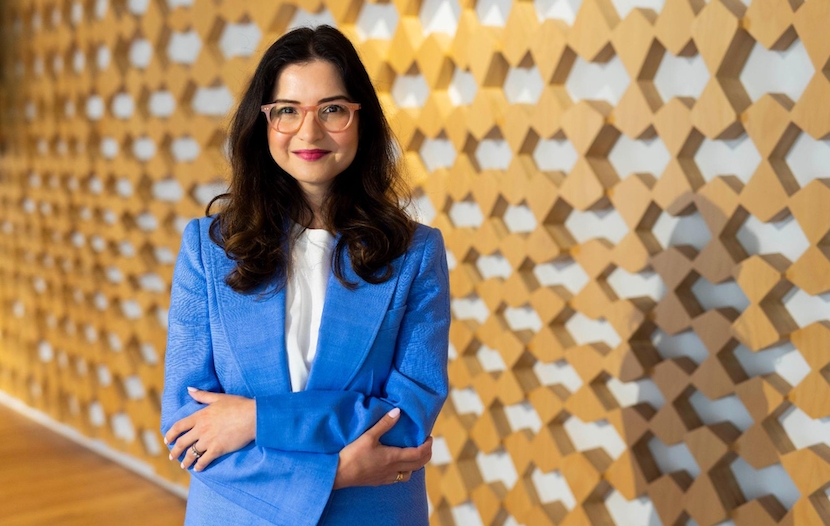
“It became clear he was caught in a romance scam,” Gould recalls. “But it wasn’t as simple as telling him it wasn’t real. The scammers were manipulating his emotions, his longing for love and his need to feel useful. My training as a psychologist could not counter that.”
That experience inspired Gould – Senior Research Fellow at the Monash-Epworth Rehabilitation Research Centre – to create CyberAbility, a Monash University program conducting world-leading investigations into online safety and recovery for people with acquired brain injuries (ABI).
Over more than a decade, CyberAbility has united clinicians, researchers and people with lived experience of ABI to co-design therapy programs and learning resources that help vulnerable Australians stay safe online.
And now, major funding from auDA – the .au Domain Administration – is helping CyberAbility turn years of pioneering research into real-life impact nationwide. It’s bringing hope, healing and digital safety not just to people with ABI, but to those who are vulnerable for a host of reasons, from disability to isolation.
From scam to success story
Today, Colin co-leads the project with Gould, has completed a master’s in disability studies, and serves as President of Brain Injury Matters, the peak self-advocacy organisation for people with brain injuries in Victoria.
“Seeing him go from being scammed to being an advocate is the perfect illustration of what recovery can look like,” Gould says. “Colin took one of the most painful experiences of his life and turned it into something that protects thousands of others.”
The new $1.5 million three-year auDA Research and Development (R&D) Grant is enabling the program to expand across Australia and help many more like Colin – updating scam education resources, conducting a randomised controlled trial of a specialised recovery program called Smooth Sailing After Scams, and working with banks and other frontline organisations to build greater empathy for vulnerable Australians affected by cons.
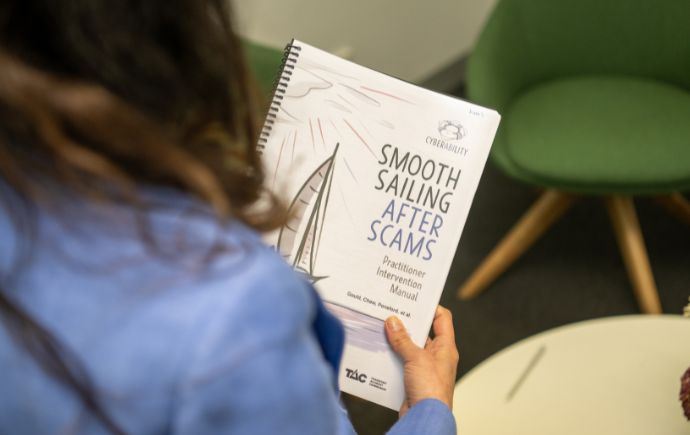
It will support new training for frontline staff and produce information material to help people recognise and recover from scams. And it will strengthen collaboration between CyberAbility and a broad network of organisations striving to build digital trust and community resilience.
When we see something that works, we want to help it scale,” says Dr Bruce Tonkin, CEO of auDA. “This is a model that can be adapted for anyone vulnerable to online scams, older Australians, people with disability, people who might be isolated. It’s about using digital tools for social good.”
For Tonkin, the project exemplifies what auDA’s R&D grant program was created to achieve: practical, people-focused innovation that strengthens trust in the digital world.
As an operator of part of Australia’s critical internet infrastructure, auDA relies on trust in its operations. “One of our core pillars is trust,” Tonkin says. “People are increasingly concerned about cybercrime but don’t always know what steps to take.
“What we like about CyberAbility is that it’s practical. It builds real-world tools, co-designed with people who’ve been affected.”
Strong start
auDA first partnered with Monash in 2022 through its Community Grant Program. The grant funded CyberAbility’s early scam awareness research and the development of a self-assessment tool to help people understand their risk of being tricked.
Previous funding from the Transport Accident Commission enabled CyberAbility to pilot therapy and education materials for hospitals and community organisations, giving hundreds of people with brain injuries and their support networks new strategies for identifying and recovering from online deception.
“Monash stood out during the R&D grant assessment process because they’d built genuine partnerships,” Tonkin explains. “They weren’t just publishing papers; they were working with the National Anti-Scam Centre, Westpac, other universities and advocacy groups like Brain Injury Matters. It’s a true multi-stakeholder approach.”
Exploiting emotions
For Gould, CyberAbility’s work goes far beyond prevention. “After a scam, people are often met with disbelief or ridicule,” she says. “They’re told: ‘How could you be so stupid?’ But it’s not about intelligence, it’s about emotion. Everyone has emotions, and scammers exploit them.”
Her team’s therapy and co-design programs rebuild dignity and confidence. Participants meet others who’ve had similar experiences, share stories and learn to spot the emotional triggers scammers take advantage of. Many return as mentors: Gould calls them the “Scambassadors”.
“I’ll never forget one of our participants saying that being part of our co-design group felt like an intervention for the shame she’d been living with,” Gould says. “That was incredibly powerful. It shows that by involving people directly, we aren’t just creating a program, we are helping them heal.”
Through the auDA R&D Grant, CyberAbility is amplifying that ripple effect. Its goal? To enable everyone to move through the digital world – with all the advantages that gives –with confidence and trust.

For Gould, CyberAbility’s work goes far beyond prevention. “After a scam, people are often met with disbelief or ridicule,” she says. “They’re told: ‘How could you be so stupid?’ But it’s not about intelligence, it’s about emotion. Everyone has emotions, and scammers exploit them.”
Her team’s therapy and co-design programs rebuild dignity and confidence. Participants meet others who’ve had similar experiences, share stories and learn to spot the emotional triggers scammers take advantage of. Many return as mentors: Gould calls them the “Scambassadors”.
“I’ll never forget one of our participants saying that being part of our co-design group felt like an intervention for the shame she’d been living with,” Gould says. “That was incredibly powerful. It shows that by involving people directly, we aren’t just creating a program, we are helping them heal.”
Through the auDA R&D Grant, CyberAbility is amplifying that ripple effect. Its goal? To enable everyone to move through the digital world – with all the advantages that gives –with confidence and trust.
Join us in supporting bold ideas and brighter futures
At Monash, we’re empowering Australia’s innovators, entrepreneurs, and leaders. Through world‑class education and research, we’re nurturing future thinkers: people who will drive new industries, advance their fields, and shape societies grounded in innovation, peace, and inclusion. You too have the power to make a lasting impact. By supporting today’s and tomorrow’s change‑makers, you can help accelerate discovery, strengthen communities, and inspire generations to come. We invite you to connect with our team and explore how your support can help build a better future.