


4 March 2025
Indigenous students bring a unique and valuable perspective to traditional science: the roots of their innovations and technological insights stretch back thousands of years. “Think of the boomerang,” says Professor Christopher Lawrence, Department of Human Centred Computing and Associate Dean, Indigenous in the Faculty of Information Technology and Faculty of Engineering at Monash University. “It’s all about science, technology, engineering, and maths – and yet university experts are still trying to work out the mathematics of it.”
Professor Lawrence believes that the National Indigenous Space Academy (NISA) program is “a turning point in the history of Australia with regards to space research and progress.” A visionary initiative, funded by key donors and backed by the Australian Space Agency, it offers five Indigenous students from across Australia the chance to participate in a prestigious 10-week internship at NASA’s Jet Propulsion Laboratory (JPL) in California.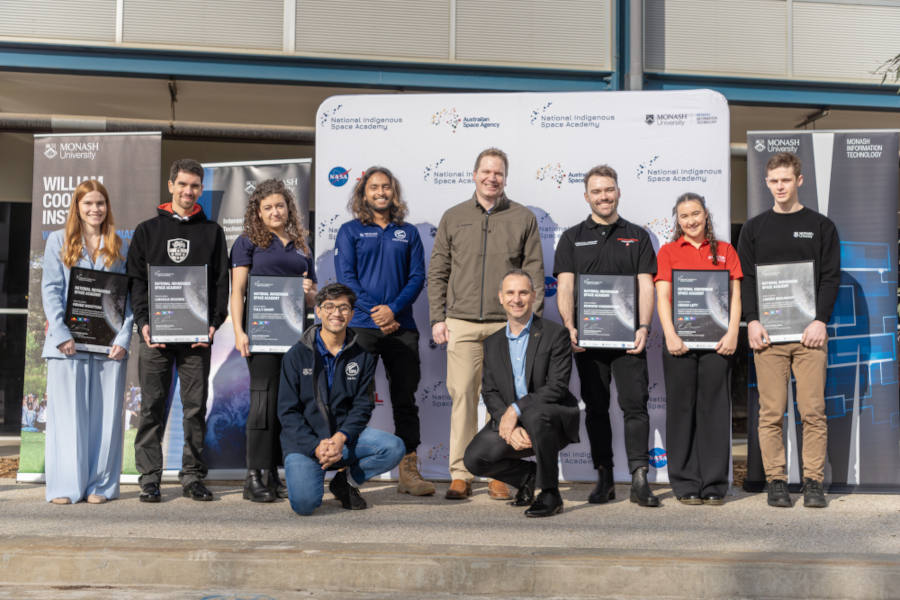 The 2023 NISA cohort at the official press meet. From L to R: Renee Wootton, Lincoln Bourke, Tully Mar, Enrico Palermo (Head of the Australian Space Agency), Ted Vanderfeen, Cedar Lett and Linden Beaumont with members of Monash University's High Powered Rocketry student team
The genesis of NISA
Professor Lawrence, a proud Wadjak/Ballardong Noongar man, has long dreamt of opening doors for Indigenous Australians in STEM. His personal experiences fuelled his ambition – both of his parents were part of the Stolen Generations, and he’s driven to see his people excel in fields where they’ve been historically underrepresented. “These young people we’re sending to NISA – they’re me. I’m living vicariously through them,” he says.
When Professor Lawrence brought up the idea with experts from NASA’s JPL during a leadership program in San Diego, it was an instant hit: both NASA and JPL have a commitment to including minority and Indigenous groups in their research and groundbreaking projects. Within a year, the first students headed to NASA. That was in 2019, and NISA has been running ever since.
Empowering Indigenous talent
Each year, NISA selects five Aboriginal and/or Torres Strait Islander students studying science, technology, engineering, or mathematics (STEM). The process is unsurprisingly rigorous and highly competitive: students from universities across Australia apply and are chosen on academic merit.
After being selected, students embark on a journey that starts with a Space Bootcamp at Monash. Here, they dive into aerodynamics, astrophysics, planetary science, and more. They are also involved with the Monash Student Teams initiative, getting hands-on with the Nova Rover and High-Powered Rocketry teams.
To support the students as they transition on to the programme, Indigenous psychologist Aunty Pat Dudgeon, Professor of Psychology at the University of Western Australia, is on hand. Aunty Pat encourages students to stay connected to their roots, ensuring that they protect and look after their own social and emotional wellbeing while they’re away, and manage feelings like imposter syndrome. As Professor Lawrence explains, “Indigenous psychology is different to non-Indigenous psychology.”
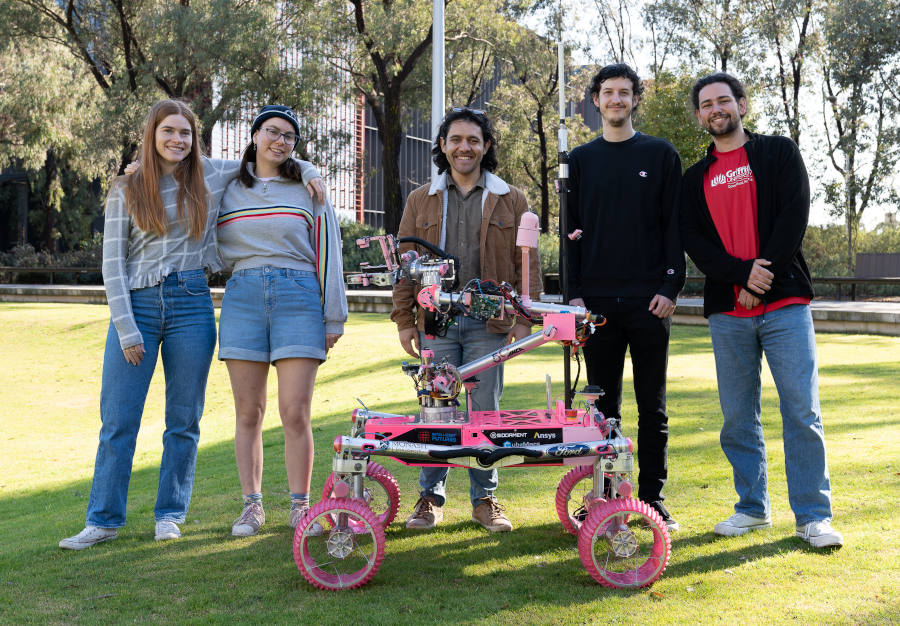 2024 NISA cohort standing behind the Monash Nova Rova. From L to R: Renee Wootton, Lucy Barr, David Corporal, Carl Goodwin and Jordan McGrath
Real-world experience
Once at NASA, the students jump straight into some of the most cutting-edge space projects, working on real-life missions. Previous NISA participants have contributed to the Mars Rover 2020 mission and the RoboSimian robot. One student even helped redesign oxygen systems for astronauts.
The students have also contributed to incredible projects which push the boundaries of human knowledge, from designing drill bits for Mars missions, to exploring Antarctica’s water systems. “NISA isn’t a Disney fantasy—it’s real,” emphasises Professor Lawrence.
 2023 NISA cohort at NASA's JPL. From L to R: Tully Mar, Lincoln Bourke, Linden Beaumont, Ted Vanderfeen and Cedar Lett
Making it happen
NISA wouldn’t exist without several key supporters. Alongside the Australian Space Agency, Professor Attila Brungs (then Vice-Chancellor of the University of Technology Sydney) played a crucial role in turning Professor Lawrence’s vision into reality and giving NISA the financial kickstart it needed. “When I told him about my idea he said ‘Chris, here’s some money, go and make it happen,’” Professor Lawrence recalls.
The CSIRO is also a significant partner. In 2024, they contributed $300,000 to help fund up to five NISA students annually. This funding helps students focus on their work without the distraction of financial worries. “From an employment perspective, it’s the first of its kind in Australia,” says Taylor Bamin, CSIRO’s Manager, Indigenous Employment and Gamilaraay woman.
Having a National Indigenous Space Academy that is led by an Indigenous scientist, has a self-determining model, and is creating global citizens is really exciting.”
Kim Dyball, Executive Manager of CSIRO’s Young Indigenous Women’s STEM Academy, is particularly enthusiastic about the opportunities NISA offers young women. “We have so many young women across the country interested in aerospace engineering, so a 10-week placement with NASA’s JPL is a dream,” she says. “We wanted to help make that connection.”
Acknowledgement is another crucial factor. “At CSIRO, we acknowledge that Aboriginal and Torres Strait Islander peoples were Australia’s first scientists and engineers,” says Taylor. NISA provides these students with well-deserved recognition, highlighting their vital role in advancing Australia’s STEM future.
Transforming lives, shaping futures
NISA’s impact goes far beyond the students – it’s transforming Australia’s STEM landscape. “Back in 2019, we sent three Indigenous students to NASA,” reflects Professor Lawrence. “One went on to set up his own mathematics unit at Cambridge, another now works in robotics research at CSIRO, and the third runs his own science lab at Monash University.” Indeed, all got their PhDs – and two became Fulbright Scholars. Thanks to passionate leaders like Professor Lawrence and the support of donors and partners, NISA is changing lives and ensuring Indigenous Australians are at the forefront of space exploration.
Join us to Change it. For Future Generations
Monash University’s Change It. For Future Generations campaign focuses on empowering our future leaders and ensuring students have access to rich experiences without barriers.