
How digital reform drives MSME upgrading across Indonesia
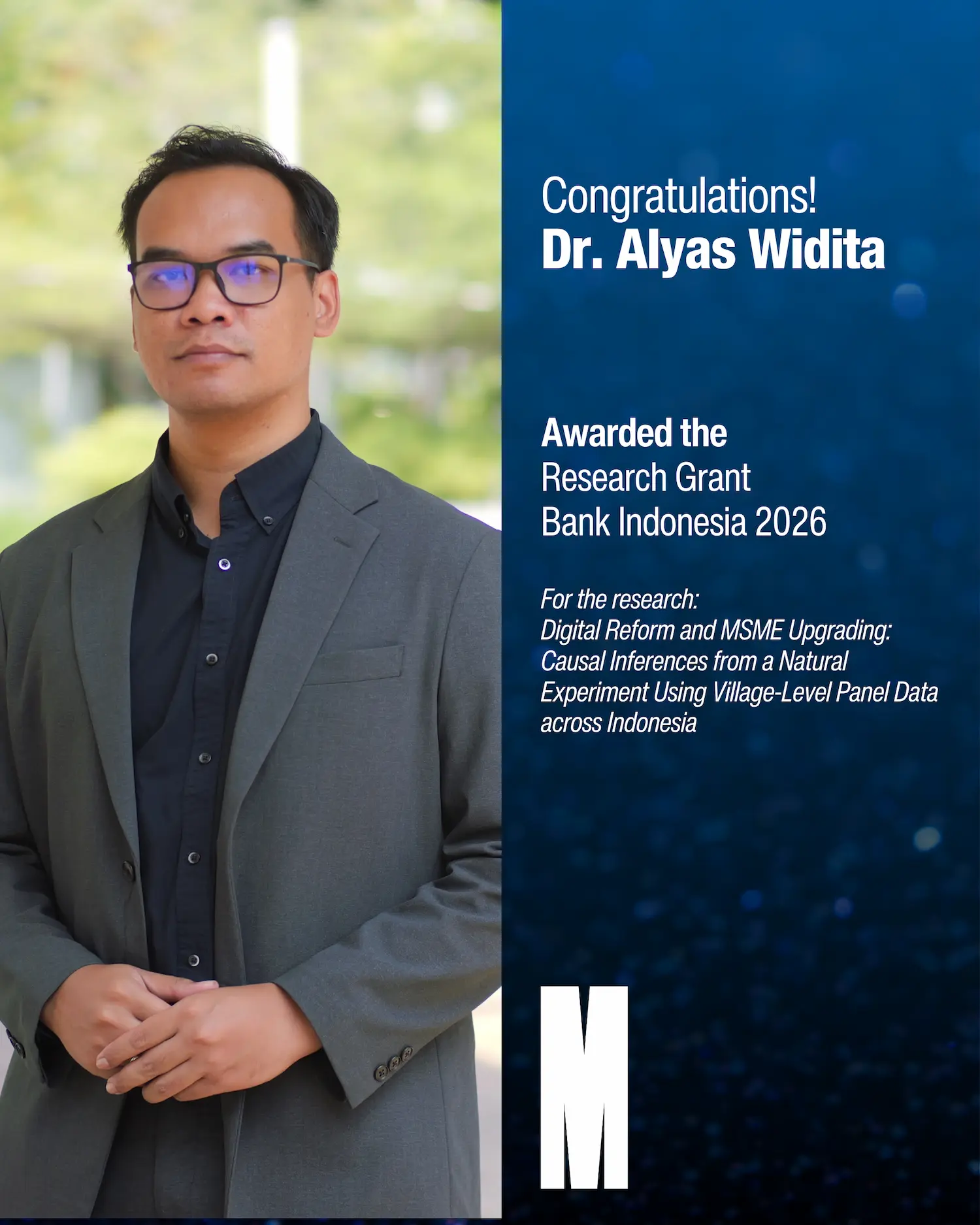
Dr. Alyas Widita receives research grant from Bank Indonesia
BSD City, Tangerang – A study from Monash University, Indonesia academic, Dr. Alyas Widita examines how government-led digital transformation policies are influencing the growth and structural upgrading of Indonesia’s micro, small, and medium enterprises (MSMEs), offering novel insights from a nationwide quasi-natural experiment.
The research, titled "Digital Reform and MSME Upgrading: Causal Inferences from a Natural Experiment Using Village-Level Panel Data across Indonesia," is conducted in collaboration with Prof. Deden Rukmana (The University of Texas at Arlington, United States) and Dr. Fajar Belgiawan (Institut Teknologi Bandung).
Indonesia's MSME sector comprises approximately 65 million enterprises, contributing around 61% of national GDP and employing 97% of the workforce. Despite their central role in the economy, many MSMEs remain constrained in their ability to "naik kelas" — transitioning from low-productivity activities to higher value-added production.
National digital reform as a policy experiment
The study evaluates Indonesia's nationwide digital transformation initiative launched in 2021 under Presidential Regulation No. 3/2021, which established the Tim Percepatan dan Perluasan Digitalisasi Daerah (TP2DD).
As part of this policy, the government introduced the Indeks Elektronifikasi Transaksi Pemerintah Daerah (IETPD), categorising districts into four levels of digital maturity: Inisiasi, Berkembang, Maju, and Digital. The staggered progression of districts through these tiers provides a natural experimental setting for assessing policy impacts on the real economy.
Methodology and data
Using village-level panel data drawn from the Potensi Desa (PODES) 2021 and 2024 microdata, the study applies a categorical difference-in-differences (DID) approach to examine changes in MSME outcomes across districts with different levels of digitalisation progress.
The analysis focuses on two key dimensions:
- Changes in the number of micro and small industries (Industri Mikro Kecil – IMK) at the village level
- Shifts in industrial composition toward higher value-added activities
To capture structural upgrading, the study introduces a High-Value Share (HVS) index, categorising 16 IMK sectors based on capital intensity, skill requirements, market reach, and digital integration potential.
Dr. Alyas Widita highlighted, "studies of cities are inseparable from the study of how enterprises form and behave. The staggered rollout of Indonesia's digitalisation agenda offers a rare opportunity to observe, at a reasonably granular level, the extent to which institutional reform reshapes the economic fabric of places."
Broader academic context
This research articulates Monash University, Indonesia’s interdisciplinary focus on data-driven policy analysis, urban and regional development, and digital transformation in emerging economies. Insights from the study are particularly relevant to fields such as economic geography, governance, and spatial planning. These themes are also central to the learning and research environment of the Master of Urban Design at Monash University, Indonesia, where students explore how cities and regions can be shaped through evidence-based design, policy innovation, and sustainable development approaches.
Policy implications
The findings provide early causal evidence on whether government-led digital reform translates into measurable improvements in MSME performance at the local level. The results are expected to inform policymakers, including Bank Indonesia and other stakeholders, in refining digital transformation strategies and designing more spatially targeted interventions.
This research contributes to ongoing efforts to strengthen Indonesia’s digital economy and support inclusive MSME upgrading across regions.