
Research priorities
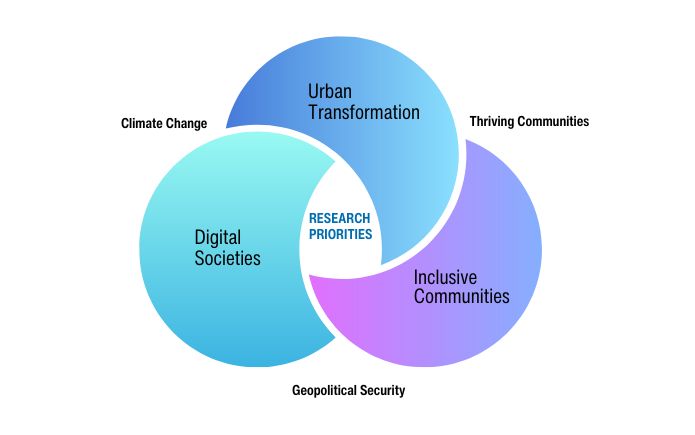
Our Research Priorities
Our research priorities represent key expertise and capabilities at Monash University Indonesia and research needs in Indonesia, the wider Southeast Asia region, and globally. These impact areas intersect and align closely with the vision and research priorities of Indonesia’s National Research Roadmap 2017 – 2045, Monash University’s Global Challenges, and the Sustainable Development Goals (SDGs). Through tackling these research priorities, Monash University Indonesia will contribute to building a global research ecosystem in Indonesia, connecting local and global researchers, engaging in discourse on and in Indonesia and shaping solutions to key societal challenges.
Urban Transformation
Rapid urbanisation and development in Indonesia and Southeast Asia have transformed cities and their population, resulting in significant changes in both the built environment and the social, environmental, and economic fabric. Urbanisation is a significant challenge for Indonesia. In the 1950s Indonesia was 12% urbanised; it is currently over 50% now, and predicted to be over 70% by 2050. While urbanisation will benefit its population in terms of social development, including human health, cities account for ~80% of the world's energy and generate more than 60% of greenhouse gas emissions.
Addressing the challenges around urban transformation requires new knowledge and better understanding of digital technologies and the impacts of urbanisation, and need to draw on human-centred solutions to support transformational change that improves livelihood, well-being and resilience, while safeguarding nature and adapting to and mitigating climate change.
Key words: Urban design, policy and planning, Urban health, Nature-based Solutions, Housing, Transportation, Smart cities and Climate change adaptation and mitigation.
Digital Societies
Technology has become an integral part of the development of Indonesian society. It is not only used as a tool to facilitate social activities, but also plays a central role in how people access and consume information, and participate in economic, health and social life. Yet, the digital divide across populations, gaps in technological infrastructure, cybersecurity and data protection, challenge the development of smart cities and digital societies.
Emerging approaches and technologies such as data science, AI, Machine Learning, Internet of Things, blockchain, earth observation satellites and big data represent innovative strategies that harness information and communication technologies to transform health, education, business, infrastructure, and commerce, to build a more connected and safer future.
Key words: Data science and analytics, Digital Health, Digital epidemiology, Public Health Surveillance, Infodemics, Machine Learning, Artificial Intelligence, Digital technology policy and Data governance, Cyber Security, Remote Sensing
Inclusive Communities
Communicable and Non-Communicable diseases, endemics and pandemics, displacement and migration, inequality, systemic discrimination, violence, and political volatility challenge not only how we live, but also how well we live together. The challenge is building cohesive and thriving communities that respect all people, provide equitable access to resources and promote equal opportunity.
Build inclusive communities necessitates new knowledge and a better understanding about human behaviour and practices, transformative approaches that shape new ways of living, and responses that are built not for, but with communities locally, regionally and globally.
Key words: Poverty alleviation, Social equity, Public health, Health systems strengthening, Gender equality, Democratisation and Political institutions, Colonial and imperial history, Violent extremism; Collaborative governance and partnerships