#19 - The Novelist’s Film (2022)
Written by Spencer Hines (PhD Candidate in the School of Culture and Communication, Faculty of Arts, University of Melbourne).
In an oeuvre frequently, albeit reductively, characterised by chatty reflections on the ‘hardships’ of being an artist, The Novelist’s Film (So-seol-ga-ui Yeong-hwa, 2022) is the closest Hong Sang-soo has come in thirty-plus films to the ushering of a creative manifesto. Jun-hee (Lee Hye-young) is a novelist with a bout of writer’s block. On a day trip to Hanam—a city on the outskirts of Seoul in Gyeonggi Province—she reacquaints with old friends and makes new ones, one of whom is Gil-soo (Kim Min-hee), an actor. Their meeting is a catalyst. It reignites Jun-hee’s long harboured desire to make a film, a cure to her writer’s block and the beginning of a new creative adventure.
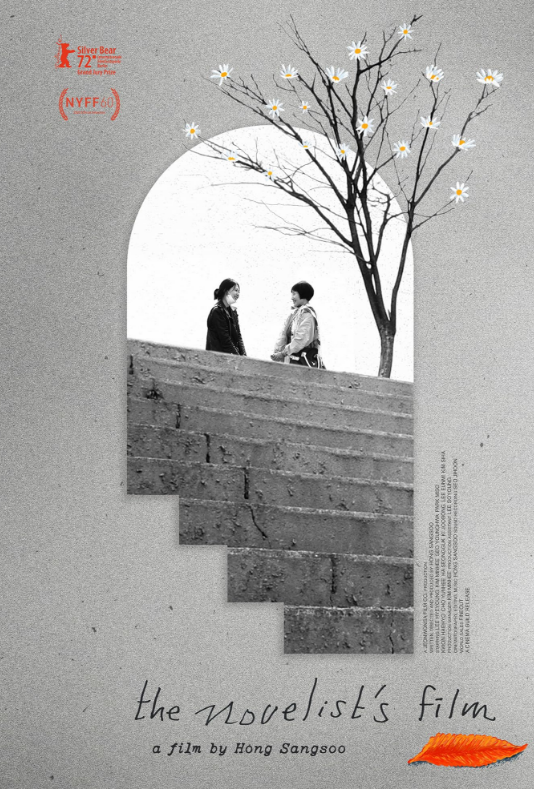
[Figure 1: The Novelist's Film poster. Image source: IMDb]
Hong resolutely claims his films are not autobiographical. Nevertheless, Jun-hee’s musings on her film-to-be come suspiciously close to articulating Hong’s unique and esoteric creative practice. This novelist’s film will be shot in the space of just a few days. It will centre on Gil-soo, a person who Jun-hee has become intrigued by, whose personality has sparked something inside her, and who she is content to simply observe. It will be shot casually, with a digital camera. It might seem like a documentary on the surface, but in reality, it is anything but. There will be a very simple story, but this will not prevent unfolding chance discoveries from steering the process in new, unexpected directions.
Hong, too, infamously begins filming with little more than a selection of locations and actors. He wakes early and writes from scratch the script pages to be filmed that day. His films grow. They evolve in a state of perpetual call and response in which each day’s creative discoveries serve as the foundation for the following day’s script-to-be. This sense of progression is retained in the post-production process, where material is largely edited in accordance with the order in which it is shot, the order in which it is conceived. Hong’s 27th film is a uniquely contemporary offering, the work of a filmmaker whose process and films have evolved beyond that which was far closer to ‘conventionality’ in the early stages of his career in the late 1990s, at the peak of ‘New Korean Cinema’. This is a production borne of impulse and instinct, for which Hong served as director, writer, cinematographer, editor and composer.
The film also sees to the meeting of two of the most significant collaborators in Hong’s contemporary oeuvre. Jun-hee is played by Lee Hye-young, the daughter of film director Lee Man-hee, who collaborated with Hong’s mother, producer Jeon Ok-seon, on a series of films during South Korea’s cinematic ‘golden age’ of the 1960s, perhaps the most famous of which is A Day Off (1968). Gil-soo is played by Kim Min-hee, in her ninth appearance in a film written and directed by her domestic partner, Hong. Theirs is a collaboration which has propelled Hong’s contemporary work into more intimate and personal directions, away from the cold edge and cynicism by which his early work is frequently characterised.
The Novelist’s Film contains little of the structural trickery rife throughout Hong’s earlier work. This is a simple tale of a woman’s journey towards creative fulfillment, a playful film comprised of subtly humorous vignettes and prosaic observations of a quotidian life. Jun-hee learns sign language, ascends a tower to admire the view, and takes a walk in a park. This all unfolds in conventionally ‘uncinematic’ spaces, presented with the saturated and overexposed black and white of a low grade low-grade digital camera which lends the film a haunting-come-ethereal quality, as though this novelist’s creative yearnings are the fabric of dreams.
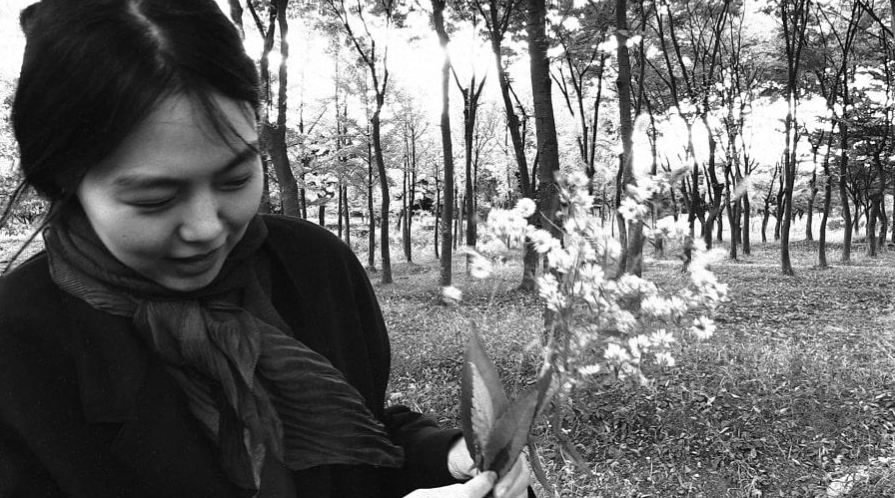
Hong’s films are increasing straying towards abstraction, beyond the boundaries of ‘fiction’. The Novelist’s Film teeters on this fine line, dips its toe over the other side and tests new waters. The film ends with some footage of Kim Min-hee wandering though the riverside park in Hanam, shot with a handheld camera operated by Hong. Kim and Hong speak to each other in the footage. Kim, clearly, is not ‘acting’. They exchange the phrase, ‘I love you’, and towards the very end the black and white subsides for an outburst of saturated colour, a revelation following a sea of monochrome. This overwhelmingly intimate footage Kim was not shot with the intention of it forming part of the film. It is quasi-home video footage, shot with a freewheeling spirit. In fact, Hong says it abstractedly inspired the idea of Jun-hee’s story in the first instance, the seed from which The Novelist’s Film emerges. In the context of the wider film, however, the footage is framed as Jun-hee’s film, but we know that it belongs to Hong. Reality and fiction blur and life bleeds into art.
 [Figure 2 Image source: Finecut]
Reference list:
Hong, Sang-soo. 2022. "A Public Conversation with Hong Sangsoo on The Novelist’s Film,” interview with Mark Peranson. Cinema Scope, November 1. https://cinema-scope.com/cinema-scope-online/a-public-conversation-with-hong-sangsoo-on-the-novelists-film/.