#2 - Aimless Bullet (1961)
Review by Russell Edwards.
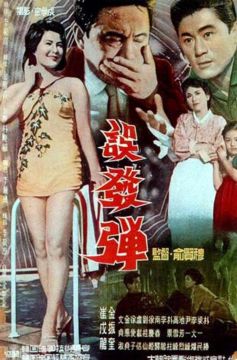 [Image source: IMDB]
Aimless Bullet (Obaltan, 1961), Yu Hyun-mok’s acclaimed and most widely seen film was made during the brief window of artistic freedom that operated between the ousting of Syngman Rhee’s corrupt government and the military coup that spawned Park Chung-hee’s dictatorship. Expanding the perimeters of South Korean cinema, Yu’s film is a rigorous, taboo breaking portrayal of the nation in the microcosmic form of an impoverished family, and a sustained contemplation of post-war trauma.
Fractured to the point of devastation, Aimless Bullet’s family unit are rudderless, and like Yu himself who was raised in what became North Korea, are cut off from their traditions and origins. Chol-ho is an honest and poorly paid public accountant who not only struggles to support his pregnant wife and daughter, but lives with his extended clan. Chol-ho’s brother Yong-ho, is an angry army veteran who feels unrewarded for his fight for freedom. To make ends meet their sister, Myong-suk fraternises with the new occupiers — the American soldiers — much to the shame of both her brothers. Pointedly, in a society that treasures the worth of education, the very youngest brother, drops out of high school to sell newspapers on the street. “Let’s get out of here”, the frequent exclamation of their mentally unhinged, bed-ridden mother serves only to remind the other family members that there is nowhere to go. To put it in the Australian vernacular: Aimless Bullet’s family are battlers who are doing it tough.
South Korea’s dashed hopes amidst desperate conditions echoed the European experience after World War II, so it should be no surprise that Korean filmmakers, including Yu, were influenced by Italy’s neo-realist films like The Bicycle Thieves (Ladri di biciclette, Vittorio De Sica 1948). A tight budget accounts for the film’s poverty row look — it was a stop/start production — and is partially responsible for some occasional visual inconsistencies. However, not all of the stylistic variations are by-products of insufficient funds. Despite Yu commonly being described as a realist director, the range of styles demonstrated here are testimony for the director’s passion for breaking barriers; artistic as well as social and political.
[Image source: IMDB]
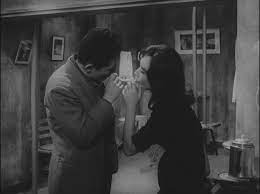
In addition to neo-realism, Aimless Bullet also offers tastes of film noir and melodrama. As the English title Aimless Bullet sounds like a noir, this often leads Western audiences in the wrong direction, but with the film’s climactic bank robbery those genre expectations don’t go completely unfulfilled. The most obvious nod towards melodrama comes in the recreation of the shared lighting of a cigarette cribbed from Love is a Many-Splendoured Thing (Henry King 1955). It’s a classic Hollywood image, but as used in Aimless Bullet the gesture is far more erotic and consequently more powerful as it implies the grasping at pleasure within a miserable realm. The influences on Aimless Bullet are many and go beyond the obvious. Best to let go of pre-conceived ideas, while noting that South Korean cinema’s tendency toward genre hybridity is not just a recent phenomenon.
Yu was a dedicated Christian. His later films, Martyr (Sungyoja 1965) and Son of Man (Salamui Adeul, 1980) directly explore issues of faith. With restraint, Aimless Bullet offers brief Christian imagery such as marching citizens carrying placards about Jesus during the film’s noir-ish bank robbery, but Yu doesn’t minimise post-war trauma with pat spiritual philosophy. Rather, after playing with neo-realism, expressionism, melodrama, theatricality, and noir, the film’s final images of Seoul border on the abstract. In doing so, Yu provides the audience with a final space to reflect on their own choices on what to believe in, and what to do next.
See the full uncut movie here.