#8 - Homebound (1967)
Review by Russell Edwards.
A woman married to a wheelchaired writer finds herself on the precipice of illicit romance in Lee Man-hee’s emotionally and sexually evocative Homebound. The film begins with the author of a weekly newspaper serial, former Lieutenant Choe Dong-u (Kim Jin-kyu) giving the story’s latest instalment to his attractive wife Ji-yeon (Moon Jung-suk). Ji-yeon then makes the long commute from their two-story mansion in Inchoen to Seoul to file the story with the newspaper. This appears to be a regular errand that Ji-yeon ritually undertakes as a supportive housewife to the disabled Korean War veteran. But on this day, the dissatisfied editor complains that the wife in the story is too saintly to be believed by modern readers. Can the writer make changes? Ji-yeon is disquieted. She knows, as we also ascertain, that the dutiful character is based on her. Ji-yeon is a good woman, even if the newspaper’s readers don’t believe it. On the same day, Ji-yeon catches the eye of the much younger Gang-uk (Jeon Gye-heon) on his first day at the newspaper. Fortuitously, Ji-yeon forgets her purse, thus giving Gang-uk a chance to return it and introduce himself. After this brief meeting, Ji-yeon returns to her decaying gothic home in Inchoen and her husband scarred by his wartime experiences.
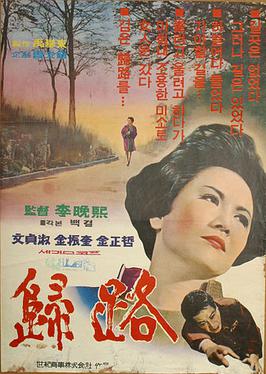
[Homebound (Gwi-ro, 1967) aka The Way Home. Image source: Wikipedia]
Having set up this scenario, Lee Man-hee then essentially repeats the story. When Ji-yeon next delivers her husband’s copy, the second encounter is more emotionally charged. Ji-yeon misses her return train, so she and Gang-uk wile away the time together until the next train’s departure. While propriety is maintained, flirtation and betrayal is in the air. Further complications ensue when the pair are spotted by Ji-yeon’s sister-in-law.
Beautifully realised by 1960s directing giant, Lee Man-hee, Homebound is deceptive in its simplicity. As it explores love and desire, Homebound also balances fantasy and reality. The scenes in Seoul’s streets provide a strong aura of realism. Lee reveals a metropolis criss-crossed by footbridges and trains that transport commuters like Ji-yeon in and out of the city. But alongside the urban realism, fantasy also finds its expression. Ji-yeon and Gang-uk visit discreet Seoul bars where couples indulge sexual impulses. Such places exist in any city, but these nocturnal oases of indulgence may be illusions. Homebound begins with a substantial chat between the married couple that implies that there is only a gossamer curtain between dreams and wakefulness, or fantasy and illusion. The film can be read literally of course, but it is also possible that the images are the product of the disabled writer constructing his story revisions. If so, then the rich fantasy borders on self-pity as he considers the possibility of his wife leaving him. Or perhaps, Homebound is a collection of Ji-yeon’s reveries, echoing the fantasies of women who flocked to Seoul’s movie theatres to escape oppressive spouses. Whichever version of the film you imagine to be correct, Homebound isa showcase for lead player, Moon Jung-suk. A two-time winner of Best Actress at the Blue Dragon Awards for two other Lee Man-hee films, (Don’t Look Back, Do-ra-bo-ji Ma-la, 1964 and The Market Place, Si-jang, 1966), the dignified Moon gathers audience sympathy regardless of whether she is the projection of feminine desire, or the victim of a man’s masochistic fantasy about a wife he cannot satisfy.
Homebound is available on You Tube here.