#9 - Old Boy (2003)
Review by Russell Edwards.
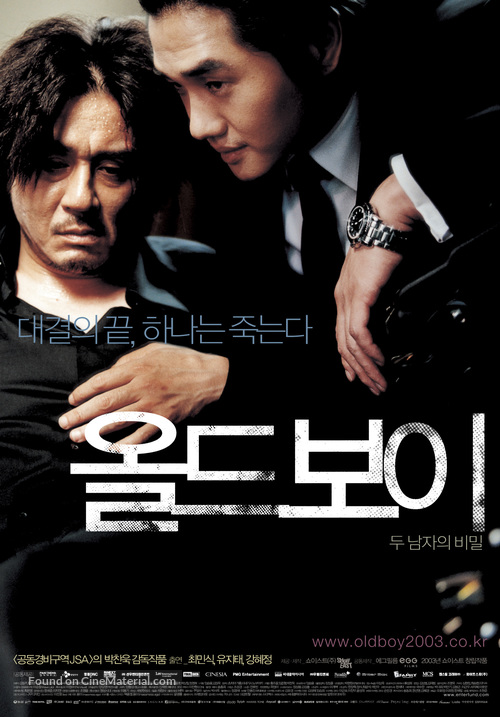
Park Chan-wook’s Old Boy (2003) is a key milestone on South Korean cinema’s road to international prominence, which crested with Parasite (Gi-saeng-chung, Bong Joon-ho, 2019). Walking a fine line between cultish commercialism and angry transgression, Old Boy is the middle ‘part’ of Park’s Vengeance trilogy nestled between Sympathy for Mr Vengeance (Bok-su neun na-ui geut, 2002) and Sympathy for Lady Vengeance (Chin-jeol-han Geum-ja-ssi, 2005). This is probably the director’s most widely seen movie (with The Handmaiden running a close second), mainly thanks to cineaste director, Quentin Tarantino who was head of the 2004 Cannes jury when Old Boy received the Grand Prix thus increasing its global marketability. (N.B.: the Palme d’Or went to Michael Moore’s Fahrenheit 9/11). [Old Boy poster (2003). Image source: CineMaterial]
The film is a sinister fable about Oh Dae-su (Choi Min-sik), a man who is imprisoned in a hotel-like jail cell for fifteen years by an unknown person for unrevealed reasons. Then, as suddenly and mysteriously as he was abducted, Oh is just as suddenly released, leaving him to contemplate that most existential of questions: ‘Why?’ Loosely based on a Japanese manga written by Tsuchiya Garon and illustrated by Minegishi Nobuaki, this adaptation by Park, and writers Hwang Jo-yun and Lim Jun-hyung is seamlessly altered to suit the South Korean setting.
During his imprisonment, Oh watches a lot of television. Besides providing an awareness of his being framed for his ex-wife’s murder, the factual events Oh sees on television during his incarceration include the Twin Towers attack and Princess Diana’s death. Other events, such as the collapse of the Seongsu Bridge, Chun Doon-hwan’s arrest and the meeting of Roh Moo-hyun with Kim Jong-il, underline the film’s Korean-ness and the rapid transformation as South Korea moved from dictatorship to democracy. Recalling that Old Boy was made less than a generation after the dictatorship’s dissolution, it is easy to see how Oh’s aggrieved feelings about unjust confinement informs his despair and rage in the film’s first half. That said, there’s some risk in over-interpreting films through South Korea’s domestic history, despite the nation’s cinema frequently returning to that well. Given international ignorance about South Korean history, it is important to note that the film’s worldwide success must therefore stem from an emotional and intellectual place beyond Korean borders. The frustrations of living under dictatorship cannot be the only source of the film’s appreciation.
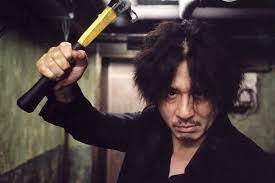 [Actor Choi Min-Sik as Oh Dae-Su. Image source: The Guardian]
Oh Dae-su’s predicament prompts comparisons with Josef K being accused of an unknown crime in Franz Kafka’s The Trial. Reaching back into classical literature, the film also recalls Oedipus Rex. The name Oh Dae-su is allegedly derived from the Sophocles play/Greek legend, and that certainly fits in terms of the revelations that come at the film’s end. But you don’t have to be an existentialist or a classical civilisation scholar to feel Old Boy’s emotional wrench or to be confronted by its sometimes, shocking images. Nor, despite multiple cinematic references from Un Chien Andalou (Luis Bunuel, 1929) to Vertigo (Alfred Hitchcock, 1958), does the film require you to be a film buff.
The film’s sense of elusive time slipping away is something any audience can relate to. This theme is present from the ticking during Old Boy’s introductory titles and continues throughout the film with close-ups of wristwatches and digital clocks. Using Choi Min-sik as our rageful proxy, the film taps into a universal fury about the unwanted dilemmas we must explore in our painfully finite lives. At the same time, the film is brutally frank in its suggestion that if you can’t handle the answers, you may be better off not asking any questions.
Old Boy will soon be released on Blu-Ray by Umbrella Entertainment.