
The Washington Declaration Turns One: Is it Time to Celebrate?
By Alexander M. Hynd (UNSW Sydney)
April 26, 2024.
 [Image source: The Korea Herald]
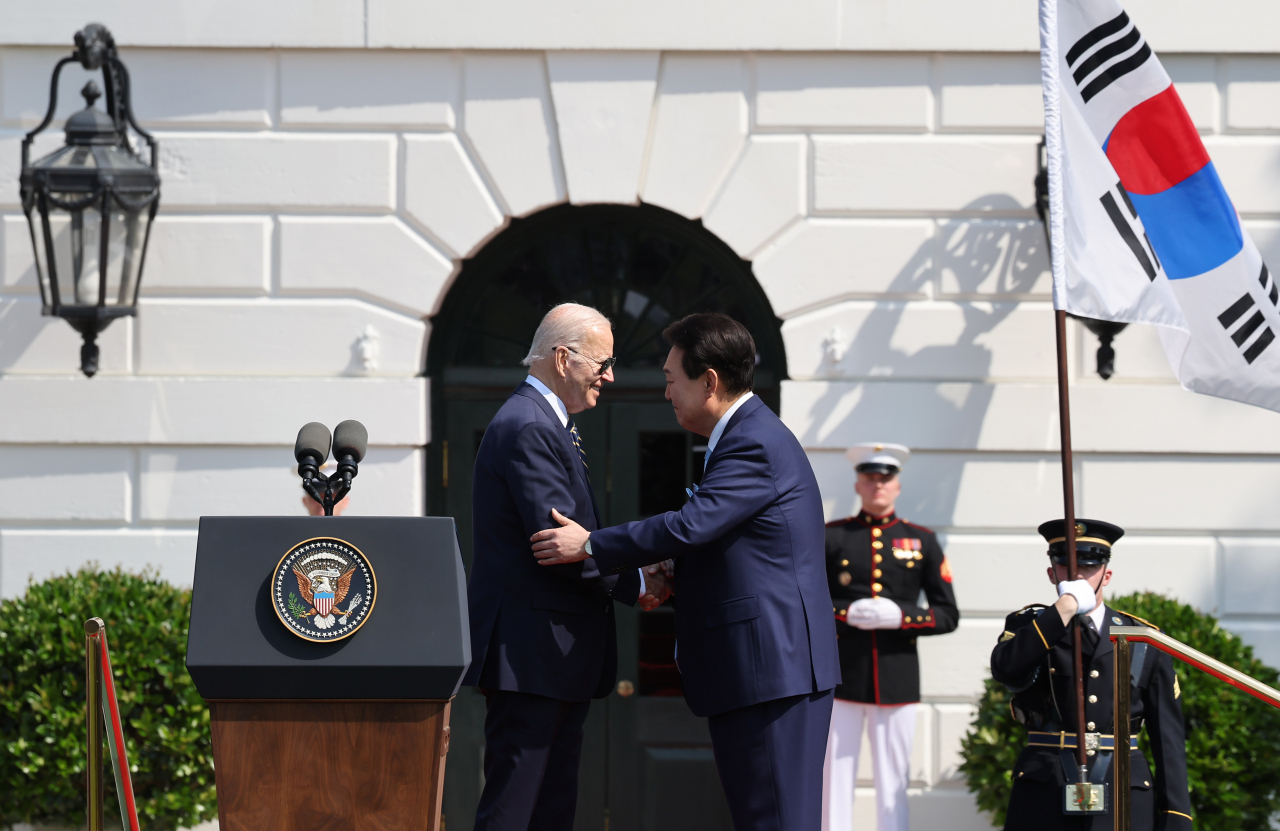
April 26, 2024, is the one-year anniversary of the Washington Declaration. This high-level strategic agreement was signed by US President Joe Biden and South Korean President Yoon Suk Yeol during a bilateral summit in the US capital – against a backdrop of North Korea’s nuclear weapons development, escalating great power competition between the US and China, and ongoing debates in South Korea about its own potential pathways to acquire nuclear weapons.
The Washington Declaration included a number of key points. Notably, President Yoon committed South Korea to remain a signatory to the Treaty on the Non-Proliferation of Nuclear Weapons (NPT), and to similarly retain its compliance with the two states’ bilateral agreement around peaceful use of nuclear energy. In other words, Yoon agreed that South Korea would not seek to develop its own nuclear weapons – despite the domestic popularity of such a policy among the public and, increasingly, South Korea’s political elites. The crucial context here is that previously, in January 2023, Yoon had made headlines when he suggested that, in response to North Korea’s ongoing nuclear program, ‘[i]t’s possible. . . our country will introduce (US) tactical nuclear weapons or build them on our own’.
In return for President Yoon’s continued commitment to nuclear non-proliferation, the US sought to strengthen perceptions of its own security commitment to South Korea’s defence. In particular, it aimed to reassure Seoul that it can continue to place trust in the US’ nuclear umbrella. Alongside an explicit statement that “highlighted the U.S. commitment to extend deterrence to [South Korea] is backed by the full range of U.S. capabilities, including nuclear”, new mechanisms put forward here included naval visits to South Korean ports by US nuclear ballistic missile submarines, and increased coordination and consultation on the US’ nuclear strategy. Attention was particularly focused on the creation of the Nuclear Consultative Group (NCG) – imagined as an additional and novel forum through which to discuss the two allies’ nuclear deterrence strategy in the face of North Korean threats.
Reactions to the Washington Declaration have been mixed. Internationally, North Korea, China, and Russia all unsurprisingly denounced the agreement, with the North Korean leader’s sister, Kim Yo Jong, characterising it as “a typical product of [South Korea and the US’] extreme anti-[North Korea] hostile policy reflecting the most hostile and aggressive will of action”. In contrast, American Korea watchers were largely supportive, with one calling it a “software upgrade for the U.S.-South Korea alliance”.
Within South Korea, opinion was split. Some praised the agreement for strengthening deterrence against Pyongyang. However, the country’s leading daily newspaper, the conservative Chosun Ilbo, declared that the agreement amounted to “South Korea’s nuclear shackles”, because it reiterated Seoul’s commitment to the NPT. Meanwhile, liberal outlets criticized the agreement for failing to help restart negotiations with North Korea, and one commentator characterized the deal as a further symptom of growing distrust between the US and South Korea.
At the same time, while the pact was being presented to the South Korean public, a minor but telling diplomatic disagreement broke out between the two allies – pointing to the potential for different interpretations of the Washington Declaration. South Korea’s deputy national security advisor appeared to frame the agreement as a form of ‘nuclear sharing’. The Biden administration quickly responded by making clear that this was not the case, and insisting that it instead be seen as a form of reinforced extended nuclear deterrence.
A year later, how can we assess the impact of the Washington Declaration? First, President Yoon’s recommitment of South Korea to the NPT should be cautiously welcomed by all those in favour of nuclear non-proliferation. However, while the agreement may have temporarily dampened discussions in Seoul around the possibility of an independent nuclear weapons program, it does not appear to have radically shifted South Koreans’ perception of trust in the US’ nuclear umbrella.
Second, the US has followed through on its commitment, with strategic nuclear assets regularly visiting the peninsula – as seen in the port visits of US nuclear ballistic missile submarines. However, as demonstrated in research by Lauren Sukin, there is a risk that even if the US security guarantee were to be viewed as increasingly credible, this could backfire and lead to higher domestic support for an independent South Korean nuclear program – due to fears of the US using their own nuclear arsenal when unwanted.
Finally, the Nuclear Consultative Group appears to be taking shape, with multiple apparently successful meetings held in the last 12 months. However, in retrospect, not enough was done at the beginning to publicly define the role and purpose of the group. The Biden administration clearly envisioned the NCG from the start as a means to reassure and inform Seoul of the US’ nuclear umbrella commitment. But some in Seoul still see it as a potential first step towards future nuclear weapons sharing between the allies.
Ultimately, the Washington Declaration’s long-term effects may only be decided by future elected leaders in Seoul and Washington. If the next president in either country were to signal their desire to rethink South Korea’s nuclear policies – the legacy of the Washington Declaration would once again be called into question, and could face a major new challenge.