
Topic #3 - Please and Thank You
If you grew up speaking English, you probably have a memory of the importance of saying “please and thank you” being stressed to you as a child. Of course, it’s natural to have a desire to be polite and express gratitude to those helping you out. The exact way that we do that, however, is highly contextual and culturally dependant. What is interesting about Korean is that Korean speakers don’t always use the equivalents of “please” and “thank-you,” they express politeness and gratefulness in other ways as we see below…
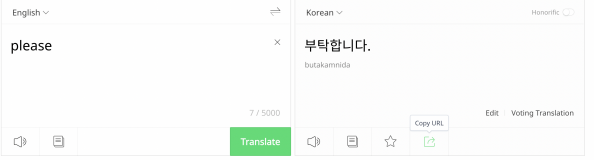
If you entered “please” into Google Translate and Papago, you get back “제발” and “부탁합니다”. As for “thank you”, you probably know “감사합니다” and “고마워요”. These are direct translations, but there are many contexts where they wouldn’t be the only possible response for a native Korean speaker. In this lab we will go over some contexts and examples where other language takes the place of “please and thank you” in English.

Please
Situation | Korean Sentence | Direct Translation |
|---|---|---|
You want to say, “can I please have some more rice?” to a waitress | 밥 좀 더 줄 수 있나요? | Could you give me some more rice? |
You want to ask someone to charge your phone | 혹시.. 휴대폰 충전 좀 해 줄 수 있을까요? | Could you possibly charge my phone? |
When you want to say, “excuse me, could I please get past?” | 지나갑니다. 잠시 비켜주세요. | I’m going past. Please let me get through. (The + 주세요 grammar form functions similarly to please, but isn’t a word on its own). |
In the above examples, a raised vocal tone and use of formal speech is polite enough without the use of a ‘please’ to indicate the request.
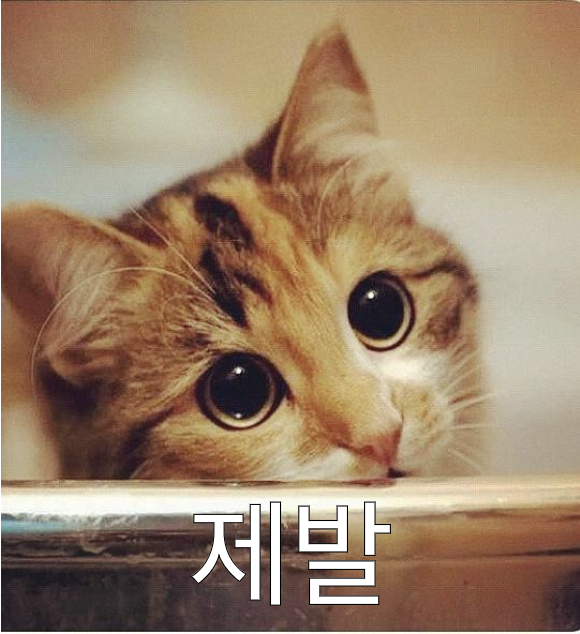
This might have you wondering when you can use ‘제발’? In general, it’s a more extreme expression for when you’re begging for something.
제발
Situation | Korean Sentence | Direct Translation |
|---|---|---|
When you only need one last number to win the powerball | 제발, 하나만 더!!! | Please, just one more!! |
When you’re already late and traffic isn’t moving | 제발, 빨리 좀 가자 | Please.. let’s go quicklyyyy |
When you want to go to a concert, but your mum won’t give permission | 제발….제발….제발!!!!! | Pleaseee…. Please…. PLEASEEEE!!!!! |
There are even more varied ways to express thankfulness. While these words don’t directly contain the phrase “thank-you,” but they express the emotion similarly.
Thankfulness
Situation | Korean Sentence | Direct Translation |
|---|---|---|
Getting off the bus leaving a restaurant after signing for a package | 수고하세요! | “Work hard!” Of course, you’re not really ordering them to work hard. This is an entirely polite and normal parting phrase if you are separating with someone who is working their job. While it might seem smug or rude to say in English, it is not at all in Korean. Important note: ‘수고하세요!’ should not be used to someone who is clearly much older than you and higher in status than you. (e.g., 할머니, 할아버지, 선생님 OR 사장님). In this case you can say, “내일 뵙겠습니다!”, “먼저 가겠습니다.”, “먼저 퇴근하겠습니다.”, “감사합니다!”. |
Leaving a restaurant After eating food someone prepared for you After someone else bought your meal | 잘 먹었습니다. | “I ate it well!” This is pretty self-explanatory. You don’t need to say “thank you for cooking”, it’s considered enough that you enjoyed the meal. |
After your friend treated your meal | 다음에는 내가 살게. | “I’ll buy next time.” Although people in Korea do sometimes split the bill, it’s more common to see people taking turns treating each other. Rather than saying “thank you so much for lunch”, between friends you would just as easily let it go after promising to pick up the next one. |
A particular scenario where saying ‘thank you’ is complicated in Korean is when you’re receiving a gift or item. It’s generally considered good manners to refuse a present once before receiving it (see this post for a discussion) so often responses to receiving a gift might seem like a rejection or a dismissal if directly translated to English. But the feeling in Korean is one of appreciation.
Say you drove a long way to visit your friend’s house in your hometown. On the way down, you made sure to stop by a market and pick up his favourite fruit. When you arrive with the tray of mandarins, your friend might say “수고스럽게 뭘 또 사 왔어..” (Something like: “why go to this much trouble to buy something”). Of course, your friend is very happy with the gift. Or perhaps, when meeting a friend for lunch, you remembered that they had mentioned enjoying a particular chocolate and picked some up on the way. They might respond “아니 뭐 이런 걸 다” (“No.. what is all this?”) or “이런 거 필요 없는데…” (“I really don’t need something like this.”). But, they are very excited to get the chocolate and can’t wait to have a bite.
There has also been research about the different emotional attitudes to saying thank you. Lee and Park (2012) found that English speaking Americans placed more importance on ‘gratitude statements’ than Korean participants did. You can read two of their articles here, and here.
This problem isn’t limited to English speakers trying to understand Korean. If you look around on social media, you can also see plenty of Korean speakers looking for resources on how to express these feelings more naturally in English too! Looking at videos like this one can give you an idea of how Korean speakers approach these topics in English.
Hope this was helpful!