
Topic #4 - I know, I don't know
In daily conversations, there are many situations where we have to express knowing or not knowing something.
In English, we can comfortably say I don’t know, or I know, without thinking too hardly about where we are or who we are talking to. However, in Korean the specific context and relationship between speaker and listener is crucial to know how to express these feelings without being rude.
In Korean, you can use 알다 to mean lots of different things. As you can see in the dictionary, it can be translated into a variety of English expressions:
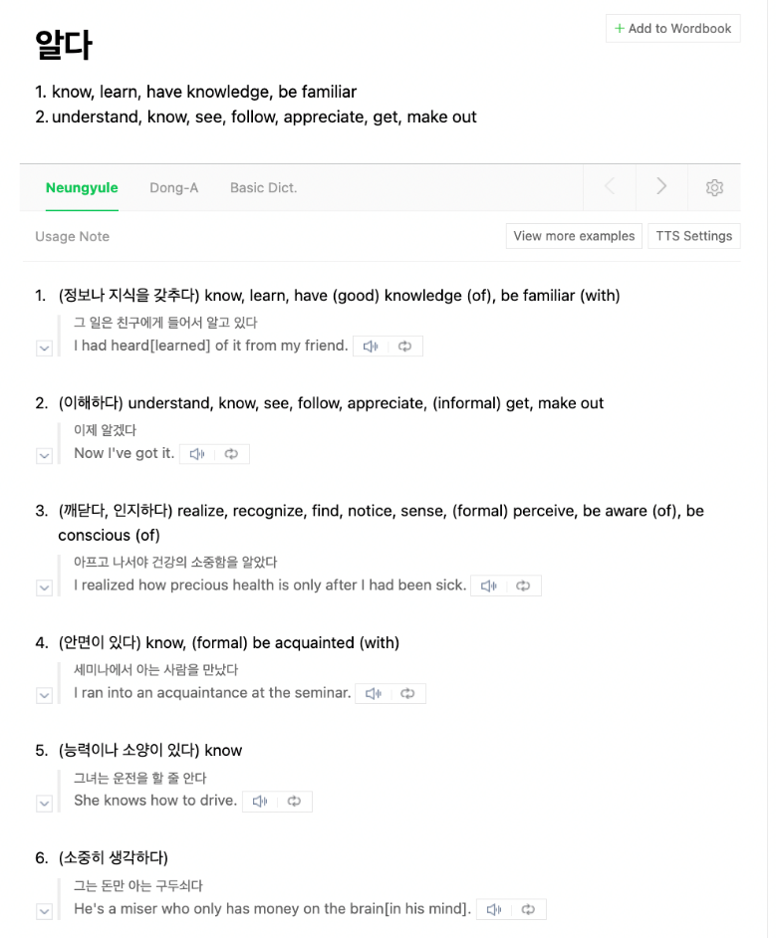
Lots of learners of Korean instinctively say ‘ 알아요’ or ‘몰라요’ in present tense. If you listen carefully to native Korean speakers’ conversations, you will hear different forms just as often. In this Language Lab, we will explain different ways to use these two words that will help you sound more natural and be more well-mannered in front of those of higher status or who are older than you.
The main difference between ‘몰라요/몰랐어요’ and ‘모르겠어요’ is the implication of what you don’t know. In the first case, you’re simply informing the listener of the fact that you don’t know something. This might be impolite in a situation where something has just been explained to you, or you should have presumably already been aware. For example, if your teacher just spent a lecture explaining a grammar point to the class, and when asked if you understood the example you answered ‘no idea!’ that would not be appropriate manners. This is where ‘모르겠어요’ comes in. 모르겠어요 (or, more formally, 모르겠습니다) also expresses that you’re unsure, but carries the implication that you have tried to think of the answer and have not been able to get it. In this situation, a ‘잘 모르겠습니다…’ could be considered something closer to ‘I’m not quite sure…’, and is definitely more polite.
Let me show examples of when 몰라요/몰랐어요 can be used:
경비원 : 학생! 남의 택배를 가지고 가면 어떡해!
학생 : 옆집 택배인지 몰랐어요.
Security guard: Student! You can't take other peoples parcels!
Student: I didn't know it was the neighbours.
(Here, the student is explaining that he was unaware that the package belonged to his neighbour. He isn’t responding to being taught something, rather explaining a status of unawareness.)
아주머니 : 혹시, 근처 지하철 역으로 가고 싶은데 어디로 가야 하는지 아나요?
아저씨 : 죄송해요, 저도 몰라요.
Older lady: I want to go to the subway station around here, do you perhaps know where I need to go?
Older gentleman: Sorry, I also don't know.
(Here, the two speakers are both older and strangers. Hence, while he maintains his politeness by using ‘요’, it is appropriate for him to say ‘몰라요’ He could also use 모르겠어요, which comes across softer and a little more polite. But it wouldn’t be rude of him to use 몰라요 either. .)
알아요/알았어요 vs 알겠어요/알겠습니다 can be understood the same way. 알아요/알았어요 is only describing what you already do or do not know, while 알겠어요/알겠습니다, in this kind of context, means you’ve understood what you’ve been told and will continue to work based off that information in the future. Here are some examples of when they might be used, to demonstrate the difference.
사장님: 내일부터 9시에 출근하도록 하세요.
알바생: 네, 알겠습니다!
Boss: Start work at 9am from tomorrow onwards.
Part-timer: Yes, understood!
(Using 알겠습니다 is polite, and they are letting the boss know that they will go forward with an understanding of what they have been told.)
선배님 : 내일 공휴일이라 학교에 나오지 않아도 되는 거 알아요?"
학생 : 네, 알아요.
Senior: You guys know that since tomorrow is a holiday, you don't need to come to school?
Student: Yes, I know.
(In this situation, the younger student is being told information that she already had. Since the point of the sentence is to express that they knew that information already, '알아요' best expresses that.)
엄마 : 친구를 주먹으로 때리면 안 돼. 알겠니?
아들 : 알았어요.
Mum: You can't hit your friends. Got it?
Son: I knew that!
(Here, the son is getting scolded by his mother. He already knew that it was wrong to hit someone, but perhaps he did it anyway. This response isn’t unforgivably rude, but it isn’t the politest either. It’s possible because it’s his mother, but you would not react this way to a teacher or someone else much higher in status than yourself.)
선생님 : 1더하기 1 은 2 예요. 알겠어요?
학생 : 네, 알겠어요.
Teacher: One plus one is two. Understood.
Student: Yes, understood.
(Here, the teacher asks if they understood, and they reply that they got it. This is less formal than ‘알겠습니다, but still polite enough to be acceptable within this kind of relationship).
You should be careful about when you use 알아요/알았어요/몰라요/몰랐어요 with people older or higher status than you.
Therefore, in your Korean class when the teacher asks 알겠어요? (Do you understand?), you should not say 네, 알았어요 but 알겠습니다.
You can get more help in using these phrases by listening to this podcast.