
#1 - 1.23 The USS Pueblo Incident
Published on August 26, 2023.
On January 23, 1968 the USS Pueblo, a United States spy ship on its maiden voyage, was approached by a North Korean submarine chaser in the East Sea (Sea of Japan) in what the US claimed were international waters and ordered to stand down or be fired upon. The vessel had been conducting surveillance of Soviet Navy activity in the Tsushima Strait and gathering signal and electronic intelligence on North Korea off the country’s east coast and contained a wealth of sensitive material. The Pueblo, a slow-moving WWII-era cargo-vessel repurposed for spy activities and virtually unarmed, attempted to maneuver away to prevent boarding, but was confronted by an additional North Korean submarine chaser, four torpedo boats and two Mig-21 jet fighters. The resulting North Korean attack resulted in three injuries and the death of an American sailor Duane Hodges. Radio contact was established with US forces in Japan and South Korea but promised air support did not materialize. The Pueblo, along with its 82-member crew and remaining trove of sensitive material the crew failed to destroy, fell into North Korean hands, beginning a nearly year-long ordeal.
Figure 1 (left): Positions of USS Pueblo as transmitted by radio. USSPueblo positions - Category:Maps of the Pueblo incident - Wikimedia Commons

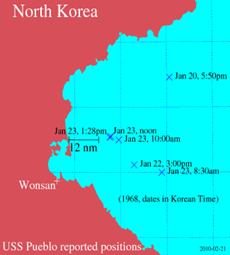
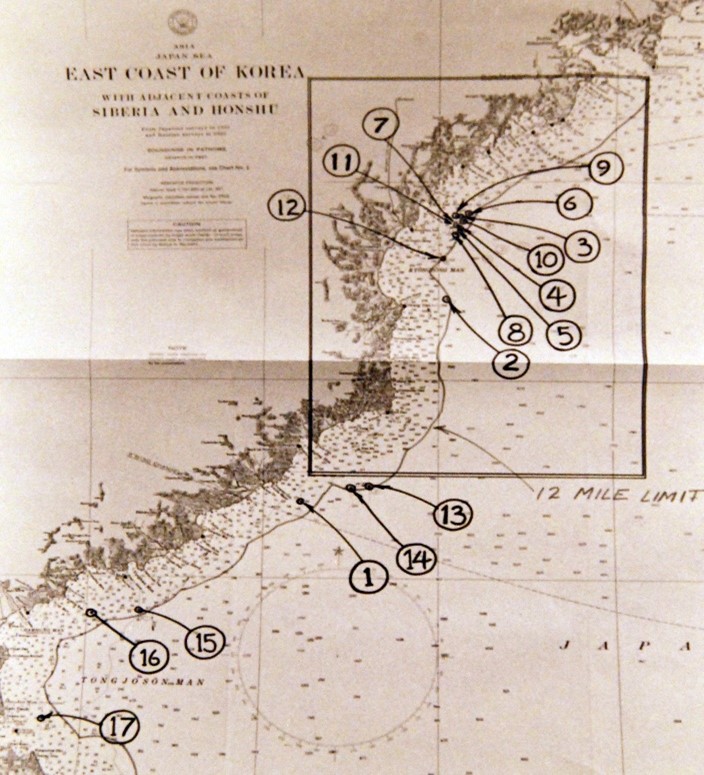
Figure 2 (right): Chart showing the alleged 17 points of violation of the territorial waters claimed by North Korea during the period of capture, January 15-24, 1968. Captain Lloyd M. Bucher, Commanding Officer of the Pueblo, denied each allegation, January, 1969. Official U.S. Navy photograph, now in the collections of the National Archives. (2017/05/23). File:428-GX-USN-1140171 (34717511891) (cropped).jpg - Wikimedia Commons
_(cropped).jpg)
An outraged US military demanded action, but military options available were impractical and dangerous. The Lyndon B. Johnson (1963-9) administration considered a blockade of Wŏnsan harbour where the Pueblo was held, air strikes on military targets, and an attack across the DMZ, but all of these responses were rejected because of the risk they posed to the POWs. Ultimately a more measured response was pursued, including the deployment of more naval forces in the immediate area, reconnaissance flights over the location of the Pueblo, and the protesting of the incident at the UN. The Johnson administration also entered into diplomatic talks with North Korea at P’anmunjŏm. As for the US captives, they were forced to endure brutal torture, starvation, and appalling conditions with no end in sight as negotiations dragged on for months. Due to continued torture and threats of execution, the prisoners were given no choice but to cooperate reluctantly with their captors, although within this cooperation they were able to mount subtle forms of resistance. In propaganda pictures prisoners gave the middle finger, but when the captors discovered that this was not a Hawaiian symbol for “good luck” as US soldiers had claimed, more torture ensued. One prisoner wrote in Morse Code at the bottom of a confession “this is a lie.” The Pueblo skipper Lloyd Bucher, in his forced confession, declared “my fervent desire to paean the Korean People’s Army, Navy and their government,” pronouncing “paean” as “pee on.”

Figure 3: North Korean propaganda photograph of prisoners of the USS Pueblo. Photo and explanation from the Time Magazine article that blew the Hawaiian Good Luck Sign Secret. The North Koreans for months photographed them without knowing the real meaning of the gesture, while the soldiers explained the sign meant good luck in Hawaii. File:North Korean Propaganda Photograph of prisoners of the USS Pueblo, with the Hawaiian Good Luck Sign, 1968.jpg - Wikimedia Commons

Finally on December 23, 1968, exactly eleven months since the capture of the Pueblo, to secure the release of the 82 captives the US agreed to sign a letter expressing what came to be referred to as the three As: Admission, Apology, Assurance. That is, admitting that the US violated North Korean waters, apologizing for doing so, and assuring that it would never do so again. The US for its part demanded the right to repudiate the letter before signing, which North Korea accepted. Each side in effect was allowed to save some face: North Korea acquired the propaganda it needed and a “victory” over Imperialist America and could choose to ignore the repudiation, while the US signed a meaningless document everyone knew to be coerced while saving the lives of its crew. Hearings were held back in the US the following month to determine the fate of the crew, and while court-martial was recommended for Commander Bucher and Lieutenant Harris, the charges were thrown out, as it was determined that they had “suffered enough.” In terms of intelligence, it was considered one of the greatest breaches in US history. According to one estimate, the Soviet Union had gained 3-5 years on the United States in communications technology due to this single incident.
What came to be known as the Pueblo Incident was characteristic of North Korea’s belligerent turn from the late 1960’s following an earlier period in its history marked by domestic orientation and economic rebuilding after the Korean War. In 1966 for example, the country violated the North-South armistice agreement sixty times, a significant number to be sure, but in 1967 this rose to 543 times, and in January of 1968 alone forty times. Furthermore, on the same day as the capture of the Pueblo, a clandestine group of North Korean commandos whose mission was to assassinate the South Korean President Park Chung-hee had been intercepted just 100 meters from the Blue House. South Korea attempted to train its own undercover unit to infiltrate North Korea to assassinate Kim Ilsŏng but the unit was soon decommissioned in light of improving relations between the countries, resulting in a mutiny and the death of most members, events dramatized in the 2003 South Korean film Silmido. The following year moreover North Korea shot down a US reconnaissance plane over the Sea of Japan, killing all thirty-one on board. Incidents such as these must have emboldened North Korea and brought about the realization that, despite the conventional military might of the United States, there were few practical responses to such provocations. North Korea’s pattern of brinksmanship and provoking limited clashes with the United States to extract concessions may be traced back to this period and events such as the Pueblo Incident.
This incident also occurred against the backdrop of the US military escalation in Vietnam, and the so-called Tet Offensive that occurred just a week later, one of the largest operations of the Vietnam War. Although North Korean leadership closely followed the US and South Korean involvement in Vietnam and viewed itself within a broader international communist struggle against American imperialism, the Pueblo Incident seems only tangentially connected with US escalation in Vietnam, despite the coincidence in timing. North Korea did seek to discourage growing South Korean involvement in the Vietnam Conflict and benefitted from the United States’ sinking of time and resources into such a quagmire, but the capture of the Pueblo seems more like an opportunistic operation than part of a calculated, long-term strategy.
The USS Pueblo—both the Incident and the ship itself—has become a symbol of North Korean strength and defiance in its David vs. Goliath struggle with American Imperialism. This has not been lost on North Korean leadership. In October 1999, immediately before a visit by US Presidential Envoy James Kelly to the country, the Pueblo was towed from the port of Wŏnsan on the east coast to Namp’o on the west coast before being moored on the T’aedong River in P’yŏngyang, near the spot where the General Sherman Incident (1865) had reportedly taken place. This incident, explored in another chapter, involved the Korean destruction of a US merchant ship that was forcefully seeking trade in isolationist Chosŏn Korea, and is considered the beginning of Korea’s struggle with Imperial America. In 2012 the Pueblo was again moved, this time to the Pot’onggang Canal in P’yŏngyang to become a permanent fixture of the Fatherland Liberation War Museum, where visitors may board the ship, view the ship’s secret code room, and see various of its artifacts on display. Naval Colonel Pak Inho (83), who helped seize the Pueblo and is revered as a national hero, is on hand to regale visitors with memoirs of the battle.

The Pueblo moored in P’yŏngyang as part of the Fatherland Liberation War Museum, October, 2012. USS Pueblo (AGER-2) in Pyongyang - October 2012 - Category:USS Pueblo in North Korea - Wikimedia Commons
_in_Pyongyang_-_October_2012.jpg)
Today, the USS Pueblo is the second-oldest commissioned ship in the US Navy and the only commissioned ship to be currently help in captivity. In 2005 ranking North Korean officials reportedly indicated that they would be open to possible repatriation, but there have been no more recent developments. The fate of the ship remains as uncertain as US-North Korean relations, held captive by irreconcilable differences and the scars of history.