
#10 - 5.18 The Kwangju Uprising
Published on May 17, 2022
5.18 The Kwangju Uprising (The Kwangju Democratization Movement)
On the morning of May 18, 1980, small crowds of students gathered outside the main library building of Chonnam National University in the major regional city of Kwangju, Chŏlla Province, in the southwestern part of the Peninsula. Some of these students were coming to the library to study, others to pick up belongings left overnight, some were curious onlookers, while a few were political activists protesting against the continuation of military dictatorship. Blocking the students’ way into the library was a line of South Korean paratroopers, clad in military fatigues and armed with batons; they were dressed for war. Around 10am, war began. The paratroopers charged and began bludgeoning the students. These were not the ritualized, choreographed student-riot police, tear-gas filled clashes that became a feature of South Korean campuses from the 1970s through to the late 1990s. The paratroopers began brutally beating students to the ground. Cornered students cut off from their lines were set upon by packs of soldiers and beaten unconscious. Eventually, the clashes spilt out onto the streets around the university. Enraged by the extreme brutality of the army forces, other students, as well as ordinary citizens, joined in the crowd battling the paratroopers in the charge and retreat format of a medieval battle (for an example of this urban fighting, see this CBS News report). Protestors armed themselves with rocks and sticks while the paratroopers continued to smash skulls. By the end of the afternoon, the clashes had spread downtown blocking the main thoroughfares of the city, and the military’s numbers were augmented with police officers and reinforcements of paratroopers. Within two days, the entire city was in full-scale revolt against state forces. This was the start of the Kwangju Uprising – known as 5.18 to indicate the month (5th) and the date (18th) on which the violence began. The Kwangju Uprising lasted a week and led to hundreds, perhaps thousands of deaths until it was suppressed by military forces. It also leaves one of the most controversial legacies of any event in recent Korean history. Kwangju radicalized South Korean politics and caused a seismic shift in the attitudes of ordinary people towards the United States and the West in general. Many radicals were even motivated to embrace North Korea. In short, Kwangju was a game-changer in Korean history.
The events that led to the Kwangju Uprising began several months previously in Seoul. General Park Chung Hee who had ruled South Korea with an iron fist and developed the national economy was assassinated by his own chief of state security. Park’s death led to the ‘Seoul Spring’ (named after the 1968 Prague Spring of communism with a human face) a short-lived period of popular demonstrations calling for greater democratization (see figure 1). Park’s assassination also led to a power vacuum within the most modern and powerful state institution, the military. General Chun Doo Hwan, the officer responsible for investigating the former President’s death, launched a bloody coup d’etat in December 1979. For months, Chun and his generals stood by as the Korean public’s demands for democratic elections increased. Finally, on May 17, 1980, Chun declared martial law over the country, arrested prominent student leaders, closed universities and banned all public gatherings. Hotbeds of protest like Seoul, Pusan-Masan, and Taegu went silent on the morning of May 18; it was just Kwangju that held out.
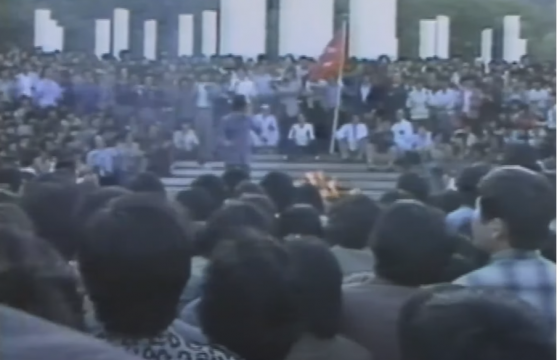
Figure 1: Student rally held during the Seoul Spring (CBS News Screen shot)
In Kwangju, the turning point in the balance of power between the citizens and army came on May 20-21. After three days of escalating battles between paratroopers and demonstrators, generals ordered their forces to fire indiscriminately into the crowd, killing and injuring unknown numbers of protestors. Instead of fleeing, the crowds raided armouries in police stations and began returning fire. A combined charge of vehicles driven by taxi and bus drivers broke through army lines, and to avoid further losses, the troops retreated to the outskirts and attempted to seal off the city hermetically. Flush with victory, the people of Kwangju formed Citizen’s committees and a People’s army to rule the city, tend to the wounded, bury the dead, keep order and negotiate with the army (Figures 2 and 3). They sent out infiltrators to pass on news of the events and spread the revolution countrywide. The committees appealed to the United States Government to intervene on behalf of the Korean people via letters smuggled to the Seoul embassy. The army never managed to seal off the city and journalists from Le Monde, New York Times, and Mainichi Shimbun smuggled news of the uprising worldwide. Chun’s government-controlled media was forced to reveal the extent of the anger against his rule, but blamed the disorder on North Korean operatives.
The unity within Kwangju did not last. Splits within the Citizen’s Committees over strategy led to the seizure of power of a hard-core group of students who vowed to fight the army to the death. On May 27, the army violently crushed the remaining resistance, thereby, ending the Kwangju Uprising.
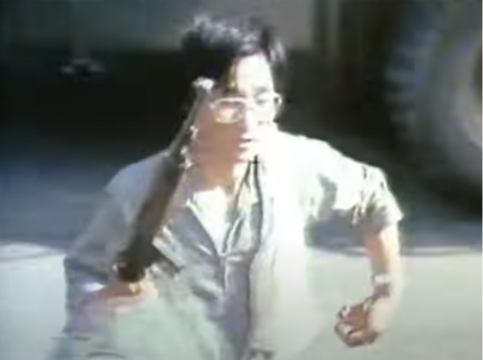
Figure 2: Kwangju citizens arm themselves to fight the army (CBS News screenshot)
The Uprising had ended, but the legacy of the violence lives to this day. Chun used Kwangju as an excuse to consolidate his grip on power, becoming President in rigged elections the following year. Kwangju radicalized young Koreans, and the student movement developed more sophisticated methods of resisting the dictatorship, helping to oust the regime in 1987. Koreans also turned their wrath on the US, who they blamed for allowing Chun’s generals to move key military units from under US Army jurisdiction to suppress the Kwangju unrest. Questions remain about the role of the US Ambassador Gleysteen. Why did he not respond to Kwangju appeals for US intervention? The US government tried to draw a line over events that had tarnished its reputation as a defender of human rights by making public its own records about Kwangju. However, the damage was done, and the State Department drew some hard lessons from the affair. The next time General Chun threatened to use military force to crush dissent in 1987, the US Embassy was swift to threaten the withdrawal of Washington support for Seoul. The legacy has also turned into a political battleground for Korean progressives and conservatives as well, with the latter group arguing that Kwangju was a North Korean sponsored attempt at reunification of the Peninsula. Other questions about who ordered the troops to open fire and the precise number of casualties will probably never be resolved until the South Korean state opens their official archives to the public. However, few politicians are willing to risk the political fallout that full disclosure about Kwangju may bring.
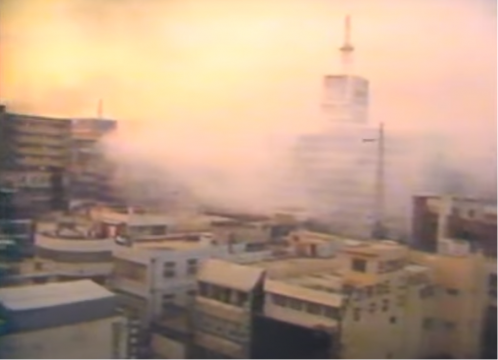
Figure 3: Kwangju on fire at the height of the fighting (CBS News screenshot)
-------------------------------------------------..
Watch the CBS report about Chun’s declaration of martial law in Korea (17 May 1980):
https://www.youtube.com/watch?v=DY87or4gNNU
Find the first TV images of the Kwangju Uprising here (19 May 1980):
https://www.youtube.com/watch?v=paDnQJVxYVA
Find Hinzpeter’s first filmed shots of the Kwangju Uprising. These are his images of a liberated Kwangju with the citizens in control (22 May 1980):
https://www.youtube.com/watch?v=NvjchJPoorE
Andrew David Jackson ©
Please do not reproduce without permission.