
#11 - 5.31 The Start of the 2002 Japan-South Korea World Cup
Published on May 30, 2022
May 31, 2002. The Start of the 2002 Japan-South Korea World Cup
In April 2022, it was announced by the Yonhap News Agency that June 1-6 2022 would be designated “Football Week” by the Korean Football Association to commemorate the 20th anniversary of one of the greatest sporting achievements in Korean history: the South Korean association football (soccer) team’s advance to the semi-finals of the world’s greatest mass spectacle – the World Cup. The April press announcement appears to have attracted little attention from the Korean press or the wider public. This is somewhat surprising, because two decades before BTS and other K-pop acts attracted significant public attention, it was the national football team that carried the hopes of the country. For almost a month, almost fifty million people were either glued to their TV screens or on the streets demonstrating their support for the squad. The chants of ‘O P’ilsŭng Ko-re-a’ [Korea must win] and ‘Tae-han-min-guk’ [the official name for Korea] rang out in every bar, street corner and square in the country. Outside of wartime it is difficult to imagine that this many people could be so unified in their support for a single cause.
Notwithstanding the remarkable public show of support for the team, which occasionally reached frightening levels, the 2002 Japan-Korea World Cup produced one of the most exciting events ever staged. 2002 turned the established football hierarchy on its head. The stage was set in the opening game, when the African champions Senegal beat the 1998 World Cup holders France. This was followed by the minnows USA beating the highly fancied Portugal 3-2 in a remarkable game in Suwon. One after one, big footballing scalps fell. However the greatest shocks came with the performance of the two host nations. No team from Asia had ever progressed beyond the group stages of the World Cup, which had been traditionally dominated by the European and South American giants. There was immense domestic pressure on Japan and South Korea to qualify for the second round. The announcement that FIFA had decided to jointly award the right to host the World Cup to both Japan AND South Korea was greeted with widespread derision and disappointment. Both countries had used mass sporting events in the past to showcase their economic and political development. The 1964 Tokyo Olympics announced Japan’s re-emergence on the world stage. The 1988 Seoul Olympics demonstrated to the world South Korea’s astounding economic recovery from the devastation of war and its democratic progress. By bidding against each other for the World Cup, Japan and South Korea had hoped to defeat their neighbour by winning the sole right to host the event and thereby receive total international recognition. This did not happen, and although there were appeals for FIFA to reconsider the outcome, the world regulating body of soccer told the Japanese and Koreans to get on with it. There was huge pressure for results on the pitch to justify the huge capital expenditure investment for an event that neither Tokyo nor Seoul believed would bring sufficient attention to their country. This was a big thing to ask considering Japan had never qualified for the World Cup, and South Korea had never won a match at the finals. In the event, neither country would be disappointed.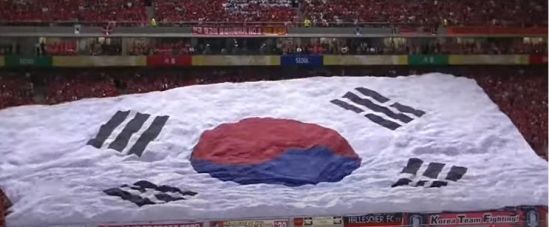
Figure 1: Giant flag unfurled by South Korean fans at the 2002 World Cup.
The first scalp fell to the Koreans, who defeated Poland 2-0. Not to be outdone, the Japanese first drew with a strong Belgium team 2-2 and then defeated the Russians 1-0. This was the footballing equivalent of the Japanese victory over Russian imperial forces in the 1905 Russo-Japanese War – a conflict that changed the international balance of power in a time of high imperialism. Just as in 1905, the 2002 defeat caused outrage in Russia, riots broke out in major cities and sushi restaurants were torched. In their next game, the Japanese beat Tunisia to achieve their goal of qualifying for the round of 16 and did it in style, topping their group. However, the most remarkable results went to the South Korean team. First, they knocked out the mighty Portuguese 1-0 to qualify. Then in the knockout rounds they humbled the Italian team 2-1, and in the quarter finals dispatched the highly fancied Spain on penalties. South Korea eventually lost 1-0 to Germany in the semi-finals and lost a third/fourth place play off 3-2 to Turkey in one of the most exciting games in World Cup history.
However, the South Korean team’s performance had brought them onto the world stage in astounding fashion. Not only had they achieved their aim of progressing beyond the group stages, they had beaten their bitter rivals Japan, they had made the semi-finals and they had done it in style. History is never far from the surface in Korea, and so it proved in 2002. Prior to the finals, much media attention had focused on how the only team from Korea to have ever achieved success in the World Cup was from the North. The DPRK squad in 1966 had famously knocked out the Italians and played in a remarkable 5-4 quarter final defeat to Eusebio’s famous Portugal team. Yet the South Koreans had gone one better than their fraternal rivals by reaching the semis – an achievement that became known as the ‘sa-gang sinhwa’ – the ‘legend [myth] of the last four.’ President Kim Dae Jung called the national team’s qualification for the semi-finals the ‘greatest day in 5,000 years of Korean history.’ Political and class differences were put aside and it seemed that all South Koreans were for a few weeks at least unified by football.
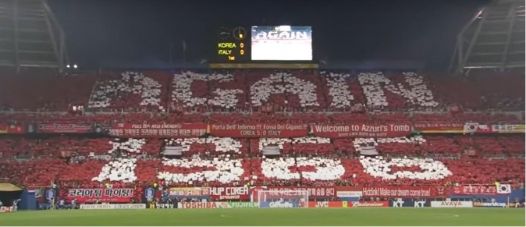
Figure 2: ‘Again 1966.’ Football fans urging on the South Korean team in the 2002 World Cup finals. Here they refer to the famous North Korean victory over Italy in the 1966 finals (Screen capture from KBS).
While the bottom half of the Peninsula may have been united behind their team, the South’s victories were not greeted with such joy in the North. The British journalist and novelist George Orwell once said that “Sport is just war without the guns.” In this case, while the South Koreans were engaged in a struggle for international recognition against the Japanese, Pyongyang was also fighting for attention as well. In 1989, to deflect international attention from the success of the 1988 Seoul Olympics, the North Koreans staged their own mass sporting and cultural event: the 13th World Festival of Youth and Students. In 2002, Pyongyang tried to do precisely the same thing, by organizing their own Arirang Mass Games at exactly the same time as the World Cup. As in 1989, in 2002 the North Koreans failed to draw much international interest in their event so did not succeed in their aims. However, the DPRK had made the point they wanted to make – that they were still a rival to the South and they would not be ignored.
In addition to being an exciting finals, the 2002 World Cup marked some important changes in South Korea. First, it brought the entire country an important boost after the trauma of the 1997-1998 Asian Financial (IMF) Crisis, when a meltdown in the currency led to the government seeking a bailout from the International Monetary Fund. The resultant restructuring had hit many Koreans hard and the World Cup projected to the world the face of a society which had dragged itself back from economic meltdown. A partial cultural shift also came with the advent of a new philosophy of traditional Korean hierarchies – known as the ‘Hiddink syndrome.’ Guus Hiddink was the Dutch football manager who had been drafted in to achieve the impossible and take the national team into the knockout stage of the competition. Hiddink was horrified by the national squad's footballing culture that he believed was the root cause of their lack of success. Traditional senior-junior and regional relationships dominated the selection process resulting in older players being given preference to stronger and more skilful younger players. Team members playing abroad acted like rock stars and contributed little in training sessions. Hiddink took a no-nonsense approach, cleared out the deadweight, discarded traditional hierarchies and deference and made the squad the fittest in the tournament. For a short while, the Hiddink approach was touted as a panacea to all Korean socio-cultural problems and many tried to implement Hiddink-style methods into businesses, work and familial relationships. While these Hiddink style methods appear to have been forgotten, the miraculous performance of the South Korean team in the summer of 2002 will live on for much longer.
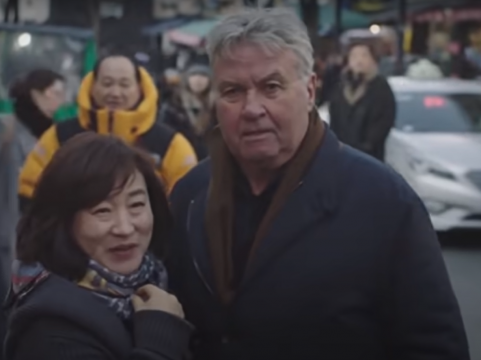
Figure 3: Guus Hiddink on a visit to Seoul
-------------------------------------------------..
Andrew David Jackson ©
Please do not reproduce without permission.