
#12 - 6.25 The Start of the Korean War
Published on June 24, 2022
6.25. The Start of the Korean War
In the early hours of June 25, 1950 tens of thousands of troops of the North Korean KPA (Korean People’s Army) poured over the 38th Parallel, the border dividing a communist Democratic People’s Republic of Korea (DPRK) from a US backed Republic of Korea (ROK). This was the start of the major military conflagration that was the Korean War, one of the most destructive conflicts of twentieth-century history, and an attack that solidified the division of the Peninsula. But how should we characterize this conflict that brought so much destruction?
It was the first ‘hot’ clash of the Cold War. The possible collapse of South Korea to the communist onslaught sent shockwaves across the world, and the United Nations Security Council (UNSC) passed a resolution authorizing the use of force to repel the North Korean invasion. Instead of vetoing the UNSC resolution which would have stymied the UN response, the Soviets famously chose to boycott the vote, allowing Truman’s US Government the moral and legal justification for the mobilization of close to twenty nations to aid South Korea. The United States sent 300,000 troops as part of the UN forces, but support was also provided by Australia, the UK, Turkey, the Philippines, and Ethiopia amongst many others.
During the first year, it was a war of movement as the two sides chased one another up and down the Korean Peninsula. The KPA forces were battle-hardened from service with Mao’s troops in the Chinese Civil War and they included mechanized divisions supplied by the Soviets. These troops sent the ROK forces into headlong retreat, and when the Americans hastily dispatched troops from Japan to stem the assault, KPA troops brushed them aside. In the end, UN forces held only a single toehold in the southwest tip of the Peninsula – the Pusan Peninsula. General Douglas MacArthur’s audacious Inch’ŏn landings divided the stretched KPA forces from their supply lines and the North Koreans were driven back to the border with China. MacArthur’s famous threat to take the war into China and to strike Manchuria with nuclear warheads precipitated the participation of Chinese forces which drove UN (United Nations) forces south.
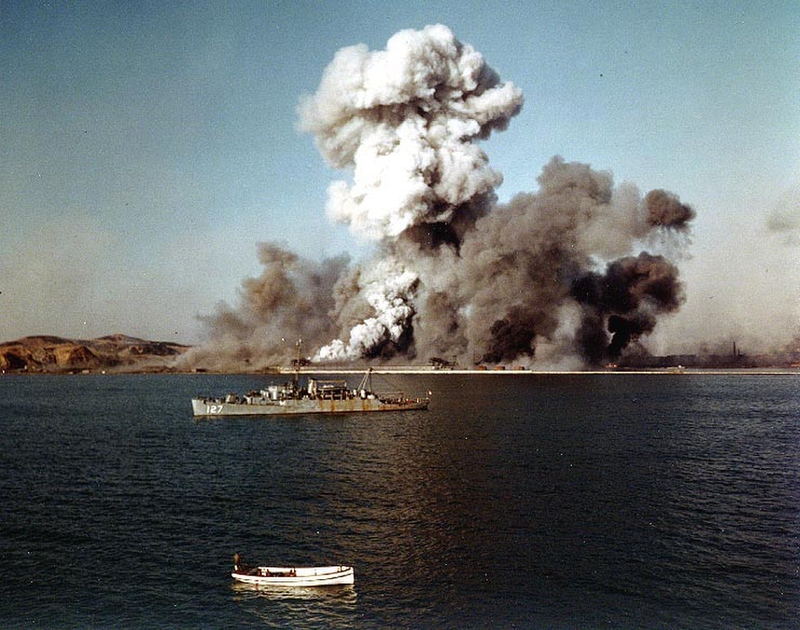
Figure 1: Destruction of Hŭngnam Harbor during the Korean War. Image source.

The Korean War was a total war in which almost two million Chinese, North and South Korean and US combatants and three million Korean civilians died. During the early stages of rapid movement, most major areas on the Korean peninsula, including Seoul, changed hands at least twice, falling to the communists and then back to the UN Forces (figure 1 and 2). The capture of an area brought the establishment of new authorities espousing radically different principles, resulting in official and unofficial reprisals. The most notorious examples were the Podo League massacres, in which suspected communists were rounded up and executed by the Syngman Rhee regime (1948-60) prior to the North Korean advance.
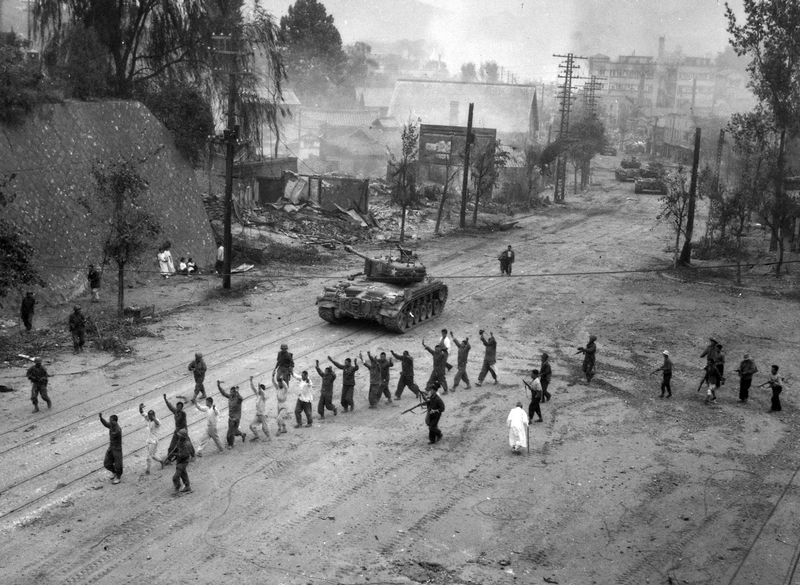 Figure 2: Troops and civilians during the second battle for Seoul, image source.

The Korean War was also a civil war in which neighbor turned on neighbor and brother on brother. The primary split between Koreans was ideological – between Soviet style communism and American anti-communist ideology – representing two models of how to construct a postcolonial nation out of the ashes of Japanese rule. But in the chaos of conflict, contingent factors divided families. Both ROK and KPA forces pressganged civilians into serving in their armies either as porters or as soldiers, while many refugees fled the fighting, often leaving family members behind in the hope that they could return after a few days. The result was that by the end of the war and with the stabilization of the division into North and South Korea, as many as 75% of all families were separated as a direct result of the fighting, making this the most tragic long-term legacy of the war.
The final phase of the war (1951-53), became both an ideological conflict and a bombing war. Both sides had fought each other to a standstill. The armistice negotiations dragged on for two years stalling over the precise position of the armistice line and the issue of the repatriation of POWs. Each side attempted to secure propaganda triumphs over the other – a ‘substitute’ for military victory as the historian Rosemary Foot has argued. The truce negotiations were accompanied by a massive US bombing campaign against the North, the first use of napalm against civilians and the decimation of DPRK industry (figure 3). This was an attempt to bomb the communists into signing the peace treaty. The South Korean President Syngman Rhee regime opposed negotiations that would permanently divide the peninsula at the 38th Parallel, and prosecuted an intense campaign to continue the war until total victory against the North had been achieved. By the time the armistice was signed on the 27th July 1953 neither side had made substantial gains in terms of controlled territory: the peninsula was still divided at the 38th Parallel.
The Korean War is also an unfinished conflict. Its bitter legacy shaped the political paths of the two Koreas for the following seventy years. No formal peace treaty was concluded by the two Koreas, so the Korean War never officially ended. The war left a fragile peace intermittently shattered by limited exchanges of fire and small-scale loss of life. In the North, the conflict is known as the Fatherhood Liberation War (Chogukhaebangjŏnjaeng) and is presented as a war of liberation from the US. The North recalls the bombing with great acrimony, and Pyongyang still exploits the US military campaign in its propaganda as evidence of US unscrupulousness. Views over which side bore most of the culpability for the devastation have remained a source of rancorous contention. Initial evaluations blamed Soviet leader Josef Stalin for initiating what was widely believed to be an attempt at global communist expansion. However, these views were challenged in the late 1980s by revisionist historians like Bruce Cumings, who argued that the Korean War was initiated by Syngman Rhee and grew out of the civil conflict that followed decolonization. The revisionist argument that the United States bore more responsibility for the destruction than had been previously admitted had a profound effect upon anti-Americanism in South Korea following the 5.18 Kwangju Uprising. However, Cumings’ assertion that Rhee bears more responsibility for initiating the war has subsequently been proved incorrect by the opening of Soviet archives in the early 1990s. It was Kim Il-sung who won over a hesitant Mao and a cautious Stalin and asserted he was the one who could unify the Peninsula by military force.
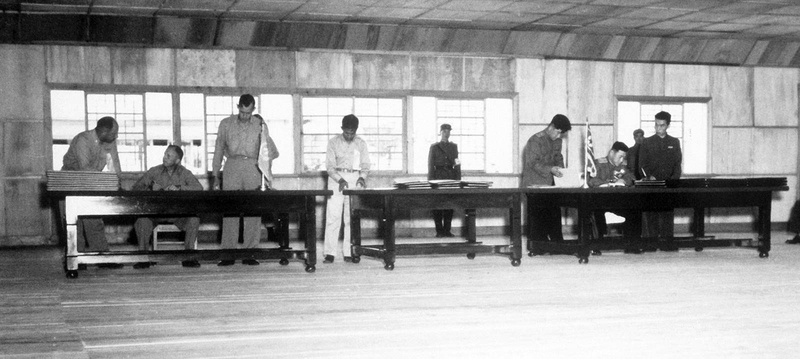 Figure 3: The signing of the armistice agreement. Image source.

-------------------------------------------------..
Andrew David Jackson ©
Please do not reproduce without permission.