
#14 - 7.8 Death of Kim Il-Sung
Published on June 29 2024
7.8.1994 Death of Kim Il-Sung
A fifty-year reign ends and a socialist dynasty begins
In the early morning of July 8, 1994 North Korean leader Kim Il-Sung died of a sudden heart attack at the age of 82. Kim was the third-longest serving non-royal head of state/government in the twentieth century, serving as official head of state since the DPRK’s founding in 1948 but de facto leader of the North since his instalment by the Soviet Union in 1945. Kim’s eldest son Kim Jong-Il was named the country’s next leader with the title “Great Successor” (widaehan kyesŭngja). Although his son had been groomed for the role for many years, his official ascension to head of state was an unprecedented move which made North Korea the first Socialist Dynasty in history.

Figure 1: Five decades of Leadership: Kim Il-Sung in October, 1948 and a posthumous portrait. Source: Wikimedia Commons
North Korea’s government did not report the death of Kim for more than 34 hours after it occurred, possibly due to concerns that outside powers would exploit the transition or take advantage of any perceived instability. Kim Il-Sung was laid to rest in the Kŭmsusan Memorial Mausoleum, where his embalmed remains lie in state inside a crystal sarcophagus. The enormous mausoleum, converted from his official residence by his son at a reported cost of up to $900 million, is the largest such structure dedicated to a Communist leader, and after Kim Jong-Il was laid to rest there in 2011, the only mausoleum to house multiple people.
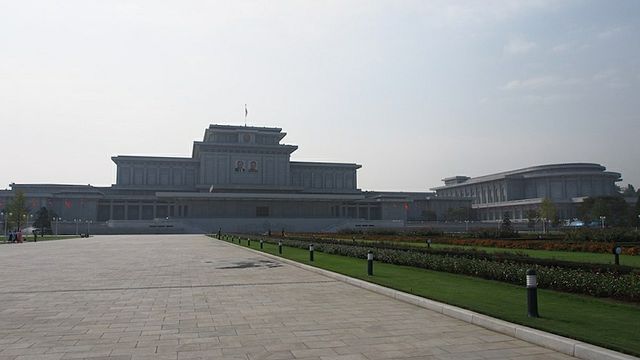
Figure 2: Kŭmsusan Palace of the Suns (Kŭmsusan T’aeyang Kungjŏn), P’yŏngyang, showing the portrait of the second “sun” Kim Jong-Il added after he was laid in state with his father. Source: Wikimedia Commons
An official period of mourning was immediately announced, lasting for ten days between July 8-17, a number which may represent a vague reference to the traditional Buddhist mourning period of 100 days. Also in accordance with tradition, during this mourning period all songs, dances, games and amusement were officially banned. A further though less stringent period of three years mourning was also implemented, during which the positions of President and Party Chief were officially left vacant; Kim Jong-il would later assume these roles, but the title of “Eternal Leader” (yŏngwŏnhan suryŏngnim) was forever reserved for Kim Il-Sung alone. The three-year mourning period was traditionally prescribed by the progenitor of Neo-Confucianism Zhu Xi (1130-1200AD), who stipulated in his influential Family Rituals of Master Zhu that pious Confucians should spend three years mourning by the graves of the deceased living in a makeshift hut wearing only coarse loincloth. Although then and following the death of Kim few actually followed these gruelling prescriptions, Kim’s death did elicit very dramatic public mourning rituals.

Figure 3: Kim Il-Sung posthumous birthday celebration, April 15, 2014. Source: Wikipedia Commons
While foreign mourning delegations were not received, China, who had fought alongside North Korea in the Korean War, sent condolences, praising Kim as a “comrade in arms.” Even North Korea’s perennial enemy the United States, which had recently entered talks with the embattled state, expressed appreciation to Kim for entering into the talks and hope that they would continue, though President Clinton was careful to direct condolences at the North Korean people and not state leadership. The talks were initiated at a difficult crossroads for North Korea. Beginning in the 1980s the nation’s previous benefactor the Soviet Union amidst mounting fiscal difficulties began to demand repayment of previous loans, which the cash-strapped regime was unable to do. The fall of the Soviet Union in 1991 and China’s unwillingness or inability to make up the shortfall sent North Korea’s economy into a downward spiral.
By the closing years of his reign Kim was increasingly open to negotiating a way out of this economic calamity as the country continued to suffer from a critical lack of energy and foodstuffs. However, the worst was yet to come. Even the challenges of the early 1990s were nothing compared to the horrendous floods, drought, and resulting famine that began shortly after Kim’s death and lasted until 1998, referred to in North Korea as The Arduous March (konan ŭi haenggun) and resulting in anywhere from a quarter of a million to 3.5 million deaths in a population of 22 million. Following the loss of Soviet Aid, the electricity-dependent agricultural sector could no longer operate, putting pressure on food production in the mountainous nation with only 20% arable land. North Korean leadership then made the short-sighted decision to denude mountainsides in order to increase arable land; torrential rains in the following years then resulted in massive erosion and flooding, loss of production, and widespread famine. These disastrous economic policies were accompanied by Kim Jong-Il’s so-called “military first” (sŏn’gun) policy which prioritised North Korea’s massive armed forces at the expense of its population. The active promotion of its nuclear weapons program, again at the expense of the North Korean people’s welfare, resulted in steadily worsening relations with the West and virtual isolation.
The Arduous March also created a wave of refugees, many of whom settled in South Korea. Many of these “newly settled people” (saet’ŏmin in South Korean parlance) who were alive during the time, in private interviews or on one of the many South Korean television talk shows that feature them, express extreme disdain for Kim Jong-Il and associate his tenure with a harrowing time in their lives and in the nation’s history. However, Kim Il-Sung and his era are generally viewed in a much more positive light, somewhat akin to the positive perception of the Park Jung-hee era by many older South Koreans due to the better quality of life associated with the time, despite lurking political oppression. Although North Korea’s mounting challenges were myriad and its success or failure cannot be attributed to a single leader, in many ways the death of Kim Il-Sung represented a new era, when the heady promise of socialist revolution met the cold reality of a post-Soviet world. Although North Korea’s “collapse” was not as ideologically marked as that of the Soviet Union, and a socialist state of sorts continued to hobble forth into the twenty-first century, North Korea was never the same after the death of Kim Il-Sung: its state employment, food distribution, and population control systems broke down shortly after, and a tacitly approved, semi-capitalist market has filled the void. The death of Kim Il-Sung therefore was not merely the passing of a world leader, but a turning point in the nation’s history.
-------------------------------------------------..
Daniel Pieper ©
Please do not reproduce without permission.