
#18 - 10.9 Hangul Day
Published on October 15, 2022
10.9. Hangul Day (Han’gŭl nal).
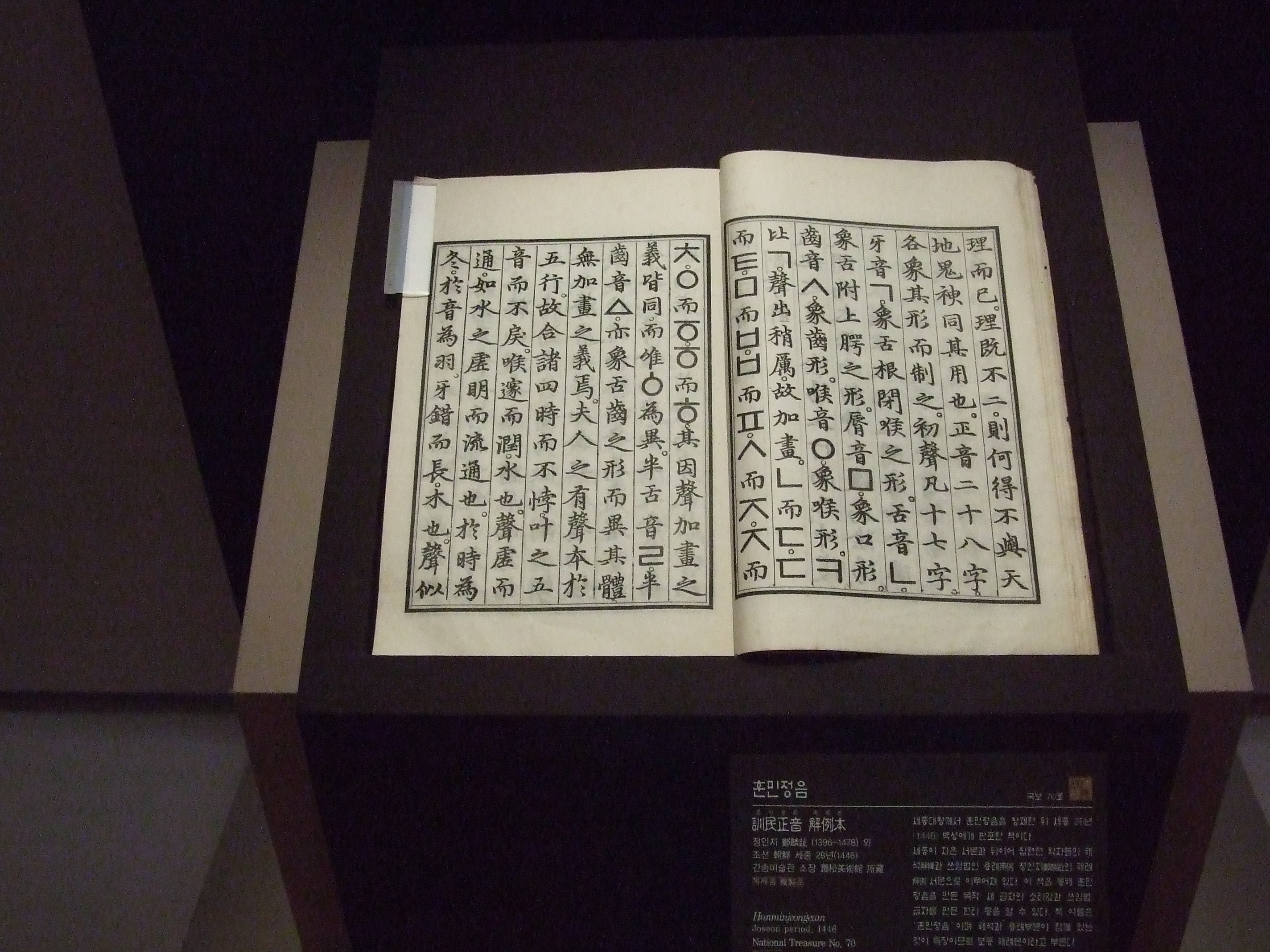
Figure 1: Replica of the Hunmin Chŏngŭm haerye (Explanations and Examples of the Correct Sounds for the Instruction of the People) rediscovered in 1940 on display at the National Museum of Korea.
On October 9, the Republic of Korea celebrates Hangul Day (Han’gŭl nal), which commemorates the promulgation of the Korean script, commonly known as hangul, during the Chosŏn Dynasty in 1446. South Korea is the only nation in the world to mark the proclamation of its writing system with a national holiday, other than its neighbor to the north, where the day is called Chosŏn kŭl nal (Chosŏn Script Day) and is celebrated on January 15th. A special commemoration for the Korean script was first proposed in 1926 by the Korean Language Society (Chosŏnŏ hakhoe), an organization which aimed to promote knowledge and usage of the script and initially received the tacit approval of colonial authority before being actively suppressed later in the colonial period. After being commemorated on various days due to discrepancies between the solar and lunar calendars and a lack of accurate historical documentation, the 1940 discovery of an original copy of the Hunmin Chŏngŭm haerye (Explanations and Examples of the Correct Sounds for the Instruction of the People) proclaimed soon after the script’s announcement placed the promulgation within the initial ten-day period in the ninth month of the lunar calendar, prompting the ROK government upon liberation to establish Hangul Day on October 9.
This original text shed light onto the principles of the alphabet’s invention, which for many years had been shrouded in mystery. The text explaining the shapes of the letters had for many centuries been lost, and so the possible inspiration for these shapes had been the source of much speculation, with some opining that the letters had been inspired by the geometric patterns found in the latticework of traditional Korean doors. It was finally revealed that hangul consonants were formed based on articulatory phonetics; that is, the consonants iconically represented the shape of the mouth, throat, and tongue as they formed the respective sounds. The velar sound “ㄱ” reflects the shape of the tongue covering the throat, the lingual “ㄴ” is the shape of the tongue touching the upper gums, the labial “ㅁ” depicts the shape of the mouth or lips, the dental “ㅅ” depicts the shape of the teeth, and the guttural “ㅇ” represents the shape of the throat. On the other hand, the vowels were envisioned to represent the sky, humans, and earth (ㆍ, ㅣ, ㅡ), which respectively represented positive, neutral, and negative forces in Confucian cosmology. Moreover, the vowels demonstrated careful consideration of vowel harmony according to Confucian principles of yin and yang. The creators of the alphabet also demonstrated a firm grasp of contemporary Sinitic linguistic theory in their comparisons with Chinese initials and finals but expanded upon known phonological theory by creating the concept of “medials” (chungsŏng) in Korean phonology. In other words, whereas current Chinese linguistic theory acknowledged only initials and finals as constituting a syllable, the idea of a medial sound conceptualized three components to a syllable and contributed a layer of complexity to Asian linguistic theory (Chinese: 하 (initial) + ㄴ (final) = 한 à Korean: ㅎ (initial) + ㅏ (medial) + ㄴ (final) = 한).
That the creators of the script were driven more by informed scientific inquiry and profound Confucian insights than creative mimicry is understandable: the task of creating the script fell to the Hall of Worthies (Chiphyŏnjŏn), a group of royally appointed scholars who were among the greatest minds of their day during the reign of a king who was more devoted to the cause of learning than any monarch in Korean history. Although there is still disagreement over the exact extent of the king’s involvement in the alphabet’s invention, it seems clear that han’gŭl was the brainchild of King Sejong and that he was personally invested in its success, if not intimately involved in the day-to-day creative process. Judging by his demonstrated academic prowess in a variety of fields, including contemporary linguistic theory, and his expressed concern for the ramifications of illiteracy in his kingdom, Sejong certainly possessed the will and means to invent the Korean alphabet. At the very least, he was able to orchestrate an ambitious and knowledgeable body of scholars to engineer a scientifically and philosophically profound writing system that would change Korean society forever. The Preface to Hunmin Chŏngŭm, well known by Koreans of all walks of life, is often invoked to demonstrate King Sejong’s wisdom and empathy for his people: “The speech sounds of our nation are different from those of China and are not confluent in writing. Thus, there are many among the ignorant peasants who, when they have something they wish to say, are ultimately unable to express their meanings. Taking pity on this, I have newly created twenty-eight letters, and simply wish for any and all to learn them with ease and use them at their convenience in daily life.”
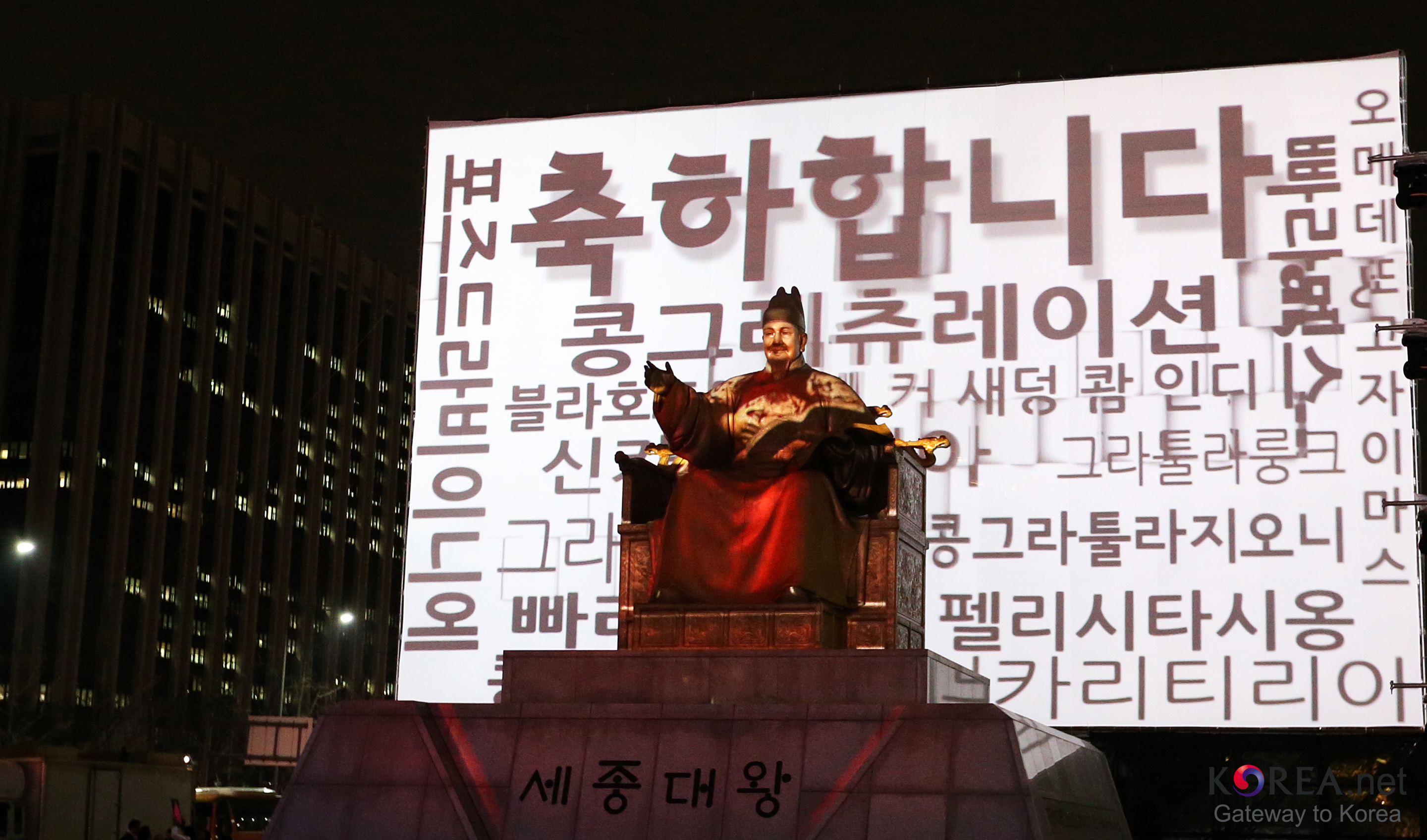
Figure 2: Hangul Day celebration on October 9, 2012, at Kwanghwamun Square in downtown Seoul depicting a statue of King Sejong the Great.
Despite the profundity of the alphabet’s principles and their potential utility, there were, of course, detractors. Chief among the opponents was Ch’oe Malli (崔萬理), himself a member of the Hall of Worthies, who in early 1444 just after the script’s announcement presented a memorial to the throne outlining the reasons that he and like-minded officials opposed the script’s creation. Among other reasons, Choi argued that the usage of such writing would distance Chosŏn from the known center of civilization and “true writing” while placing Korea among the ranks of “barbarian” countries who had also created their own writing systems and deviated from true Confucian learning, among them Japanese, Mongolians, and Jurchens (later names Manchus).
In contemporary North and South Korea, Choi is vilified as an enemy of the Korean nation, an out-of-touch elite and despicable flunkey kowtowing to foreign domination and opposing the more accessible and useful Korean script for selfish reasons. However, it is safe to say that Ch’oi’s position represented the majority of literate Koreans at the time, while support for the script would have been in the distinct minority. For an elite stratum of Chosŏn society thoroughly ensconced in Sinitic learning for centuries, a group which monopolized education and literacy in Chosŏn Korea, the strange systems of dots and geometric lines suddenly unveiled must have been alarming and potentially threatening. On the other hand, despite the egalitarian tone of King Sejong’s Preface cited above, the only or even primary reason for the alphabet’s invention was not to serve as a source of empowerment for the downtrodden and replace Literary Sinitic (Classical Chinese), but to serve as a tool for the elite to more accurately and effectively access Sinitic learning. Thus, while hangul did come to be utilized by lower classes, women, and Buddhists in the centuries that followed, as the nationalistic narrative surrounding hangul avers, it also became a critical tool to accessing Confucian learning for Chosŏn elites by providing transparent pronunciation of sinographs which, along with its royal patronage, helps to explain its survival over many centuries.
Despite the utility and accessibility of hangul, Literary Sinitic remained the dominant written code in Korea for over five hundred years, until the late nineteenth century. At this time, with the emergence of modern notions of nationalism, hangul began for the first time to be associated with the Korean nation and its people, while Literary Sinitic in parallel fashion became a symbol of outdated tradition and foreign domination. These respective associations, however, are not absolute. Although Literary Sinitic as a mode of communication is all but dead in Korea, relegated to the areas of specialized knowledge and rarified tradition, the role of sinographs (hancha) are still very much contested, with supporters arguing that they represent an essential component of Korean tradition and culture. Even in North Korea, where sinographs were discarded shortly after liberation, more than 1000 are still taught in schools, though not used in publications. Each Han’gŭl Day brings a parade of paeans in ROK newspapers to the exquisite simplicity, scientificity (kwahaksŏng), and utility of the Korean alphabet, for good reason. But the legacy of traditional learning in East Asia lives on beneath the surface of the superficially hangul-only writing, not only in the continued debate over the place of hancha in Korean society but the enormous corpus of Sino-Korean vocabulary in the Korean language. The future will tell whether hancha will continue to fade from mainstream linguistic life or experience a resurgence to reclaim their place alongside hangul.
-------------------------------------------------..
Daniel Pieper ©
Please do not reproduce without permission.