
#15 - 8.11 The YH Trading Company Incident (YH Incident)
Published on July 29, 2024
11.8.1979. The YH Trading Company Incident (YH Incident).
A perusal of recent monuments constructed to commemorate the twentieth-century hardships of Korean workers might lead one to believe that these sacrifices were the sole domain of adult men. Nothing could be further from the truth. A large number of the forced labourers conscripted by the Japanese colonial authorities to serve in Japan were women, and many were children (Hisako 2005, 98). Women also made up a significant part of the labour force that helped reconstruct the economies of both North and South Korea after the destruction of the 1950-1953 Korean War. In 1960s-1970s South Korea, female workers often operated in the most appalling conditions in fledgling export-driven textile and manufacturing industries. Unsurprisingly, women played a pivotal role in the anti-dictatorship movement and the campaign for improved working conditions between the 1970s and the 1987 collapse of military rule. The 1979 YH Incident (YH sagŏn) is a notable example of women’s sacrifice in the struggle for labour and human rights in South Korea.
The YH Incident occurred during a period of relative economic decline. From the early 1970s, President Park Chung Hee had already begun his transformation of the South Korean economy from its focus on labour-intensive, low-wage-based products (like textiles and wig manufacture) to capital-intensive heavy industrial production of cars, ships and petrochemicals (Park 2018, 84-85). However, after the 1978 second oil shock, the Park administration’s overinvestment in chemical and heavy industries resulted in consumer goods shortages, an overreliance on foreign loans and spiralling inflation (Sohn 1991, 160). Park’s economists resolved to reduce the amount of money in circulation to combat rising prices, putting extreme financial pressure on small and medium-sized businesses. The YH Trading Company manufactured wigs for export, and because of declining demand and economic mismanagement, they had declined for years. The economic downturn, however, signalled the death knell for the heavily indebted company (Son and Kim 2015; Sohn 1991, 160).
When YH Company officials announced they had decided to wind up the business and lay off all the remaining 500 staff, demonstrations erupted amongst the predominantly female workforce protesting the closure. Feelings were running high amongst the remaining workers. Although the women worked 12-hour days, enjoyed barely 24 non-working days a year and earned only 90,000 won a month, many were the sole breadwinners for their families – supporting their parents, younger siblings, and children (Son and Kim 2015). The protests brought no change in the position of management, and first, the company owners ejected the demonstrators from the factory and then cut off the electricity and water to the women’s dormitories, 200 women marched in protest to the headquarters of the main opposition New Democratic Party (NDP) in Mapo in western Seoul to ask for help. The women believed the NDP could publicize their campaign and pressure the Park government to help them (Sohn 1991, 157).
The women were greeted by NDP chair, future South Korean President Kim Young Sam, and his wife, Son Myeong, with food and support. The NDP opposed Park’s Yushin Constitution and dictatorship and championed the rights of workers, but also saw an opportunity to gain political leverage over the Park regime. The NDP called on Park to intervene in the dispute, but the government refused and instead called in 1200 riot police to evict the women. Police entered the NDP Headquarters in the early hours of the morning of 11 August, wielding batons, iron pipes and firing tear gas. In the melee that ensued, police attacked the YH workers, NDP members and reporters. Thirty people were seriously injured, including fifteen journalists and six National Assembly members. One YH worker, 21-year-old Kim Kyung-suk, was thrown to her death from the roof of the building (Son and Kim 2015; Sohn 1991, 157).
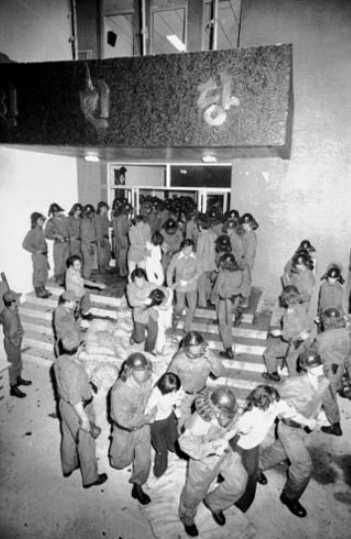
Photo of YH Workers being led away by riot police. Source: Korea JoongAng Daily
The impact of police repression and the government’s response to the YH Incident had a monumental effect on South Korean politics. The brutality of the police response against sitting lawmakers and, above all, female employees shocked the country and was popularly seen as representing a new low in authoritarian politics. Some NDP politicians continued their own sit-in protests as a result of the Park government’s response. The ruling party also launched a series of attacks on Kim Young Sam for his involvement in the YH Incident, eventually leading to his expulsion from the National Assembly. Kim called for a ‘total resistance to the Park regime’ campaign, appealing to the population to overthrow the Yushin Constitution (Sohn 1991, 161). This political crisis culminated in mass riots in Pusan-Masan (16-20 October 1979, Pu-Ma hangjaeng) and the most severe outbreak of social disorder since the protest movement against the 1965 normalization of relations between Korea and Japan (Pratt and Rutt 1999, 231). These mass disturbances in Park Chung Hee’s home province provoked severe disagreements within the regime, eventually culminating in the dictator’s assassination.
The YH Incident was one of a series of disputes that was dominated and led by female workers, including the Pangnim Textile Company, the Tongil Textiles and Ch’ŏnggyech’ŏn Textile Factory disputes (Sohn 1991, 132; KHRA 2005, 322; Ogle 1990, 80-89). Women like Chŏn T’ae-il’s mother, Yi So-sŏn, also played significant leadership roles in the struggle to improve working conditions. More than anything else, the YH Incident was a nail in the coffin of the Park Chung Hee government. For this reason, it represents a critical moment not only in the history of female participation in democratic development but also in South Korean history.
-------------------------------------------------..
Andrew David Jackson ©
Please do not reproduce without permission.
References
- Hisako, Naitou. 2015. “Korean Forced Labor in Japan’s Wartime Empire.” In Asian Labor in the Wartime Japanese Empire: Unknown Histories, edited by Paul H. Kratoska, 90-98. New York: Routledge.
- KHRA (Korean Historical Research Association). 2005. A History of Korea. Translated by Joshua Van Lieu. London: Saffron.
- Ogle, George. E. 1990. South Korea: Dissent within the Economic Miracle. London: Zed Books.
- Park, Yongjin. 2018. Modern Korean Economy, 1948-2008. Understanding Korea No. 8. Songnam-si, Gyeonggi-do: The Academy of Korean Studies.
- Pratt, Keith and Richard Rutt. 1999. Korea: A Historical and Cultural Dictionary. Richmond: Curzon.
- Sohn, Hak-kyu. 1991 (1989). Authoritarianism and Opposition in South Korea. London: Routledge
- Son Kook-Hee and Sarah Kim. 2015. ‘Factory Workers Lose a Champion.’ Korea JoongAng Daily, 23 November. Accessed 23 July 2024, https://koreajoongangdaily.joins.com/2015/11/23/politics/Factory-workers-lose-a-champion/3011918.html