
#2 - 3.1 Movement
Published on March 7, 2022
3.1 (Samil undong) The March First Movement
The creation of a Korean national spirit before the formation of an independent Korean state.
In the morning of March 1, 1919, a 29 strong group of prominent Koreans assembled at the T’aehwagwan restaurant in central Seoul to read out a declaration of independence. The statement which had been signed by 33 Koreans – 16 Christian leaders, 15 Ch’ŏndogyo members, and two Buddhists was inspired by US President Woodrow Wilson’s famous defence of national self-determination.1The statement was composed by Ch’oe Nam-sŏn and stressed the Korean people’s right to self-rule and release from the tyrannical rule of the Japanese colonial authorities which had governed the Korean Peninsula for the previous decade. But far from being a call to arms, the wording of the document stressed the need for non-violent activism to achieve Korean independence. The declaration even states that Koreans felt no particular ill-feeling towards the Japanese for their colonization of the peninsula. The signatories of the statement had intended the timing of their proclamation of their Declaration of independence to coincide with the funeral of King Kojong.2 However, security concerns as well as a fear of disrupting King Kojong’s funeral (which contradicted the non-violent aims of the text) led the signatories to move their proclamation to a more secluded location.
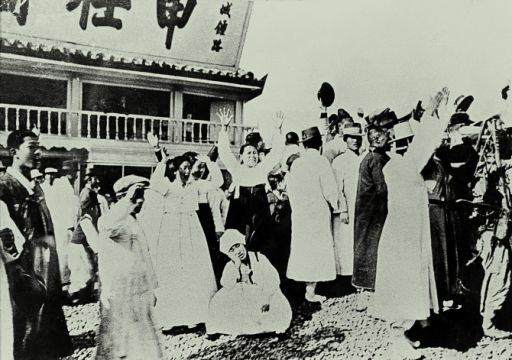
(Image Source: Cheonji Ilbo)
Later that afternoon, a teacher who happened to have a copy made the first openly public declaration of the proclamation to large crowds gathered to commemorate Kojong at Pagoda Park. The impact of the reading was immediate and incendiary. The enthusiastic crowds are said to have greeted the proclamation with cheers and songs, then they began marching through central Seoul. Gatherings of Koreans protesting Japanese rule soon spread the length of the peninsula. Estimates of numbers in the 667 reported peaceful demonstrations ranging from between half a million and a million participants. Violence, often led by more radical elements, particularly students broke out at many events. The Japanese colonial state administrators saw patriotic manifestations of Korean nationhood as direct challenges on their authority, and their response was vicious with military reinforcements drafted in from the Japanese archipelago. Official Japanese estimates claim 550 deaths, 1400 injuries, and 14,000 arrests as a result of the unrest. Korean nationalist historians calculate as many as 7000 deaths. Whatever the number, the outbreak of popular patriotic fervor and the fact that order was not fully restored until May 1919 was evidence of the level of widespread dissatisfaction with colonial rule.
Although the colonial authorities’ brutal response had seemingly derailed the momentum of Korean independence movement, theirs was a pyrrhic victory. The March First Movement as it came to be known in the years after colonial rule had finished, succeeded in unifying diverse sections of society in their opposition to Japanese domination. There had been small groups of nationalists both in Japanese occupied Korea and in exile, March 1, 1919 saw the emergence of a genuinely nationwide movement resisting Japanese rule. For the first time, groups that had never engaged in political activity to such an extent – women, peasants, and provincial town dwellers played leading roles in the demands for Korean liberation. This unity is significant for many Korean historians, who see the March First Movement as the moment a widespread sense of a national Korean consciousness was born. The March First Movement also forced the colonial authorities into a volte-face in terms of their political rule. Following the 1919 unrest the colonial authorities introduced the Cultural Policy (bunka seiji), which saw the relaxation of a great deal of the repressive military rule, the removal of some unpopular and discriminatory laws. The period also witnessed the growth of domestic cultural groups which in turn led to the cultivation of greater nationalist sentiment amongst Koreans. Throughout the 1920s, the Japanese colonial administration still ruled but brute force was replaced with co-optation. The March First Movement was also a huge public relations disaster for Japanese Imperialism. Foreign Christian missionaries, as they would in later decades, brought the truth of the authorities’ repression to those in other nations willing to listen. The lie of the Japanese colonialist claims of a mission civilatrice to Korea was exposed for all the world to see. Gradually, overseas governments began to treat more seriously some of those Korean independence campaigners which like many other Asian nationalist groups had unsuccessfully attempted to gain access to the Versailles Peace Conference to set out their case for a Korean state.
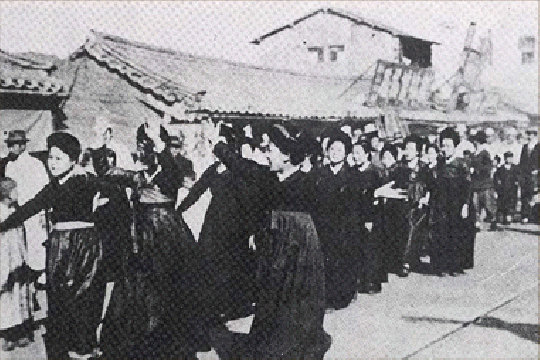
(Image Source: namuwiki)
The March First Movement has never been forgotten in South Korea and as with other colonizer-colonized histories, it is never recalled in Japan. South Koreans still engage in re-enactments of the events of March 1, 1919 annually in Seoul. The events that followed March 1, 1919 also left a legacy that has impacted the course of Korean history up to the present day. The March First Movement brought to the fore a form of political activism – the mass demonstration – that has become highly valued especially I n the South at moments when the general population feels alienated from political elites. Another vitally important feature of the March First Movement was the involvement of students and Christian church groups in the campaign for Korean independence. Students and Christian churches would emerge in the post-liberation South Korea as increasingly powerful popular voices in the campaign for greater democratic representation in government and greater equality in society. School students in particular played a key role in the next significant event of Korean history we consider – 4.19 or the April 19, 1960 Uprising.
Andrew David Jackson ©
Please do not reproduce without permission.
1 4 of the provincial signatories had been unable to attend the proclamation
2 One of the last monarchs of Korea’s Chosŏn (1392-1910) dynasty who had ruled between 1864 and 1907.