
#3 – 3.31 The Arrest of Park Geun-hye
Published on March 19, 2023
How a whistle-blower and people-power swiftly toppled a South Korean president
On March 31, 2017 South Korea’s President Park Geun-hye, daughter of the country’s well-known and longest-serving President Park Chung-hee (1961-1979), was arrested on a slew of corruption charges relating to bribery, extortion, and the leaking of classified information. The arrest capped a chaotic six-month period that had witnessed the impeachment and removal of the country’s first female leader amidst the largest protests since the democracy movement in the 1980s while exposing a series of extraordinary national scandals and laying bare the corrupt underbelly of Korean politics. On the other hand, the swift resolution of the scandal demonstrated the maturity of Korean democracy through the peaceful removal of a corrupt leader and the orderly transition to new leadership through a run-off election, as well as the potency of Korean popular sentiment and its sensitivity to the behaviour of its leadership.
The events that led up to Park’s arrest on March 31 and eventual imprisonment were dubbed the “Choi Soon-sil scandal” after the former president’s friend and advisor of the same name. Choi was the daughter of Choi Tae-min, the leader and founder of the obscure Church of Eternal Life, a pseudo-religious sect many consider a cult with elements of Buddhism, Christianity, and shamanism. Following the death of Park Geun-hye’s mother in 1974 by an assassin’s bullet meant for the President, Choi Tae-min contacted Park and claimed her mother had appeared to him in a dream and asked him to look after her in her mother’s absence. Park, who was serving as the First Lady in her mother’s stead, placed her faith in Choi, who then manipulated this trust and leveraged their relationship to funnel millions in government funds to family members and cronies through nominally patriotic organizations. Kim Jae-gyu, the Korean Central Intelligence Director who assassinated President Park Chung-hee in 1979, partially justified his actions based on the failure of the president to prevent the negative influence of Choi on his daughter and the nation.
Following her father’s assassination, Park Geun-hye disappeared from the public eye, but the nefarious influence of the Choi family continued in the personage of Choi Soon-sil, who remained a close confidant. Park returned to politics in the late 1990s, accompanied by the shadowy influence of Choi, who has been described, like her father, as a Rasputin-like figure who manipulated the levers of power from the shadows. When Park was elected president in 2012, Choi unleashed brazen forms of corruption, extortion, and influence peddling, eventually ensnaring members of the country’s top conglomerates such as Samsung. Such activities continued for years during the Park administration until a national scandal broke in late 2016 from unexpected quarters.
In August of 2016 thousands of students at Ewha Woman’s University, one of South Korea’s most prestigious institutions, gathered to protest actions taken by the university president Choi Kyung-hee, including unpopular scaling down of scholarships and curriculum restructuring. The university eventually withdrew these plans, but hundreds of students continued to stage a sit-in well into October to demand the resignation of the university president. 1600 riot police were called in to break up the sit-in, further enraging students and prompting an investigation by the ROK Parliament into university operations. The investigation uncovered more than anyone had anticipated: a connection between the university and Choi Soon-sil’s daughter. It was revealed that Choi’s daughter Chung Yoo-ra had been admitted to the university on a dubious, specially created equestrian scholarship, and had been granted a degree despite rarely attending classes, submitting sub-par work and relying on her mother’s intimidation of faculty to ensure good marks. The revelations struck a nerve in a country known for fierce competition in university admissions and growing anger over perceived favouritism in higher education.
Meanwhile, another front was opening on Choi Soon-sil from within her inner circle. Ko Young-tae, a former professional fencer-turned-designer who managed an upstart bag manufacturing company Villomillo, caught the eye of Choi, who decided to outfit the president’s wardrobe with his designer merchandise starting in 2012. This began a close relationship between the two, which reportedly soured in 2014 over an incident involving a puppy. Choi left the animal in the care of Ko who, but instead of staying to look after the puppy went to play a round of golf. When Choi returned and discovered the negligence, she flew into a rage and vilified Ko, an incident which reportedly changed their relationship and motivated Ko to exact revenge. Ko began to gather evidence of nefarious ties between Choi and the Park administration, revealing to news sources that two foundations set up by Choi to receive “donations,” Mir and K-sports, were being used to extort business conglomerates in exchange for favourable government treatment. Ko also reported that one of Choi’s favourite hobbies was “editing Park presidential speeches,” raising concerns over the level of access someone with no official government clearance had to sensitive state secrets. A non-encrypted tablet was recovered from Choi’s office that contained drafts of 44 speeches and statements given by the president from 2012-2014, with edits marked in red.
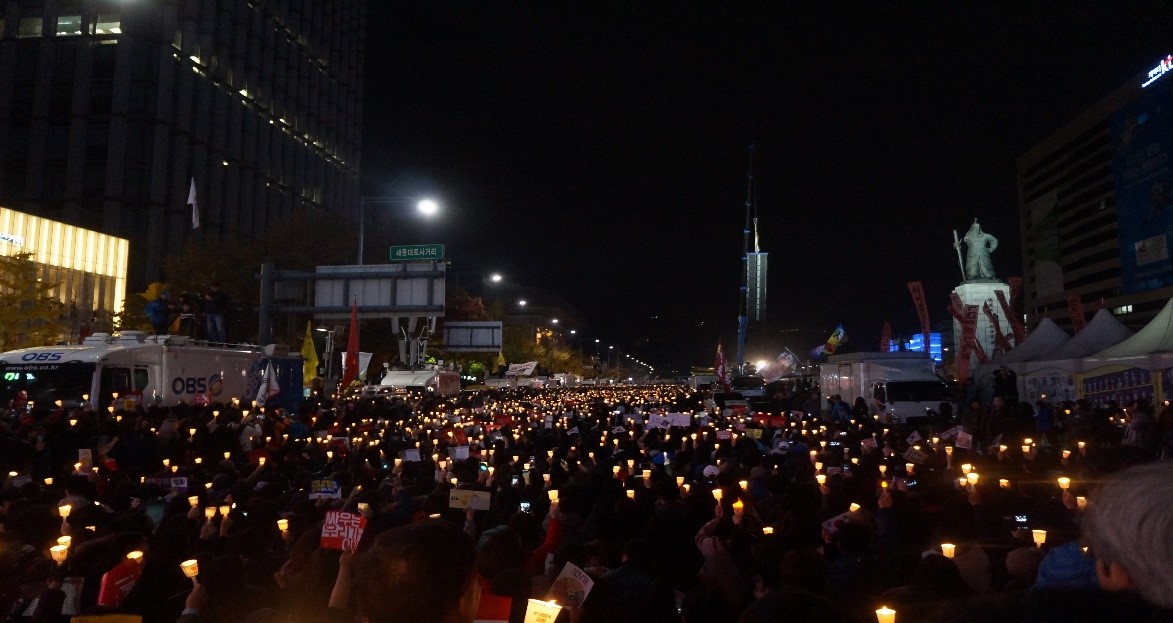
Mass gathering at Kwanghwamun, Seoul on October 14, 2016, one of weekly protests that fall and the first to top an estimated 1 million participants. On the right is the iconic statue of Admiral Yi Sunsin, defender of Korea against the Japanese in the 16th century and national hero. (Courtesy Daniel Pieper)
The story broke on October 24, 2016, and Choi was taken into custody shortly after. President Park made repeated public apologies, and her approval ratings plummeted to single digits. Her presidency would never recover. Weekly protests were staged in Kwanghwamun Square in downtown Seoul from October, culminating some days in crowds topping one million. Protest songs with guitar accompaniment and shouts of “haya haera” (step down!) pierced the crisp autumn air as massive crowds peacefully called for the president’s resignation in an atmosphere that felt indignant yet expectant. Along with the president’s removal, protestors revisited a controversy that had been brewing since 2015: the Sewol Ferry disaster, and the administration’s botched response, explored in another post here. Many questions still remained about the disaster, particularly the infamous “seven hours” during which the president’s whereabouts had still not been satisfactorily accounted for, fuelling rampant rumour and speculation ranging from incapacitation due to plastic surgery to sordid affairs with a presidential aide. The most recent revelations had for many confirmed the incompetence and corruption of the Park administration and its insensitivity to the Korean people.
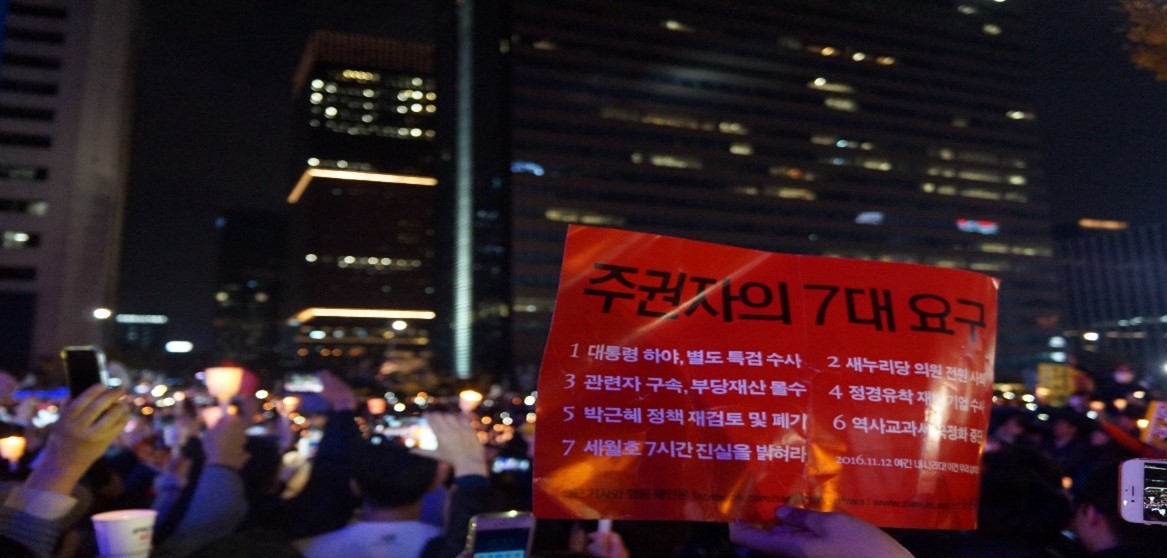
A protestor at a mass rally in Kwanghwamun, Seoul on October 14, 2016 holding a list of demands, including the resignation of President Park and a special investigation, a re-evaluation of all administration policies, and the truth behind Park’s whereabouts during the Sewol Disaster. (Courtesy Daniel Pieper)
On December 9, 2016, impeachment of the president, which by that time was heavily favoured by the public, was voted on by the South Korean National Assembly. The 300-member body voted 234 to 56 in favour of impeachment, with many members of her own party crossing party lines. The president’s powers and duties were then stripped while the Constitutional Court of Korea considered the validity of impeachment. The court focussed on the whereabouts of Park during the sinking of the Sewol Ferry, as well as collusion between Park and Choi to extort money from business leaders and the blacklisting of more than 9000 artists, authors, and other members of the entertainment industry from receiving government assistance based on supposed ideological stances. On March 10, 2017 the generally conservative court unanimously upheld the impeachment, marking the first time since the creation of the Sixth Republic in 1987 that a president had been so removed from office. Three weeks later the president was arrested, and at sentencing the following April, Park received a 24-year prison term, later increased to 25 years. In December 2021 Park was pardoned in the interest of “overcoming unfortunate past history, promoting people’s unity and joining hands for the future” by President Moon Jae-in, the left-leaning candidate whom she had bested in the 2012 presidential race.
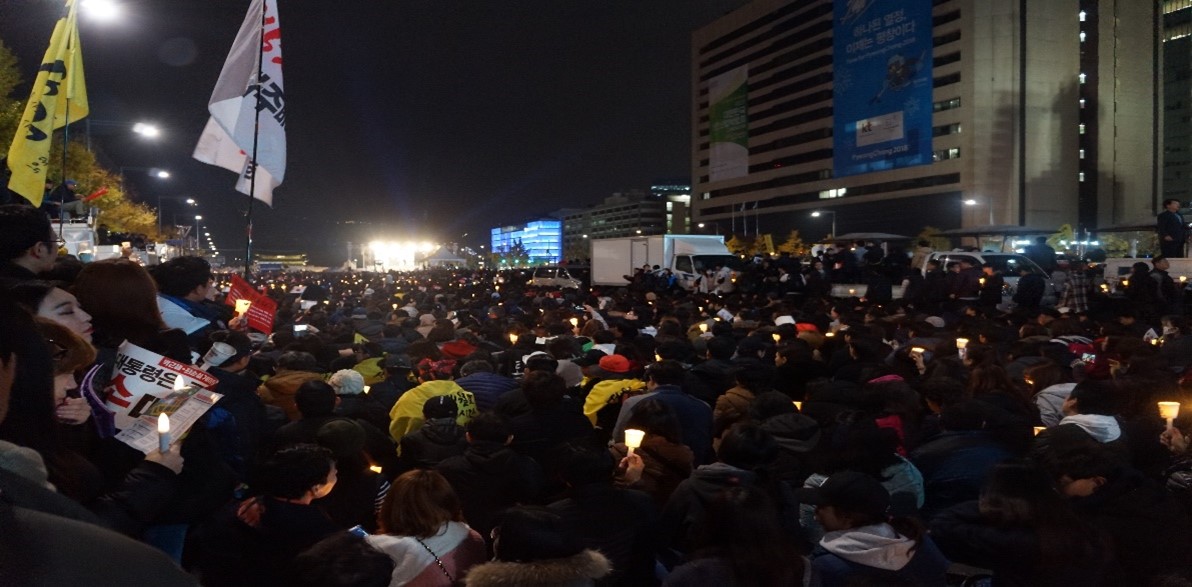
Protestors at a mass rally in Kwanghwamun, Seoul, October 14, 2016. (Courtesy Daniel Pieper)
For six months in 2016-2017 the Choi Soon-sil scandal rocked the foundations of the ROK and brought to light the best and the worst of Korean politics and society. On the one hand, familiar tales of corruption from the dictatorship years one again resurfaced, including government and industry collusion, ideological witch hunts, abuses of power, and abject favouritism. The refrain had become so entrenched in Korean politics that nearly every leader since the nation’s inception had been imprisoned after their tenure in connection with one or more bribery scandals. On the other hand, the imprisoning of such powerful individuals also suggests the proper functioning of the rule of law, that the levers of power are responsive to the will of the people. Memories of Korea’s violent road to democracy just a generation earlier and media concerns during the height of the protests over a violent government crackdown did not materialize; rather, conscientious citizens peacefully expressed disdain for the actions of their government, and the proper institutions responded and faithfully executed their assigned roles swiftly and efficiently. Ultimately, the result of the scandal left a more resilient and robust democratic institution in the Republic of Korea.
-------------------------------------------------..
© Daniel Pieper
Please do not reproduce without permission.