
#6 - Signing of the Treaty of Shimonoseki
Published on April 16, 2024
4.17 A centuries-old relationship ends, and a new empire begins.
On April 17, 1895 after four weeks of negotiation, the Treaty of Shimonoseki (Ch: Treaty of Maguan) was signed between Meiji Japan and Qing China, bringing to a close the Sino-Japanese War that had raged since July 1894, cementing Japan as the victor, and subverting the traditional power hierarchy in East Asia. A highly punitive and humiliating treaty for China, it stipulated the payment of over 200 million taels of silver to Japan and promised a wealth of economic opportunities and extraterritorial rights. The treaty also stipulated that China cede the Liaodong peninsula, the Pescadores Islands, and Taiwan to Japan, formally launching the country into the ranks of the colonial powers.
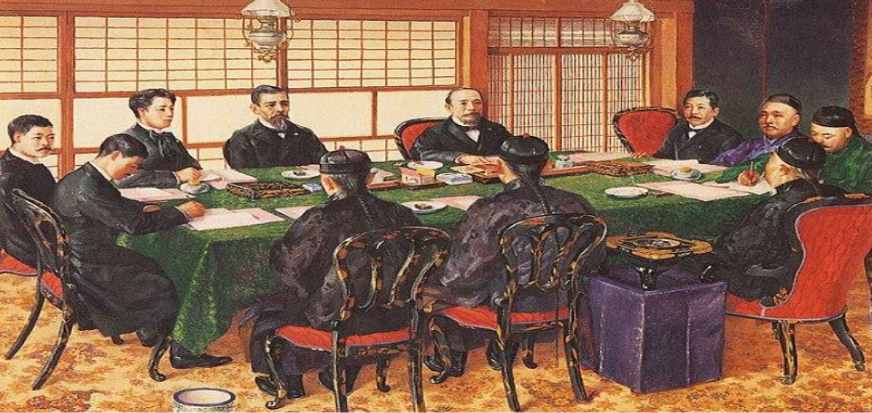 Peace Conference at Shimonoseki by Nagatochi Hideta (1929). Image source: Wikimedia.
Perhaps the most momentous stipulation of the treaty however concerned Korea: the treaty officially granted the “freedom” of Chosŏn Korea by formally ending its tributary relationship with China, an arrangement that had existed with various Chinese dynasties dating back to Korea’s Three Kingdoms Period in the fourth through sixth centuries. The tributary system was China’s main method of dealing diplomatically with the various peoples on its periphery, and throughout much of its history Korea was known as the model tributary state, a badge of honour for Korean elites who fancied their country as exemplars of the height of known civilization. As part of the tributary relationship, foreign states were granted permission to establish trade, diplomatic, and cultural contacts with China. In exchange, representatives of the state were expected to send periodical tribute missions to the capital bearing stipulated rare local products or precious goods and symbolically demonstrate their suzerainty and subservience to the Chinese Emperor. These tribute missions proved to be lucrative forums for all government officials involved, crucial avenues for the transmission of texts, and an invaluable forum for intellectual and religious exchange. This relationship also constituted a security agreement: in exchange for fealty, China pledged to protect the suzerain nation against hostile neighbours, as Ming China did when Japan launched a full-scale invasion of Chosŏn Korea in 1592.
The tributary relationship lacked a close parallel in the Western tradition, and there was some misunderstanding about the exact nature of the relationship among Western observers in the late 19th century. The relationship did not denote any sort of colonialism according to the Western standard, nor did it involve complete “independence,” for example to freely enter into diplomatic or security arrangements with other countries without China’s permission. However, what became clear during the course of the Sino-Japanese War that ended the tributary relationship was Japan’s deft manipulation of the language of Western diplomacy to claim that it was fighting for the sake of a free Korea, independent of Chinese tyranny. Many reform-minded Korean elites impressed by Japan’s progress toward modernization took these overtures at face value, and supported calls for “Pan-Asianism” that placed Japan at the pinnacle of a new East Asian order. In the pre-colonial era when Japan’s true intentions were still opaque, the Asian nation’s demonstrated ability to assimilate the best of the West in service of East Asian advancement was a compelling argument, especially after Qing fell in decisive and humiliating defeat.
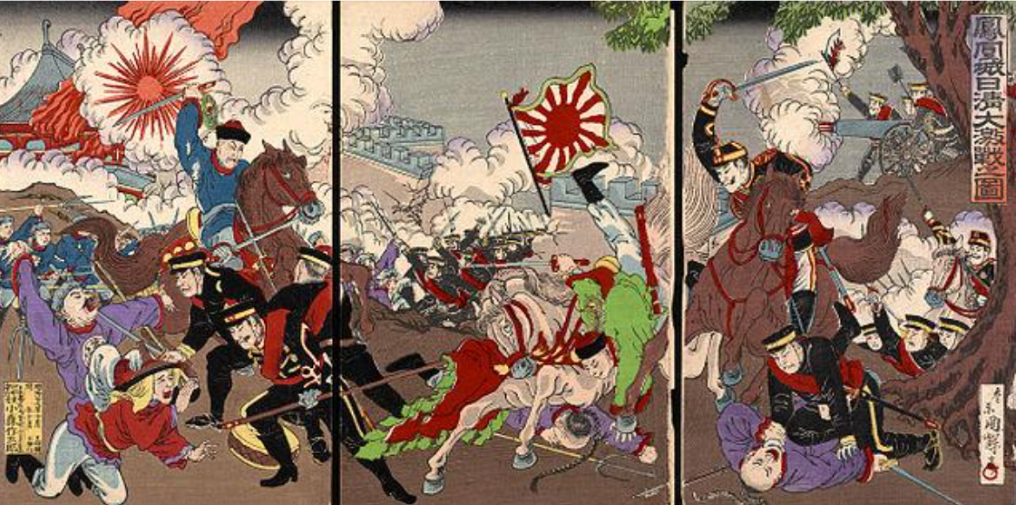 Great Sino-Japanese battle at Fenghuangcheng, October 1894. Image source: Wikimedia
The war itself came about when Chosŏn Korea called upon its traditional security guarantor China to help quell a peasant uprising in the hinterland (later known as the Tonghak Uprising). Japan however, unbeknownst to Korea, sent its own contingent of troops, and when Japan refused to stand down, war ensued. Japan used the opportunity to install a pro-Japanese cabinet in the Chosŏn government and push for reforms amenable to its interests in the country. After Japan handily defeated outgunned Qing forces the next year, and ten years later emerged victorious in the Russo-Japanese War of 1905, Japan paved the way for pacification and colonization of the country. The Treaty of Shimonoseki was thus a turning point in Korean history, altering the power dynamic in East Asia that had stood for thousands of years and opening the door to Korea’s eventual colonization.
-------------------------------------------------..
Daniel Pieper ©
Please do not reproduce without permission.