
#7 - 4.19 The April Revolution
Published on April 15, 2022
Years before BTS and K-pop, Korea’s first youthful revolution.
South Korean teens took on the state – and won – ushering in a brief flowering of democracy!
For many years the most recognizable South Korean to people outside the Peninsula was the nationalist politician Syngman Rhee (Yi Sŭng-man). One of the founders of the Independence Club that struggled for Korean autonomy during the era of high imperialism, Rhee was imprisoned for his beliefs, but armed with a Princeton Ph.D. he returned to Korea after Liberation from Japanese colonialism and became the first President of the nascent Republic of Korea (South Korea) in 1948. While he is or was well-known outside the Peninsula, apart from a brief attempt at a historical reevaluation of his legacy by right-wing historians a decade ago, Rhee is seldom recalled by your average Korean, and there are some good reasons for this.

Figure 1: Middle school students protesting against Syngman Rhee’s rule; note the youthfulness of the demonstrators.
An extremely erudite and learned man, Rhee had an excellent command of English and campaigned tirelessly for the Korean cause in Washington during the latter years of the Japanese colonial period (1910-1945). These were some of the qualities that led U.S. Government officials to facilitate his passage back to a post-Liberation Korea to become the most powerful politician in the South. If the Americans thought that Rhee would be “their man” in recognition of their largess, they would be frustrated. Rhee was fiercely independent, bad-tempered, and exceptionally difficult to deal with. The US Secretary of State John Foster Dulles called him a “master of evasion,” President Dwight D. Eisenhower said he was a “blackmailer,” John Muccio, the US Ambassador to a post-Korean War South Korea wrote of the difficulty of dealing with Rhee when he was having one of his “frothing fits” of rage. As President of a newly created, pro-American state in the South, Rhee’s rule was characterized by painfully slow economic growth, rampant financial corruption, and political nepotism. Political opposition was ruthlessly suppressed. And as the Podo League Massacres demonstrate, Rhee’s violence against opponents – both real and imagined – was often arbitrary. What made Rhee even more unpopular was his reinvigoration of hated colonial-era institutions, especially the national police force that had been popularly viewed as the main tool of Japanese repression. Already 73 when he took office, Rhee grew increasingly out of touch with popular feelings as his presidency progressed.
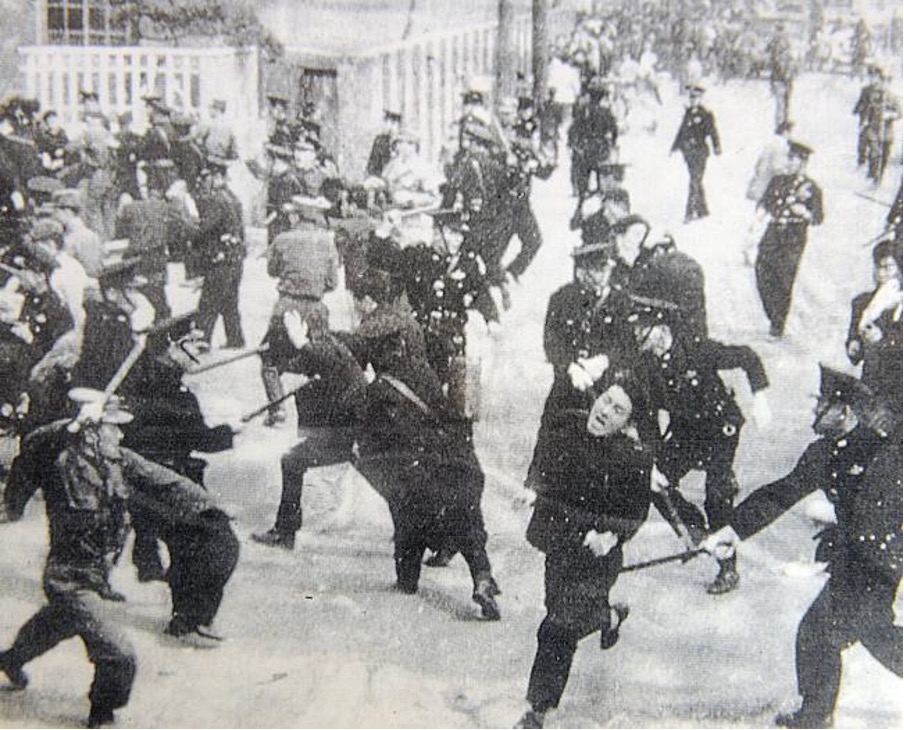
Figure 2: High school students clash with police in 1960; both sides wear their colonial-era black uniforms (Korea Herald)
So, it was that the outrageously rigged Presidential elections of 1960 brought a dramatic response from the youth of South Korea (see figure 1). The post-liberation period witnessed a dramatic expansion of education. One of the South Korean state’s early accomplishments was the mandating of compulsory education for six years of primary school. This led to a dramatic increase in literacy, greater interest in print media to supply news, and massive demand for higher-level education. Smaller colonial-era colleges and missionary-run educational institutions were transformed into the major universities of Seoul National University, Yonsei, Ewha Women’s University, Sogang, and Korea University. These elite institutions together with other small colleges clustered around Seoul accounted for almost three-quarters of the 100,000 university students nationwide by 1960. Some scholars have put this explosion in education down to the influence of Syngman Rhee while he was in power. While this may be true, what is certain is that this increase in the number of educated, literate, idealistic, and more politically conscious young people also created vocal critics of Syngman Rhee’s gerontocracy. Large numbers of college-level students in the capital close to the seat of government combined with even greater numbers of high school students nationwide represented a formidable opposition to Rhee’s rule.
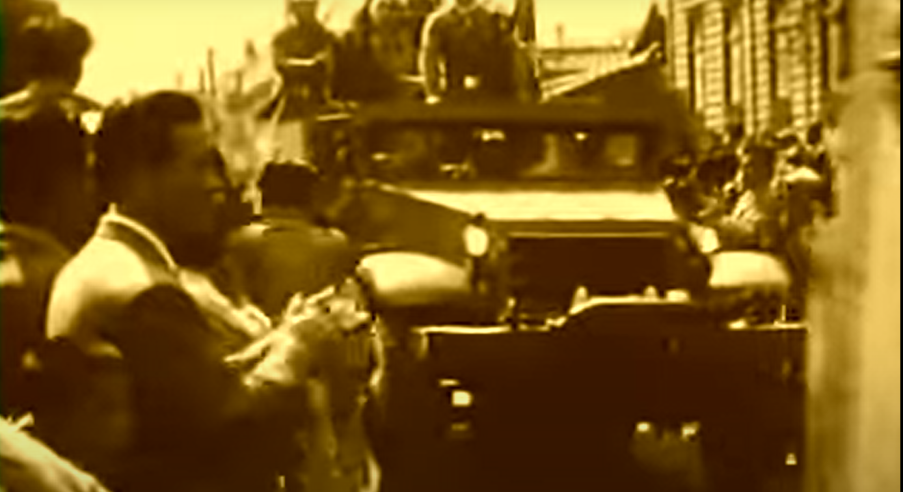
Figure 3: Demonstrators applaud the army which refused to crush the dissent (screenshot)
Rumours of massively rigged elections sparked anti-government demonstrations but the crucial spark that transformed urban unrest into revolution came in a small port city in the southern part of the peninsula. Many observers traditionally assume the most rebellious part of Korea to be Chŏlla Province, and they associate Kyŏngsang Province with the conservative politics of the Park Chung-hee and Chun Doo Hwan administrations. However, historically, Pusan-Masan in Kyŏngsang Province has been the hotbed of radicalism and political protest. So it proved in 1960. Demonstrations in Masan led by middle and high school students led to violent confrontations with police and right-wing thugs hired by the Rhee regime to break strikes and crush protests. The discovery in Masan Harbour of the corpse of high school student Kim Chu-yŏl with a tear gas canister embedded in his eye socket resulted in a wave of public revulsion. Overnight the size of demonstrations doubled. During one protest on April 19, over 100,000 university and high school students clashed with police who shot live rounds killing over 100 dead in the street (see figure 2). Faced with such brutality, day by day the size of the demonstrations increased, the disorder worsened, and with the police and Rhee’s thugs unable to keep order, the President called in the army to crush dissent. As the Bolshevik Trotsky once argued: the fate of every revolution depends not upon the level of revolutionary ferment but upon the loyalty of the state’s armed forces. In this case, the Republic of Korean armed forces sided with the youth and refused to intervene. There was another crucial intervention that determined the outcome of the revolution. The US Ambassador Muccio urged Rhee to call it a day and give in to the will of the people. Without the support of either the army or the regime’s main international backers the USA, Rhee fled into exile in Hawaii with his Austrian wife Francesca. He died there five years later.
A new government was formed under Chang Myŏn and the constitution changed to prevent the type of political abuses which had characterized Rhee’s rule. Young people had defeated the older generations ushering in a brief flowering of democratic rule. The April 19, 1960 Revolution or 4.19 (sa-il-ku) as it has come to be known is significant because it represented a reversal of Korean cultural norms, a victory of youth and idealism over age and experience. This would not be the last example of such rebelliousness in South Korea’s compressed twentieth-century experience. There are also evident parallels between 4.19 and later historical upheavals like the 5.18 Kwangju Democratization Movement (Kwangju Uprising) and the June 1987 Uprising. Kim Chu-yŏl died in a similar manner to a student demonstrator Yi Han-yŏl during the 1987 June Uprising that brought down the military dictatorship. Kim and Yi became potent symbols of the struggle for democracy and their deaths catalyzed the protests. 4.19 also saw the emergence of two powerful institutions that would dominate South Korean economics and politics over the next three decades: students and the army. These two opposing forces would go on to clash frequently, most seriously in 1980 at Kwangju, which proved to be another crucial turning point in Korean history.
Watch a KBS history of 4.19 (in Korean): here.
Listen to Andy Jackson's interview about the 4.19 Revolution with Morning Wave in Busan radio station here.
-----------------------------------------
Andrew David Jackson ©
Please do not reproduce without permission.