
#8 - The Last Civil Service Examination is Held
Published on April 15, 2024
5.5 1894 The Last Civil Service Examination is Held
On May 5, 1894 the following entry appears in the Annals of the Chosŏn Dynasty (Sillok): “The tri-annual palace examination was held today at Ch’undang Pavilion. Sin Chongik and fifty-eight other civil officials along with Sin Yŏnggyun and 1,146 military officials were selected.” The brevity of the entry belies the momentousness of the occasion: this was to be the final instalment of the civil service examination (kwagŏ sihŏm), a Korean institution that had stood on a permanent basis since the Koryŏ Dynasty in 958AD, determining wealth and status and shaping the intellectual contours of Korea throughout much of the country’s history.
Records of the time do not seem to suggest that those administering or taking part in the examination realised that this would be the final occasion, although reform in all areas of society had become one of the watchwords of the Chosŏn government by 1894. Just two months after the palace exam the first round of the so-called Kapo Reforms would begin to usher in revolutionary changes in Korean society, including the manumission of slaves, the abrogation of the class system, and elevation of han’gŭl to official status, among many other changes. On July 12, “Regulations for Selection” (sŏn’gŏ chorye) were issued, effectively replacing the traditional system for selecting government officials with modern criteria and closing the curtain on a fixture of traditional Korean society that had lasted nearly a millennium. Among the scholars who sat for the last examination were such luminaries as the future independence fighter Yi Sangsŏl, who later served on the clandestine delegation to the Hague in 1907 seeking Chosŏn independence, and the future first president of the Republic of Korea Syngman Rhee. Their presence reflected the transitional nature of the civil service examination at this juncture in Korean history; even reform-minded scholar officials were ensconced in the traditional education system and were still invested in examination success and the traditional learning it embodied.
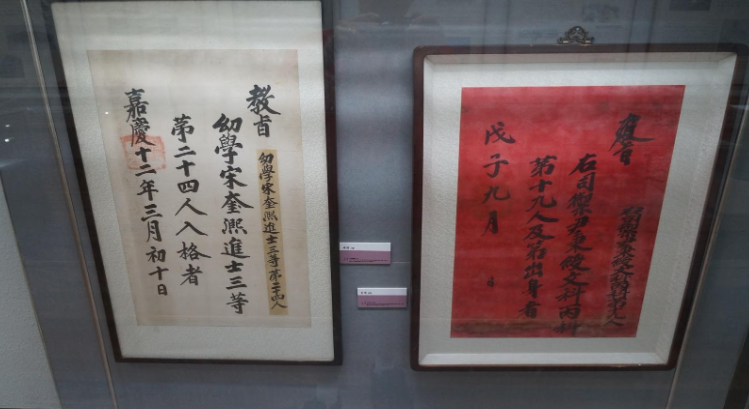 (The White Diploma (Paekp’ae) and Red Diploma (Hongp’ae) awarded to passers of the lower-level and higher-level examinations, respectively. Photo courtesy of Daniel Pieper.)
Many observers noted the significance of the exam’s abrogation. The Protestant missionary James Scarth Gale, one of the pioneers of Korean Studies in the West who spent nearly forty years in the country, reflected on the effects of the exam three decades later when he wrote, “In the year 1894 the proclamation of new legislation abrogated the past, and along with it a long tradition of ancient research was discontinued. Confucianism died overnight, and a ship called nation was set adrift, the anchor of its deep history being left behind. The winds of destiny which had been blowing for the past 28 years seemed to blow Korea far from its historic moorings. Therefore, today we can say that Korea has been blown far out to sea and not returned. The old has disappeared, but the new has yet to arrive. Japanese concepts, Western ideas, ideologies of a new world—as yet not clearly defined, are crashing and colliding in midair like wireless telegraphs.”
Though a slightly hyperbolic account, Gale’s claim that Confucianism had “died overnight” was understandable. The examinations were the foundation of Confucian learning in Korean society and legitimised a whole regime of education that helped to mould Korea into arguably the most Confucian nation in the world. The Korean examination system was modelled on that of Tang China and was divided into the following sections: 1) Chesulkwa (製述科), which emphasized skill in literary composition, 2) Myŏnggyŏngkwa (明經科), which tested candidates’ knowledge of the Confucian Classics, and 3) chapkwa (雜科) or miscellaneous fields, designed for students of “medicine, law, mathematics, and geomancy.” As noted in the opening paragraph, a military examination was also held testing a variety of practical military skills but also, reflecting the deep significance of Confucian knowledge in Korean society, an oral examination testing knowledge of the Confucian canon. Foreign language proficiency was tested under the auspices of the chapkwa (miscellaneous) examination and training in Chinese (Hanhak), Mongolian (Monghak), Japanese (Waehak) and Jurchen (Yŏjinhak) was conducted in the Sayŏgwŏn (Bureau of Interpreters).
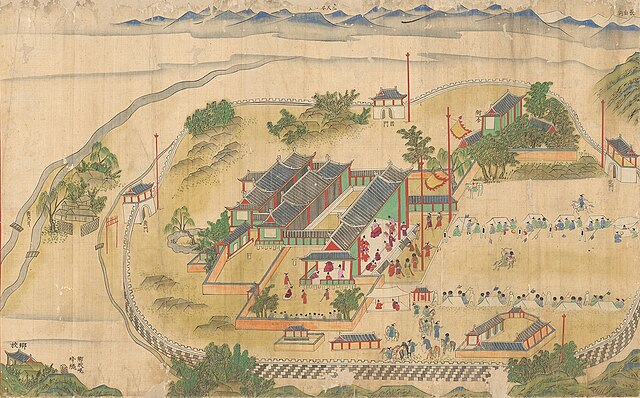 (Figure 2: Illustration of provincial civil service examination in Hamhŭng, South Hamgyŏng Province, date unknown. Image source: Wikipedia.
With the abrogation of the exams the Chosŏn government shifted its priorities. The military, which had usually been disparaged and underfunded throughout the Chosŏn Dynasty compared with civilian leadership, received renewed focus amid growing threats from abroad. Foreign language study was revamped and expanded to reflect a changing diplomatic universe: (Spoken) Chinese, Japanese, English, Russian, and other European languages. While curriculum directly testing knowledge of the Confucian Classics was discontinued, an undercurrent of Confucian themes and content can still be found in newly published Chosŏn government textbooks. The late nineteenth and early twentieth centuries was thus a period of transitional and hybrid education, where Confucian themes of deference to elders and leaders and the importance of social bonds were blended with knowledge from and about the West. Japan also found elements of Confucianism such as loyalty and social cohesion useful as they attempted to legitimise their colonial rule.
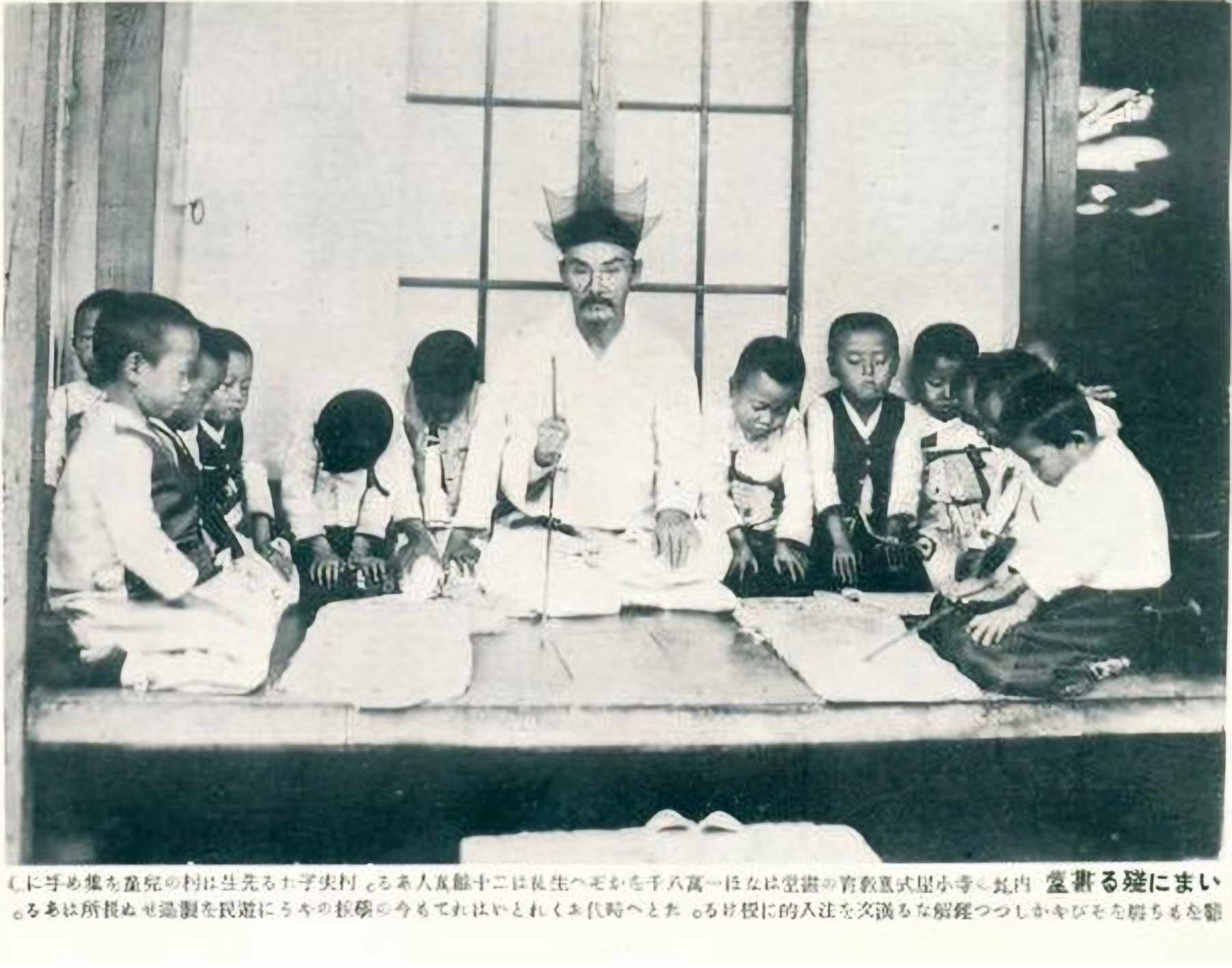 (Figure 3: Traditional Confucian school (sŏdang) during the colonial period, January 8, 1930. Image source: Wikipedia.)
Despite the abrupt end of the examinations, the language and education associated with such a long-established institution faded rather gradually. Enrolment in modern schools remained a fraction of the population until well into the colonial period, while traditional village Confucian schools (sŏdang), especially “reform sŏdang” teaching a blend of Confucianism and modern knowledge, continued to proliferate. Chinese characters (sinographs) continued to heavily populate written Korean, a legacy of centuries of Confucian learning, and the traditional medium of “Classical Chinese” continued to hold cache among the educated elite. Despite these legacies however, the abrogation of the Civil Service Examination was one of the most revolutionary changes in Korean history. Without the government imprimatur of personnel selection through examination, study of the classics was ultimately a labour of love, not a matter of employment, and subsequent generations of Korean students would cast their gaze toward a new curriculum and future.
-------------------------------------------------..
Daniel Pieper ©
Please do not reproduce without permission.
1 James Scarth Gale, “Korean Literature,” Christian Literature Society of Korea, 1923.