
#9 - 5.16 Park Jung-hee's Seizure of Power
Published on August 26, 2023
5.16 A Coup d’état that ushered in three decades of military dictatorship
In the early morning hours of May 16, 1961 just before dawn, military units mobilized on key locations in Seoul north of the Han River, the seat of power in the Republic of Korea. Encountering minimal resistance, by 4:15 AM the forces had occupied the three branches of government. Taking over the Korean Broadcasting Company headquarters shortly after, the shadowy coalition issued a revolutionary manifesto. This was the Korean public’s first glimpse at Park Jung-hee and the military government that would come to define Korean politics for the next three decades.
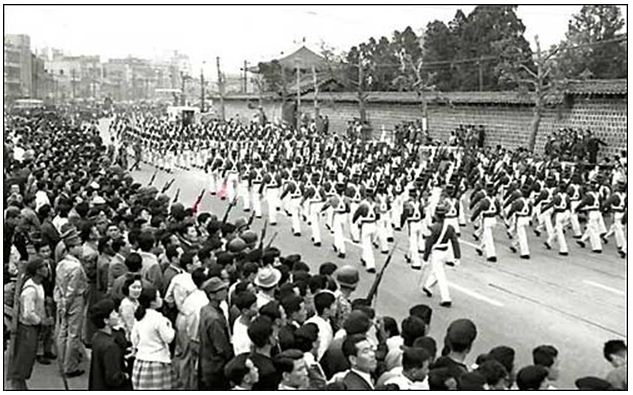
Figure 1: May 16th Coup. Source: 신안신문
Despite the swiftness with which the plot unfurled, the coup had been brewing for well over a year, and within military circles had become something of an open secret. The roots of the coup go back to the ROK’s first leader Syngman Rhee and his toppling the previous year. Rhee, a highly educated Korean independence activist and shrewd politician, had become increasingly authoritarian, intimidating political opponents, raising political funds through illegal means, and using the military to rig elections. The most blatant instance of election fraud occurred in the 1960 elections, when the aging and increasingly unpopular Rhee was reported to have won an improbable 88.7% of the vote. This led to massive protests that culminated on April 19 in 30,000 students marching toward the Blue House, after which security forces fired upon them, killing 139 and wounding hundreds more. Rhee was forced to step down in disgrace and lived his remaining years in exile in Hawaii. This series of events is known as the April Revolution, covered in another post here.
The Republic of Korea then transitioned to a parliamentary form of government, whereby the election of president shifted from popular vote to vote by National Assembly and the powers of the presidency were greatly reduced, shifting instead to the Prime Minister. The political rivals Chang Myŏn (1899-1966) and Yun Posŏn (1897-199) were then democratically elected as Prime Minister and President respectively, heading a government known as “The Second Republic” which was plagued by instability, public unrest, and indecisiveness and characterized by a weak executive and powerful legislature. The Second Republic was under constant pressure from competing interests including unions and the residual student movement that had toppled Rhee, and faced multiple crises including a high crime rate, runaway inflation, grinding poverty, and a lack of real economic growth. When certain radical political parties and student groups called for the withdrawal of foreign troops and a meeting with North Korean representatives in early 1961, more conservative elements felt that the country’s instability was becoming an invitation for the North to invade again.
In the fledgling Republic of Korea, the sprawling military was in many ways the most advanced and well-organized institution in the country. Moreover, because the institution had expanded so rapidly, to over 600,000 within just five years of its inception in 1948, a huge gap developed in the time required for promotion, with more high-ranking personnel in 1948 advancing much more rapidly than subsequent personnel, whose promotion was blocked by their superiors. It was these disaffected colonels and lieutenant colonels who formed the core members of the coup in 1961, harnessed and mobilized by Park Jung-hee and his associates. Park joined Japan’s Manchukuo Army in 1940 and after graduating in 1942 entered the third grade of the Japanese Military Academy in Tokyo. After Liberation, he entered the Korean Military Academy (KMA) and became a member of its second graduating class. Park then embarked on a turbulent military career, assigned to the US-Korean force that was to suppress the Yŏsu-Sunch’ŏn Rebellion of leftist elements within the military in October 1948 in response to the government’s decision to put down the Cheju Uprising.
Before reporting for duty however, he was arrested in connection with the South Korean Workers’ Party (of which he was a member), accused of providing arms to the insurgents and initially sentenced to death. However, at this and subsequent junctures in his career, Park was repeatedly helped by sympathetic superiors who recognized his capabilities and potential and vouched for his character. He demonstrated his commitment to anti-communism by informing on his erstwhile leftist comrades, and had his record cleared by Major General Paek Sŏnyŏp, a fellow graduate of a military academy in Manchuria. During the Korean War, like many of his generation he was rapidly promoted through the ranks, and by 1958 rose to the rank of major general, from where he planned and launched his coup.
Although Park had rose rapidly through the country’s military, in 1961 he was still a mid-ranking officer with a checkered past and questionable allegiances. There were still many challenges that mitigated against his rise to power: his coalition was heterogenous and fragmented, the “open secret” of the coup could have been derailed by competing interests in the military or government, the United States could have easily intervened at any point had they deemed the coup to be against their best interests, and the North may have exploited internal divisions to either oppose Park or affect a counter-coup toward more left-leaning leadership. However, Park was able to effectively harness the disaffection of the lower-ranking military personnel while initially co-opting and later neutralizing higher-ranking officers when his coup had become a fait accompli. Added to this was Park’s deft ability to utilize the modern apparatus of the Korean military for state-building and later the engine of economic advancement. According to one author, “For this professional but politicized military to seize power and lead society…there had to be a leader who could forge myriad military factions into a coalition and imbue it with a sense of purpose and destiny with his vision, charisma, strategic mind, and organizational capabilities. That leader was Park Chung Hee.” 1
After the coup on May 16 martial law was declared and the Prime Minister Chang Myŏn fled to a Catholic convent. Later Chang and President Yun Posŏn came out of hiding and vowed to cooperate with the junta to avoid bloodshed or instability that the North might exploit. The new military rulers then established the Supreme Council for National Reconstruction, which took firm control of the country, including the imposition of strict rule of law, and began laying the foundation for what would become known as the “Miracle on the Han River.” Today, the 1961 coup and its leader Park are controversial topics in South Korea. Although some Koreans point to the stability and economic prosperity brought about by the bloodless coup, and Park Jung-hee regularly tops the list of most popular leaders in the nation’s history, others criticize the trampling of human rights that the coup represented and resent the implication that stable economic development and democracy are mutually exclusive developments in Korea’s history. The election of Park’s daughter Park Geun-hye in 2013 buoyed by robust conservative support breathed new life into the “Park legacy” and a return to the halcyon days of miraculous economic growth; however, the president’s ignominious ouster in 2017 could mean the country is ready to turn the page.
-------------------------------------------------..
Daniel Pieper ©
Please do not reproduce without permission.
1 Yong-Sup Han, “The May Sixteenth Military Coup,” in The Park Chung Hee Era: The Transformation of South Korea, eds. Byung-Kook Kim and Ezra Vogel, 35-57 (Cambridge: Harvard University Press, 2011), 42.