
#16 - 8.15 Liberation Day
Published on September 3, 2022
8.15. A bittersweet victory: Liberation from Japan brings elation mixed with tragedy.
At noon on August 15, 1945, an unfamiliar voice rang out on short-wave radios across the Korean peninsula, a voice that very few had ever heard but from a figure who had nonetheless commanded unbridled patriotism among millions and directed the course of East Asian history. Known in Japanese as the “Jeweled Voice Broadcast” (Gyokuon hōsō) but in Korean simply as the Declaration of Surrender, Emperor Hirohito of Japan, addressing his people directly for the first time, officially acquiesced to the conditions put forth by the Allies in the Potsdam Declaration of July 26, 1945, though curiously excluded the words “unconditional surrender.” Due to the poor audio quality and the florid classical Japanese idiom in which the four-minute speech was delivered, most Koreans and even Japanese had difficulty understanding the content of the message, but the import eventually became clear: Japan had surrendered, and Korea’s 36-year nightmare of colonial rule had come to an end.
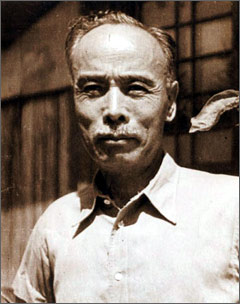
Figure 1: Yŏ Unhyŏng (1947). Image Source: Wikipedia

Earlier that morning in anticipation of the surrender, Japanese Secretary General of Political Affairs Endō Ryūsaku (遠藤柳作 1886-1963) and Korean independence activist Yŏ Unhyŏng (1886-1947), who would become a key figure in post-liberation politics, negotiated the following five points to ensure a peaceful transition of power: 1) Political prisoners throughout the peninsula would be immediately released, 2) a three-month supply of foodstuffs would be guaranteed for the city of Seoul, 3) there would be no interfering with political movements aimed at ensuring public peace and founding a new nation, 4) there would be no interfering with the organization and training of students and youths, and 5) there would be absolutely no interfering with the mobilizing of workers and farmers to the project of founding a new nation. This negotiation, conducted in secret before news of the surrender was made public, was key to ensuring a peaceful transfer of power. Despite the bitter memories of harsh wartime rule, strict rationing, forced labor for many, forced name changes and the banning of Korean language fresh in the collective psyche, Japan was able to withdraw in a relatively orderly fashion with minimal bloodshed or retribution. This was thanks in part to the discipline of Yŏ Unhyŏng’s Committee for Preparation of Korean Independence (Chosŏn kŏnkuk chunbi wiwŏnhoe) and People’s Committees that sprung up immediately upon liberation and oversaw the transfer of power at the local level before the Great Powers arrived on the peninsula. The early leadership of the center-left Yŏ Unhyŏng raised his profile among broad swaths of the political spectrum, and on September 6, 1945 the People’s Republic of Korea was proclaimed with Yŏ as its Vice Premier.
The United States and the Soviet Union, however, had other plans for the Korean peninsula. On August 8, 1945, two days after the first atomic bomb was dropped on Hiroshima but before the second bomb was dropped on Nagasaki and Japan surrendered, the Soviet Union declared war on Japan. In the days before August 15, Soviet troops were in heated battles with Japanese troops in the Russian Far East and rapidly advancing to the Korean peninsula. The United States, bogged down in island campaigns and fearing that the Soviets would reach Korea first and make the unification of the peninsula under communist rule a fait accompli, assigned two officers to define an American occupation zone on the peninsula. In the early morning hours of August 10, Dean Rusk and Charles Bonesteel, working on short notice with no input from Korean experts, drew an arbitrary line on the map dividing the Korean Peninsula at the 38th parallel and sent the proposal to the Soviets. The Soviet Union, perhaps not wanting to antagonize a country that had just demonstrated the most destructive weapon the world had ever seen, readily accepted. The Korean Peninsula, most of which had been politically unified for more than thirteen centuries, was arbitrarily torn asunder without the knowledge of its inhabitants.
To be fair, no one expected the division to be a permanent solution. However, as Bruce Cumings has shown, a series of strategic decisions taken by the Great Powers after August 15, 1945, placed increasing barriers between American-Soviet cooperation and deepened the division of the two spheres of influence which eventually hardened into separate regimes. For example, the United States’ refusal to recognize the People’s Republic of Korea and its Vice Premier Yŏ and the Soviets’ refusal to participate in UN-sanctioned elections were two key decisions that led the two Koreas inexorably toward permanent division. Moreover, the United States’ refusal to recognize the Peoples’ Committees that emerged across the peninsula at liberation paralleling the Soviet acquiescence to their authority in their occupation zone exacerbated left-right political tension and set the stage for the April 3, 1948 Cheju Uprising (Cheju 4.3 sakŏn) and Syngman Rhee’s consolidation of power, explored in another post.
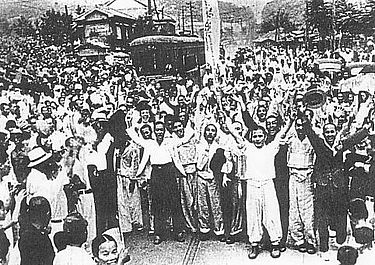
Figure 2: Korean citizens celebrating their liberation in 1945. Image source: Wikipedia.
Commemorated in South Korea as Kwangbokchŏl (The Day the Light Returned) and in North Korea as Choguk haebang ŭi nal (Fatherland Liberation Day), August 15 is remembered as one of the most important dates in the history of both countries. However, beyond an agreement on the importance of the date, the respective narratives surrounding the event in each country could not be more different. In South Korea, “Liberation Day” is somewhat tinged with regret and missed opportunities. Liberation after all was not achieved directly through the struggles of the Korean people, but “delivered” by the Great Powers, engendering in the words of the scholar Namhee Lee a “crisis of historical subjectivity” which pressed the Korean “minjung” (common people) to forge their own path toward becoming the agents of their own history. This manifested in subsequent democratization movements in 1960, 1980, and 1987, where South Korean citizens agitated to take the reins of their own history and become completely independent from foreign powers. The North Korean national narrative on the other hand claims that Kim Il Sung and his Manchuria-based guerilla forces single-handedly defeated Imperial Japan and delivered freedom to the entire Korean Peninsula, only to have that freedom crushed by the iron fist of American imperialism and South Korean puppet collaborators. Therefore, while Liberation Day represents for both countries victory over the common foe of Japanese colonialism, the Janus-faced nature of this event opened divergent narratives which charted opposing paths toward the common tragedy of the Korean War less than five years later. For one brief moment in 1945 however, the Korean Peninsula united in jubilation.
-------------------------------------------------..
Daniel Pieper ©
Please do not reproduce without permission.
References
1) Potsdam Declaration | The Bombing of Hiroshima and Nagasaki | Historical Documents (atomicarchive.com)
2) Bruce Cumings. The Origins of the Korean War. Princeton: Princeton University Press, 1981.
3) Namhee Lee. The Making of Minjung: Democracy and the Politics of Representation in South Korea. Ithaca: Cornell University Press, 2007.