
Multimodal Politeness in Korean and Beyond
Multimodal Politeness in Korean and Beyond
Introduction:
This is a collaborative, international and cross-disciplinary project that looks at the way that politeness is communicated in a multimodal fashion through speech acoustics, non-verbal behaviour, gesture and embodiment in Korean and other languages.
Participants:
- Lucien Brown, Monash University: https://research.monash.edu/en/persons/lucien-brown
- Kaori Idemaru, University of Oregon: https://eall.uoregon.edu/profile/idemaru/
- Bodo Winter, University of Birmingham: http://www.bodowinter.com
- Grace Oh, Konkuk University: https://chn.konkuk.ac.kr/jsp/Coll/coll_01_01_02_01_tab01.jsp
- Hyunji Kim, University of Oregon
Other collaborators:
- Sven Grawunder, Goethe University: http://www.phonetik.uni-frankfurt.de/staff/graw/
- Iris Hübscher, University of Zurich: https://irishuebscher.weebly.com
- Alex Paxton, University of Connecticut: https://alexandrapaxton.com
- Pilar Prieto, Universitat Pompeu Fabra: https://www.icrea.cat/Web/ScientificStaff/pilar-prieto-vives-227
- Sue Yoon, University of Hawaii
What is Politeness?
Politeness is a vital aspect of everyday life, and also a vibrant field of research in linguistics and related disciplines.
We follow Penelope Brown’s (2001: 11,620) broad definition that “politeness is essentially a matter of taking into account the feelings of others as to how they should be treated, including behaving in a manner that demonstrates appropriate concern for interactors’ social status and their social relationship.” In our research, we focus particularly on how interactors show sensitivity to power and social distance in the way that they modulate the sound of their voice and their use of nonverbal behaviors and gestures.
Why Multimodal Politeness?
Politeness research has blossomed into a vibrant field of study, spawning its own journal (Journal of Politeness Research, De Gruyter, first published in 2005), a wealth of research monographs and a number of textbooks). Additionally, there is an increasing number of publications on politeness within socio-phonetics and social psychology.
Until recently, one limitation was that the focus has tended to be on verbal language – polite verbs and expressions. However, a recent wave of interest in the nonverbal communication of politeness-related meanings has resulted in multimodality being recognized as an important growth area within politeness research. In the introduction to The Palgrave Handbook of (Im)politeness (Culpeper, Haugh and Kadar 2017), the authors note that “(im)politeness researchers are likely to increasingly shift their attention to multimodal aspects of (im)politeness” (p. 7).
Why Korean?
Korean is a language that has attracted considerable attention in politeness research, mainly due to the fact that is has a very highly developed system of verbal honorifics. In Korean, speakers attach different verb endings to every main verb depending on power and intimacy relations with the hearer (and sometimes with the person they are talking about as well). When you address a someone older than you and/or an adult stranger, every main verb will end in -yo or -supnita, whereas these endings are not needed for addressing a friend of similar age or when talking with children.
Overview of our work:
Our research project looks at how “doing deference” in Korean is realized at the non-verbal level. To do this, we collect audio and video data in laboratory and naturalistic settings and analyze the acoustics, gestures and nonverbal behaviors. So far, our studies show that Korean deferential speech is different from non-deferential speech across a range of modalities. In terms of the acoustic modality, it has lower pitch and is quieter, clearer, more monotonous, more careful, and pronounced with a more tensed voice. The finding that deferential speech has lower pitch is counterevidence to universalist claims that politeness is associated with higher pitch (Brown and Levinson 1987; Ohala 1984). In terms of gestures and nonverbal behaviors, in deferential situations, Korean speakers are more likely to maintain direct bodily orientation and gaze on the line of sight, whereas they suppressed manual and facial gestures, as well as self-touches and haptics.
We are interested in looking at how this acoustic and gestural profile of Korean politeness compares with other languages. To date, we have collected production data from German, Austrian German, Russian, Chinese and Japanese speakers. We have also conducted perception experiments with Japanese listeners, as well as English and Chinese listeners being exposed to Korean sentences.
The role of prosody and gesture in the way that children acquire politeness is also of interest to us. We are collecting data from primary school children in South Korea, as well as comparative data for Catalan.
Examples:
Test your intuition for multimodal politeness through the following examples.
Acoustics
The following recorded sentence fragments are both identical in their lexicon and morphology. However, one is clipped out of a longer utterance made to a status superior, whereas another is addressed to a friend. Can you tell which is which? See the bottom of the page for the answers
Nonverbal behaviour
These images show the same speaker during leave-taking (i.e. saying “bye”), one picture with a friend and one with a status superior. Which is which? It may be easier to tell this time, but what factors influenced your decision?
a | b |
|
|


Gesture
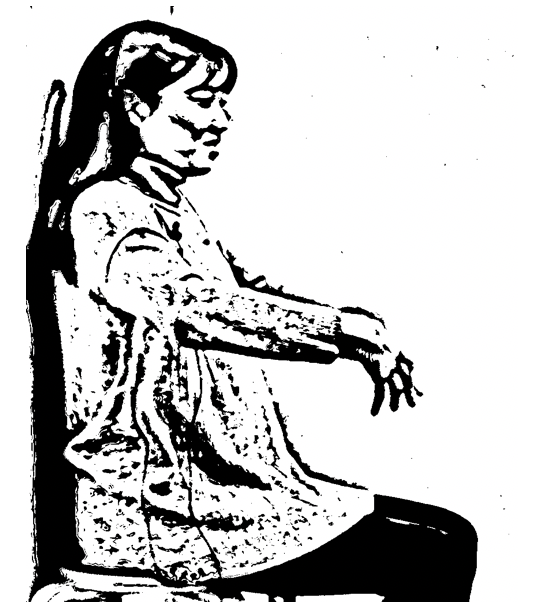
Finally, these images show the same speaker retelling the narrative of a cartoon in which a cat swallows a bowling ball. Here, she is saying that the ball is inside the cat’s stomach. On the left, she is gesturing as if the ball is actually inside her own swollen stomach, which she is clasping in front of her body (this is known as a character viewpoint gesture). In contrast, on the left she is depicting the cat’s swollen stomach with her hands (this is known as an observer viewpoint gesture). Which one do you think comes from an interaction with a friend, and which one from an interaction with a status superior?
a | b |
|
|

Implications:
Researching the multimodal properties of politeness has important implications for politeness research. The findings demonstrate that (im)politeness does not merely reside “in” verbal forms, but rather in the contextualized and embodied usage of language as social action and on the evaluation of that action by the interlocutor and other participants, as claimed by discursive accounts of politeness. Multimodal research is also important to politeness research since phonetics and nonverbal behaviour provide information regarding the underlying strategies or motivations for politeness-related behaviour.
Our research also has important practical applications for language pedagogy and intercultural communication. Since perceptions of politeness are mediated through multiple modalities, second language learners and people involved in international commerce need to make sure that the sound of their voice and their use of gestures matches their polite verbal intentions.
Research Output:
- Winter, B., & Grawunder, S. (2012). The phonetic profile of Korean formal and informal speech registers. Journal of Phonetics, 40(6), 808-815. https://www.sciencedirect.com/science/article/abs/pii/S0095447012000666
- Brown, L., Winter, B., Idemaru, K., & Grawunder, S. (2014). Phonetics and politeness: Perceiving Korean honorific and non-honorific speech through phonetic cues. Journal of Pragmatics, 66, 45-60. https://www.sciencedirect.com/science/article/abs/pii/S037821661400054X
- Brown, L., & Prieto, P. (2017). (Im)politeness: Prosody and Gesture. In The Palgrave Handbook of Linguistic (Im) politeness (pp. 357-379). Palgrave Macmillan, London. https://link.springer.com/chapter/10.1057/978-1-137-37508-7_14.
- Yoon, S. Y., & Brown, L. (2018). A Multiliteracies Approach to Teaching Korean Multimodal (Im)politeness. The Korean Language in America, 21(2), 154-185. https://www.jstor.org/stable/10.5325/korelangamer.21.2.0154?seq=1
- Brown, L. & Winter, B. (2019). Multimodal Indexicality in Korean: “Doing Deference” and “Performing Intimacy” through Nonverbal Behavior. Journal of Politeness Research, 15(1), 25-54. https://www.degruyter.com/view/j/pr.2019.15.issue-1/pr-2016-0042/pr-2016-0042.xml?lang=en
- Idemaru, K., Winter, B., Brown, L. & Oh, G. (2019). Loudness Trumps Pitch in Politeness Judgments: Evidence from Korean Deferential Speech. Language and Speech. https://journals.sagepub.com/doi/abs/10.1177/0023830918824344
- Idemaru, K., Winter, B. & Brown, L. (2019). Cross-cultural Multimodal Politeness: The Phonetics of Japanese Deferential Speech in Comparison to Korean. Intercultural Pragmatics, 16(5), 517-556. https://www.degruyter.com/view/j/iprg.2019.16.issue-5/ip-2019-0027/ip-2019-0027.xml
- Kim, H., Winter, B., & Brown, L. (2021). Beyond Politeness Markers: Multiple Morphological and Lexical Differences Index Deferential Meanings in Korean. Journal of Pragmatics, 182, 203-220.
https://www.sciencedirect.com/science/article/pii/S0378216621002320 - Brown, L. & Prieto, P. (2021). Gesture and Prosody. In Haugh, M., Kádár, D. & Terkourafi, M. Handbook of Sociopragmatics, 430-453. Cambridge: Cambridge University Press.
https://www.cambridge.org/core/books/abs/cambridge-handbook-of-sociopragmatics/gesture-and-prosody-in-multimodal-communication/748EAEFD6B32BE11B343A4C3A437C167 - Winter, B., Oh, G., Hübscher, I., Idemaru, K., Brown, L., Prieto, P., & Grawunder, S. (2021). Rethinking the frequency code: A meta-analytic review of the role of acoustic body size in communicative phenomena. Philosophical Transactions B.
- Brown, L., Kim, H., Hübscher, I., & Winter, B. (forthcoming). Gestures are modulated by social context: A study of multimodal politeness across two cultures. Gesture.
Answers to Examples
Acoustics: recording (a) was spoken to a superior
Nonverbal behavior: (b) was performed to a superior
Gesture: (b) was performed to a superior