
#4 - “Sushimga". Song of Sorrow (愁心歌)
A Story of the Song... The Story behind the Song by Roald Maliangkay (ANU)
약사몽혼[若使夢魂]으로 행유적[行有跡]이면 문전석로[門前石路]가 반성사[半成砂]로구나. 생각을 하니 님의 화용[花容]이 그리워 나 어이 할까요. 강산불변[江山不變] 재봉춘[再逢春]이요 임은 일거[一去]에 무소식[無消息]이로다. 생각을 하니 세월[歲月]가는 것 등달아 나 어이 할까요. 인생 일장춘몽[一場春夢]이요 세상 공명은 꿈밖이로구나. 생각을 하니 님의 생각이 간절하여 나 어이 할까요 (후략) | Had I let the spirits in my dream leave a trace behind, half the stone road in front of his door would have turned to sand. Thinking about him, longing for his fair face, what should I do? The landscape hasn’t changed, but spring is about to return. No news of my love since he left. When I think about it, when I can no longer bear to wait, what should I do? Life has become a dream of passion. That he became a distinguished and known figure in life was all but a dream. Thinking about him, longing for him, what should I do? |
No, this is not a K-pop song. All this stuff about love might make it seem that way, but if you took just a quick look at how it is performed, you would immediately notice the traditional costumes and absence of dance. Sushimga is a folksong, one that unlike those associated with dance or work is commonly performed by a single person seated on a stage. It is not as lively and cheerful as Arirang, but it may well be the most important Korean folksong you have never heard of.
Sushimga is widely regarded as the core of the repertoire of so-called Songs of the Western Provinces (Sŏdo sori, 西道소리), a genre of folksongs that is believed to have originated in the now North Korean P’yŏngan and Hwanghae provinces. In 1968, during the Park Chung-hee administration, it was designated Important Intangible Cultural Property no. 29. Long before that it belonged to the repertoire of kisaeng and itinerant entertainers, which may explain why the lyrics express great passion, even sexual desire. The English translation here differs from the one I included in my book Broken Voices partly in that this time I imagined the singer to be female. Throughout its history, however, the song has belonged to the repertoire of singers of either gender: even today, when most of the students are female, Kim Kyŏngbae, one of the three “holders” responsible for the genre’s transmission, is male.
The solo song does not have a set rhythm and follows a simple call-and-response-like structure that allows for endless elongation. Indeed, while most transcriptions have between three and ten phrases, one by Han Kisŏp from 1997 comprises as many as eighty-one phrases. A sheet with lyrics that was included with an SP recording of the song by Yi Yŏngsanhong (李暎山紅) and Yi Chinbong (李眞鳳) on Taihei 8040 from 1933 shows the two singers selected four phrases for the recording that differ from those translated above.
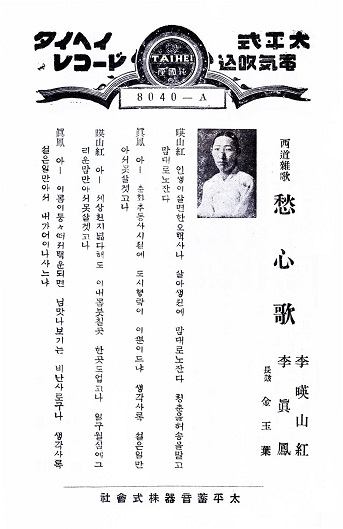
Like other Songs of the Western Provinces, it is sung with a slightly nasal resonance in a low register. The first note of each new phrase is produced strongly, much like a wail. Forced up from the abdomen, usually at a high pitch, the tone then slides down slowly by way of a wide, hiccup-like vibrato that can suddenly jump to a higher scale. Accomplished singers such as the late holder Yi Ŭngwan could jump between scales to pick very different pitches of the same note. The result is a highly ornamented but ultimately deeply melancholic, plaintive sound.
When I first heard the song, I was struck by its magnificence. I had just witnessed a full performance of Paebaengi kut (Ritual for Paebaengi) by Yi Ŭngwan’s senior student Pak Chunyŏng, when he asked me whether I had a special request. I asked him to sing Sushimga. As soon as he began singing, the mood changed significantly, despite elements of the song having been incorporated in the long piece he had just performed. Sushimga, by comparison, is deeply solemn. It is a piece that is best enjoyed on its own, though subtle accompaniment can certainly enhance its beauty. While its lyrics are not easy to comprehend on account of its slow pace and shaky vibrato, and while it lacks a set rhythm and strong melodic line, the significance of this song cannot be misunderstood: this is both an intensely personal and musically complex lament. Those who love K-pop may struggle to appreciate the appeal of this song, but I hope they will click on the links below and take time to listen to the brief but uniquely Korean musical arrangements in their entirety. The song may resonate especially with those struggling to overcome a feeling of great loss, perhaps like that time when BTS first announced a hiatus…
Listen to a performance of the song by Yi Ŭngwan here.
Listen to the Aktan kwangch’il ensemble’s beautiful if modernized rendition of the song (with much instrumental ornamentation) here.
Roald Maliangkay ©, please do not reproduce without prior permission.