
A sleepless night to guard against Giardia
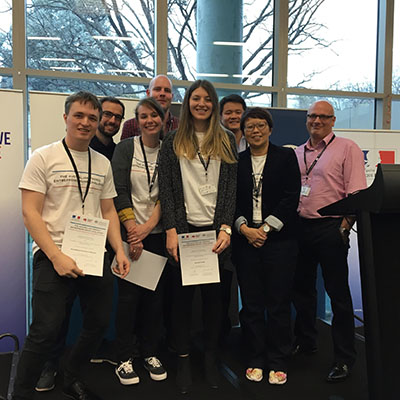
Drinking only safe, clean water can be a challenge when you're in certain parts of the world, particularly in developing countries. Imagine being able to take a picture of water droplets with your smart phone and instantly knowing if the water was infected withGiardia, the parasite responsible for traveller’s diarrhoea. That very idea was the concept that helped PhD student Amanda Vrselja, from the Monash Biomedicine Discovery Institute, win the Australian-French Entrepreneurship Challenge, along with a team of five other students.
Ms Vrselja and her team mates worked through the night – 36 hours straight – to craft an innovative and profitable start-up concept from scratch, having only met each other at the start of the day. The team were part of the inaugural Australian-French Entrepreneurship Challenge, competing against seven other teams of six Australian PhD students from research backgrounds in the biological, natural and social sciences to take out the top spot.
“The 36 hours without sleep was a little bit daunting, but surprisingly towards the end the adrenaline just starts running and you can function, though helped with a lot of caffeine and sugar,” Ms Vrselja said.
The team developed an idea for an app, called Guardia, coupled with a clip-on device to use on your smart phone like a microscope, which would identify Giardia protozoa in droplets of water based on the shape of the parasites.
“This app would have an algorithm in it that would pick up that protozoa and tell you whether it was safe or not for you to drink the water,” Ms Vrselja said.
Participants in the challenge worked through the nights of June 2–3 to craft their concept and pitch it to an expert jury of entrepreneurs, scientists and managers. The teams were congratulated by Australia’s Chief Scientist, Dr Alan Finkel, and the awards were presented by the Ambassador of France to Australia, Mr Christophe Lecourtier.
For the first few hours of the event, the participants attended workshops and worked with mentors to prepare them for the challenge and learn more about entrepreneurial skills.
“The first time I heard about the challenge, I dismissed it because I thought, ‘I come from a biomedical research background. What kind of experience in entrepreneurship do I have?’” Ms Vrselja said.
“But the fact that there were going to be people from all different fields of science appealed to me. You can get stuck within your own field and not interact with other areas of research, and I know that some amazing collaborations can come out if you mix a few ideas together.”
The winning team, including Ms Vrselja, will travel to France in late September or early October this year, part of their prize for winning the challenge.
Ms Vrselja, from Professor Jane Black’s lab in the Department of Anatomy and Developmental Biology, is one and a half years into her PhD, researching the impacts of premature birth on the heart.
“My PhD project’s a part of a pre-clinical study in an ovine model designed to investigate the short- and long-term health outcomes of preterm birth and associated antenatal and postnatal influences,” Ms Vrselja said.