
What we do
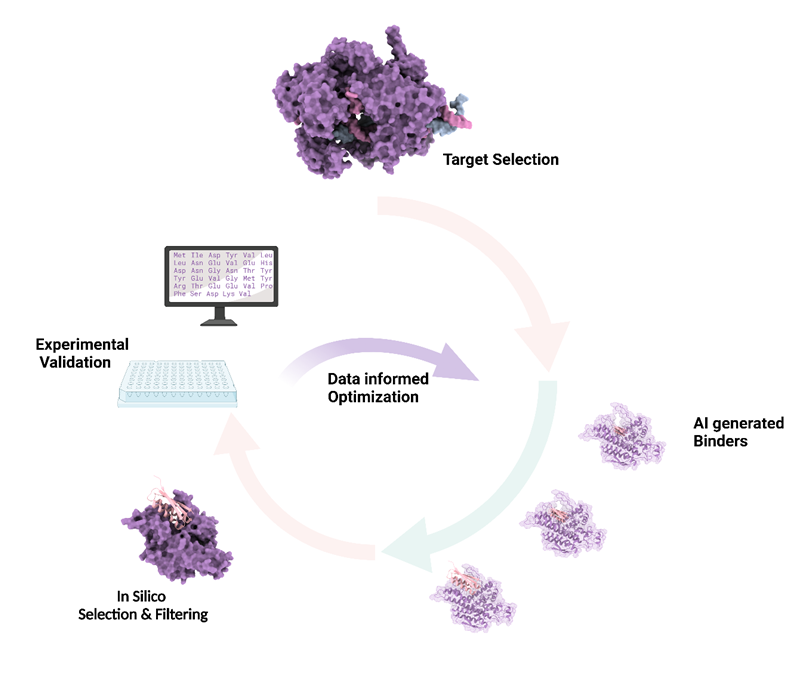
Our program was founded to help researchers access, understand and use the myriad computational tools available for AI-guided protein design, bringing them to the Australian research ecosystem where they can accelerate research and innovation. Working with the AIPDP provides access to a platform capability in AI-accelerated protein design for use by academic researchers and industry to develop therapeutics, diagnostics, and research tools.
Our team leverages combinations of validated publicly available software (RFdiffusion, BindCraft, BoltzGen, and more) as well as custom networks to provide researchers with the benefit of the best tools for their task.
Our expert team of structural biologists and computer scientists understand the design process from end-to-end. This in-depth knowledge of protein structure and machine learning makes us a highly agile program capable of regularly onboarding cutting-edge tools in AI-protein design.
We work with users, taking the time to address specific project needs with customized state-of-the-art computational technologies, empowering and upskilling the broader research workforce to create unique solutions to challenges in biology and protein design.
Working with us
We offer a few different pathways to work with us to meet your protein design needs including:
- Regular drop-in sessions to meet with our experts
- Project collaboration pathways
- Tailored fee-for-service project engagement
To learn more about how we could work with you, please contact one of our team members.
Research outputs
1. Clement, J., et al. A complete RXFP1–relaxin interaction model unlocks the design of potent mini-protein modulators. BioRxiv (2026) https://doi.org/10.64898/2026.06.19.733483
2. Wang, X., et al. Cryo-EM structure of human LRRC15 reveals the basis of therapeutic antibody recognition. BioRxiv (2026) https://doi.org/10.64898/2026.06.16.732218
3. Taveneau, C., et al. De novo design of potent CRISPR–Cas13 inhibitors. Nat Chem Biol (2026) https://doi.org/10.1038/s41589-025-02136-3
4. Fox, D.R., et al. Inhibiting heme piracy by pathogenic Escherichia coli using de novo-designed proteins. Nature Communications 16, 6066 (2025)https://doi.org/10.1038/s41467-025-60612-9
5. Valentin-Alvarado, L.E., et al. From Code to Comprehension: AI Captures the Language of Life. The CRISPR Journal, 8 (1), 2-4 (2025). https://doi.org/10.1089/crispr.2025.0008
6. Fox D,R., and Taveneau C, et al. Code to complex: AI-driven de novo binder design. Structure 33, 1631-1642 (2025) https://doi.org/10.1016/j.str.2025.08.007
7. Michie, K. et al. Australian Structural Biology Deep-Learning Infrastructure Roadmap. Australian BioCommons (2025) https://zenodo.org/records/15786982