
Protein discovery may boost egg quality and increase chances of a healthy pregnancy
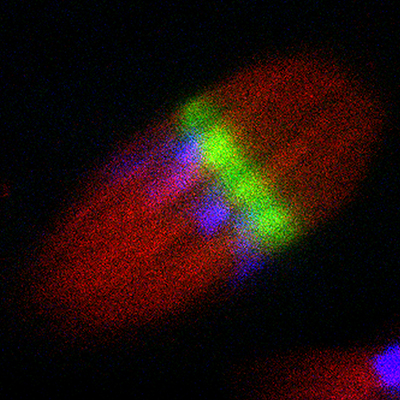
Mouse miotic spindle showing chromosomes (blue) and spindle (red)
Monash researchers have found the loss of a particular protein may be crucial in understanding why the eggs of some women fail to fertilise or, when they do, have a greater incidence of chromosomal abnormalities such as Down’s Syndrome. The discovery opens the door to eventually being able to replace this protein during IVF to improve the health of the oocyte and increase the chance of conceiving a healthy baby.
The international research team, led by Professor John Carroll and Dr Qing Hua Zhang, of the Monash Biomedicine Discovery Institute, have found that a protein already known to have a fundamental role in doubling the DNA content before cells divide, may play a completely different role in eggs- that of ensuring chromosomes separate correctly at the time of fertilisation. The protein, Cyclin A2, may therefore have the potential to protect against chromosomal abnormalities that can cause infertility, miscarriage, and birth defects. The study has just been published in the Journal of Cell Biology.
The discovery of the protein’s role in the eggs of mice may have implications for why eggs from some women have a high rate of chromosomal defects and failed fertilisation. In particular, female fertility declines rapidly after the age of 37 -- with women over 42 having only a five per cent chance of having a baby without fertility treatment. The problem is that as a woman ages, her eggs also age -- increasing the chances of chromosomal abnormalities. This leads to an increase in conditions such as Down's syndrome, where the egg has three copies of chromosome 21. However most chromosomal abnormalities in eggs lead to embryos that either fail to implant in the womb, or miscarry soon after implantation. In women over 40 most miscarriages are caused by the wrong number of chromosomes being present in the egg.
Using mice that had been genetically altered to not produce the Cyclin A2 in their eggs, the researchers found that the chromosomes were often disorganised and at fertilisation they did not separate properly. Not surprisingly, the mice are much less fertile. Dr Zhang discovered this abnormal chromosome behaviour using advanced microscopes combined with fluorescent proteins that allow the visualisation of chromosomes and the cellular cables (microtubules) that move chromosomes around. Some of the defects seen in eggs deficient in Cyclin A2, such as chromosome lagging, are similar to those in eggs of older humans.
According to Professor Carroll, the discovery could ultimately lead to new approaches to increase the chance of a successful pregnancy for would-be mothers in their late 30s and early 40s and in other patients whose eggs do not produce healthy embryos.
“We are currently investigating if Cyclin A2 is low in eggs from older mice, and then we will look in eggs of older women, or in eggs from patients with repeated IVF failure. Ultimately, the idea would be to boost the Cyclin A2 levels during the IVF procedure with a view to improving the health of the oocyte,” Professor Carroll said.