
Novel dosing strategies to fight deadly superbug
An international team of researchers are developing new antibiotic drug combinations to attack one of the world’s deadliest superbugs,Acinetobacter baumannii, with the support of a USD$3.4 million National Institutes of Health (NIH) grant.
The superbug Acinetobacter baumannii, or A. baumannii, is a bacterial pathogen resistant to many antibiotics. Commonly found in hospitals, nursing homes and other healthcare facilities, A. baumannii is among the most challenging hospital-acquired pathogens in the world. It appeared at the top of the World Health Organization’s 2017 list of priority pathogens that “pose the greatest threat to human health”.
A. baumannii infections can no longer be treated effectively with a single antibiotic; therefore, researchers around the world are working hard to develop new drug combinations and new antibiotics to combat this bacterial superbug.
Monash Biomedicine Discovery Institute’s (BDI) Associate Professor John Boyce is co-investigator on the 5-year NIH grant. Associate Professor Boyce’s lab will receive USD$630,000 from the grant, allowing them to undertake transcriptomic and genomic analysis of the response of A. baumannii to different antibiotic combinations, and identify the specific resistance mechanisms that occur during failed treatments. This research will then be used as part of the mathematical models to predict the best synergistic combinations and specific dosage regimens.
“Only by understanding precisely how the bacteria change in response to each antibiotic treatment can we design effective combination therapies that will stop treatment failures and the development of more resistant strains,” Professor Boyce said.
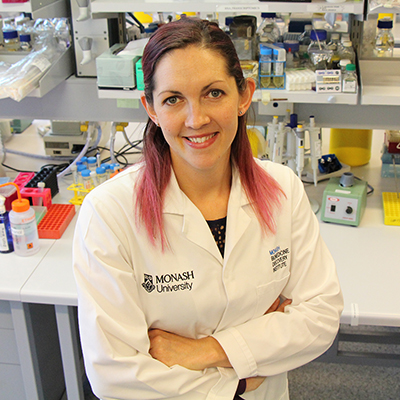
Dr Deanna Deveson Lucas will be conducting the research in Associate Professor Boyce’s Monash BDI lab.
“This grant will enable us to perform large scale analysis into how resistance develops during antibiotic treatment. We will use whole genome and transcriptome sequencing to identify the changes in the genes involved in antibiotic resistance, and how the expression of those genes alters in the organism during different treatments,” Dr Deveson said.
“Understanding how A. baumannii responds during antibiotic therapy will allow us to develop effective combination antibiotic treatments that will reduce the likelihood of resistance developing.”
Associate Professor Jürgen Bulitta from the University of Florida College of Pharmacy is the principal investigator on this grant.
“Acinetobacter baumannii can cause serious infections of the respiratory tract and bloodstream, and also impact burns and combat wounds,” Associate Professor Bulitta said.
“These infections are notoriously difficult to treat and can be deadly if they enter the respiratory system or bloodstream,” he said.
The grant funding represents a first step toward attacking the A. baumannii superbug.
This research will be supported by the National Institute of Allergy and Infectious Diseases of the National Institutes of Health, under award number R01AI130185.
This article is based on a media release originally prepared by the University of Florida.