
Mysterious ape from Java uncovered

Investigations on fossil teeth prove another Pleistocene ape species in Southeast Asia
An international team of researchers, involving Dr Luca Fiorenza from the Monash Biomedicine Discovery Institute (BDI), have identified a fossil ape species from the Senckenberg Hominid Collection. The new species that was initially described as Meganthropus palaeojavanicus, and interpreted at that time as a primitive man, has undergone a number of re-identifications. This latest study, using advanced computer methods, have determined that the initial identification was not correct.
More than 200 fossil teeth and mandibular fragments have been discovered on the island of Java in Indonesia. Most of these hominin remains belong to the extinct species Homo erectus, which also included the first early human fossils found by Eugene Dubois in 1891 outside Europe. It’s known that Homo erectus was in Java during the Pleistocene epoch about a million years ago, together with the ancestor of today's orangutan.
However, as Dr Ottmar Kullmer from the Senckenberg Research Institute explained, "we can now prove that there was another ape present at the same time".
By examining the anatomical structures of the teeth, the researchers have shown that in Java, Homo erectus was not the only hominid species to live on the island, but that it cohabited with at least two more hominids about a million years ago; ancient orangutans and Meganthropus. The study, led by scientists from the Senckenberg Research Institute in Frankfurt, was published today in the journal Nature Ecology & Evolution.
Together with the first author of the study, Clément Zanolli from the University of Bordeaux, Dr Kullmer and the international team of scientists examined fossil hominid teeth, which were initially found in 1941 by Gustav Heinrich Ralph von Koenigswald, using the advanced computer methods.
One of the methods used to examine the teeth was the occlusal fingerprint analysis, which allows scientists to reconstruct the masticatory movements of an individual from the analysis of tooth wear.
“Our results clearly show that the masticatory behaviour of an ape significantly differs from those of modern humans and their closest ancestors” Dr Fiorenza explained.
“Probably, having relatively large canines and u-shaped jaws influence how apes chew their foods,” he said.
"Our micro-computed tomography and tooth enamel analysis shows that the teeth are neither Homo erectus nor orangutans," Dr Zanolli explained.
"There is no evidence that they are ancestors of modern humans," he said.
There have been ongoing scientific controversies about the 'mysterious hominid Meganthropus' over the years, but no reliable evidence for its existence, according to Dr Kullmer. Without evidence otherwise, most paleontologists believed the fossils should be classified as Homo erectus. However, the new data now shows that the enamel thickness distribution, and cusp morphology of Homo erectus' teeth, as well as those of the orangutans, clearly differ from that of the Meganthropus remains.
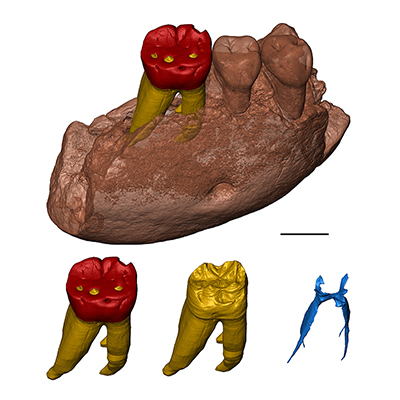 Dental wear pattern of the molars of Meganthropus is more similar to those of modern and fossil orangutans.
"We therefore assume that the re-classified new species had a diet mostly consisting of fruit, similar to modern orangutans. Homo erectus, on the other hand, was probably more flexible in its diet because of its ability to process foods.
According to the current study, there were at least three hominid genera inhabiting the Indonesian forests about a million years ago, in addition to Homo erectus. This indicates a greater hominid paleo-biodiversity than previously thought. There could potentially be yet another genus living in these islands at that time, the giant ape known as Gigantopithecus.
“However, more evidence is needed to confirm this,” Dr Kullmer said.
Read the full paper in Nature Ecology & Evolution titled Evidence for increased hominid diversity in the Early-Middle Pleistocene of Indonesia.
This is an edited version of the original media release from Senckenberg Research Institute.
About the Monash Biomedicine Discovery Institute
Committed to making the discoveries that will relieve the future burden of disease, the newly established Monash Biomedicine Discovery Institute at Monash University brings together more than 120 internationally-renowned research teams. Our researchers are supported by world-class technology and infrastructure, and partner with industry, clinicians and researchers internationally to enhance lives through discovery.