
Taste of UN politics flavours biomedical science students' career ideas

Two Monash Biomedicine Discovery Institute (BDI) students who participated in a United Nations (UN) ‘model’ conference say the experience was life-changing and could potentially shape their future careers.
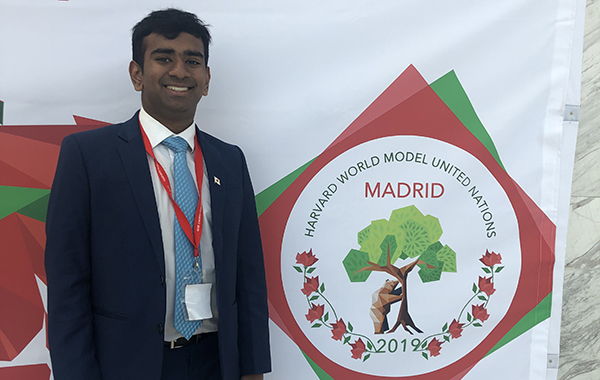
Phillipe Adamtchek and Pravind Easwaran, both second-year biomedicine students, received scholarships from the UN and funds from their Monash University faculty to represent Australia at Model United Nations conferences held in New York and Madrid (respectively) earlier this year.
The conferences simulate the procedures of the global body with students participating in teams as ‘delegates’ representing a country to UN committees and other bodies within the UN system. Participants research and formulate political positions based on the various countries' real-life positions, gather signatories and supporters, form blocs, report on their policies for global change and how they would be implemented, debate them, and hopefully gain approval for their own position at a democratic vote.
Pravind Easwaran spent nearly six months researching and preparing for the conference after being selected as part of a team of 17 students from Monash, one of only two students in studying in the medical sphere.
Pravind was assigned to a model World Health Organisation (WHO) committee looking into the regulation and use of genetically modified (GM) crops from Japan’s perspective. He had previously researched GM crops as part of biochemistry and molecular cell biology units at Monash. He conducted his own review of literature examining the effects to health of GM food, presenting the results at the conference.
“The conference showed me that what happens in the biomedical sector is much bigger than the science itself,” Pravind said.
“There’s a whole world of connections attached to it – politics and economics, and a lot of other areas that influence the area apart from the biomedicine,” he said.
“I’d love to be able to do something in public policy in global health, perhaps in disease tracking.”
Phillipe Adamtchek represented India on climate change policy.
“You get first-hand experience of the world of politics, how it actually works, how the UN system works, how reforms do get enacted and how complicated the whole process is,” Phillipe said.
Yet to decide if he’ll work in biomedical research or in hospital in the medical field, Phillipe said taking part in the event opened his eyes to another side of medicine and health.
“I’d never really considered a job in politics before,” he said.
“But after this experience it’s something that really appeals to me.”
Both students said they learnt much about other cultures and forged friendships around the globe at the conference.
Phillipe said that while the extra-curricular experience was a once-in-a-lifetime opportunity that students wanting to do it should pick their time carefully to fit in with their studies.
About the Monash Biomedicine Discovery Institute
Committed to making the discoveries that will relieve the future burden of disease, the newly established Monash Biomedicine Discovery Institute at Monash University brings together more than 120 internationally-renowned research teams. Our researchers are supported by world-class technology and infrastructure, and partner with industry, clinicians and researchers internationally to enhance lives through discovery.