
Another year of outstanding achievements across the Monash BDI
More than 400 researchers, educators, professional staff and students gathered last Wednesday to reflect on the exceptional efforts made by all to further biomedical research and teaching. These contributions were celebrated at the institute’s annual End of Year Celebration, incorporating the Awards for Outstanding Achievement.
Professor John Carroll, Director of the Monash Biomedicine Discovery Institute (BDI), welcomed staff with a presentation that highlighted significant milestones and achievements made by both individuals and teams.
The presentation highlighted the talent, dedication and energy across the Institute, resulting in a Prime Minister’s Prize, two new Australian Academy of Science Fellows and three scientists among Order of Australia recipients for 2023 as well as fellowships and grants from a diverse range of national and international funding bodies, new initiatives aimed at consumer and community engagement and the many activities in place to support our students.
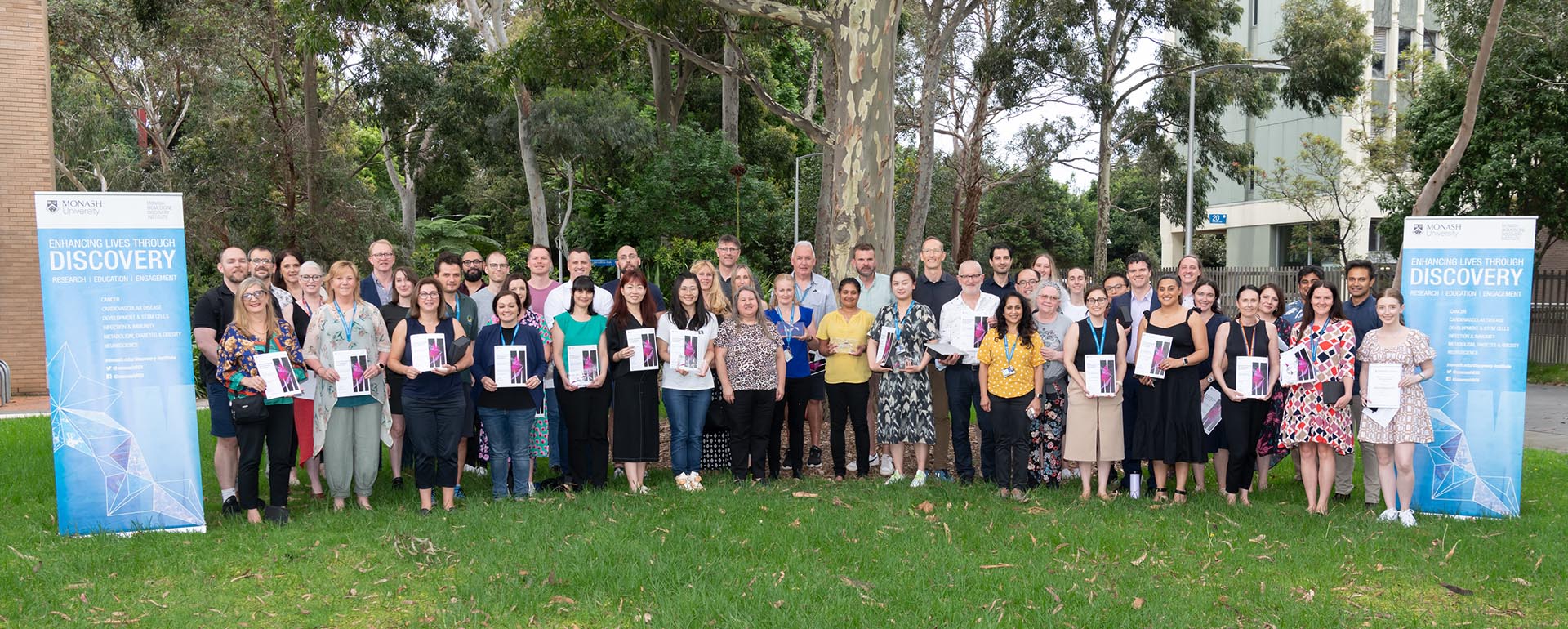
The winners of the Monash BDI 2023 Awards for Outstanding Achievement with members of the institute’s leadership team (click to enlarge).
Professor Chris Thompson, Director of Education at the Monash BDI, spoke about how fantastic it has been to see the reactivation of the education activities and spaces. He also thanked the education team for their unwavering commitment to their students and their commitment to providing an engaging, inclusive and innovative learning environment.
“Visitors are utterly blown away by the scale of what we do, teaching thousands of students,” Professor Thompson said.
Professor Carroll then spoke about the various research achievements and milestones reached in 2023.
“There is an enormous amount of work that goes into making these successes happen. These many extraordinary achievements are only possible because of the amazing people we have at the institute, I appreciate and acknowledge the efforts that everyone has made,” Professor Carroll said.
Professor Dena Lyras, Monash BDI’s Deputy Director, paid tribute on behalf of Beate Lackmann to Beate's daughter, Christina, before presenting the Christina Lackmann Honours Medal to the top ranked Honours student undertaking a research project in one of Monash BDI’s Departments. Receiving the commemorative medal, a certificate and an award of $1,000, this year’s recipient was Chloe Edwards-Lee from the Department of Anatomy and Developmental Biology.
Professors Lyras and Carroll presented the six ECR Development Prizes, which went to Drs Cyntia Taveneau, Jenni Hayward, Simon Windley, Xinyun Jian, Diji Kuriakose and Jessica Runting.
Professors Lyras, Carroll and Thompson then presented the 2023 Awards for Outstanding Achievement, Professor Lyras first thanking those who took the time to nominate their colleagues and also the selection panel members.
The Awards recognise the outstanding achievements of members of the Institute, with each category judged by a selection panel.
________________________
Winners of the Monash BDI 2023 Awards for Outstanding Achievement
Industry Partnership and Commercialisation Award
Professor Roger Daly and Dr Anderly Chueh: a successful example of discovery biology transitioning to development with the establishment of an on going relationship with venture funding that led to validation of the concept and a subsequent license with outlined milestones to develop the technology.
Clinical Engagement and Translation AwardThere were two awards in this category this year:
- Associate Professor Karla Hutt and Dr Amy Winship: For their work with clinical oncologists and consumer advocates to address the issue of infertility and premature menopause caused by damage to the ovary by cancer treatments. As a result of their collaboration, the FDA now recommends the inclusion of ovarian toxicity endpoints in every clinical trial that involves premenopausal women and provides detailed guidelines on how to implement this.
- Cancer Donor Program (Dr David Pook, Professor Renea Taylor, Dr Melissa Papargiris, Dr Jenna Kraska, Dr Mitchell Lawrence): is an initiative established by the Prostate Cancer Research Team within BDI, to facilitate collection of cancer tissue after death and bridge a gap between cancer donation and organ tissue donation. The program enables scientists, clinicians and industry partners worldwide to study lethal cancers in a new, minimally invasive way and involve a broader group of communities in cancer research.
Award for Fostering a Supportive Culture
BLTB Green Impact Team (Dr Anita Barry, Ann-Maree Jefferis, Mark Jones, Dr Ann Bohte, Leanne Sultana, Robyn Batch, Chris Bramich): For their initiatives that contributed to the improved wellbeing of BLTB staff and increased their focus on sustainability. The team implemented many sustainability initiatives including providing reusable crockery, refillable markers, soft plastics recycling and second-hand clothing collection, and running numerous planting days, Mindful May activities, an R U OK morning tea and an upcycling workshop.
Award for Enabling Success of Others
There were two awards in this category this year:
- Professor Kim Good-Jacobson and Associate Professor Andrew Ellisdon: For their work initiating and leading the Department of Biochemistry and Molecular Biology’s Career Development Committee. The Committee has implemented multiple initiatives to meet the changing needs of the department’s researchers. Most notably, these include Career Strategy Panels in which Early-Mid Career Researchers (EMCRs) present a chalk talk and receive independent advice from senior leaders from BDI and externally. This initiative is now having an impact outside BDI, as it has been taken up by the Doherty Institute and is under consideration at La Trobe and Deakin.
- Monash BDI Mid-Career Researcher Committee (Drs Kristen Bubb, Michael Chopin, Nathan Croft, Rebecca Gorrell, Denuja Karunakaran, Antonella Papa, Nicole Mifsud, Dominic De Nardo, Mitchell Lawrence, Dustin Flanagan, Maureen Hagan, Romana Stark, Olga Panagiotopoulou, Sarah Lockie, Mehdi Adibi, Claire Foldi, David Gonsalvez, Thierry Jarde, Padma Murthi, Asolina Braun and A/Prof Sefi Rosenbluh): For its work on behalf of Mid Career Researchers (MCRs) at BDI. The Committee was established only a year and a half ago and has fast become an established advocate for MCRs at BDI. They have raised the profile of MCRs, gained access to and helped develop resources for MCRs, and implemented initiatives to increase the capabilities of MCRs in a changing research environment. Importantly, the committee has boosted morale at the tail end of the pandemic. Their initiatives include highlighting success via new awards dedicated to MCRs, establishing new collaborations via seed funds, and connecting MCRs through professional development events that increase understanding of how Monash operates and other topics such as how to involve consumers in research.
Science Communication and Public Engagement Award
Associate Professor Jane Bourke: For her strong advocacy in representing those impacted by the incurable, but preventable disease: silicosis. Jane has built awareness of the dangers of engineered stone in the workplace through multiple media conferences and interviews on television and radio, representing the Thoracic Society of Australia and NZ in national news broadcasts. Jane is actively engaged with followers on Twitter/X, including promoting the Lung Foundation Australia, communicating important scientific findings and being a voice of those impacted by silicosis disease from engineered stone.
Innovation in Learning and Teaching Award
Associate Professor Tracey Gaspari, Dr Scott Clarke & the BME3030 Education Team: In BME3030, students work in lab groups of 8-10. Over the winter break, they participate in weekly workshops that outline project background, key techniques to be used, professionalism, scientific rigour (e.g. experiments conducted blinded), general lab practice and record keeping (LabArchives). Students undergo in-lab training, technical skill checks and spend 2-3 consecutive days in the lab/week working closely with a BDI academic and Teaching Associate as mentors. At weekly lab meetings students present their latest results, discuss issues and work together to troubleshoot. They present introductory and final seminars as well as provide individual executive summaries on findings to the “Board”, interpreting results and outlining future directions. An authentic simulation of what we do on a daily basis!
Teaching Excellence Award
Dr Nathan Croft: Dr Croft has worked tirelessly across several large cohorts in biochemistry units in both the Bachelor of Biomedical Science and the Bachelor of Science, and routinely gets outstanding student evaluations. His commitment to his students and the creation of innovative curriculum and assessment has also been recognised through the MSA teaching awards. "“Nathan is also so engaging and has delivered the best online content from any academic I have come across at this University." and "Nathan, made this unit enjoyable and light–hearted (loved the memes) and ... showed genuine care for our understanding of concepts.”
Outstanding Contribution to Enhancing Student Learning Award
Dr Peter Boag: For his central role in delivering expert-level bioinformatics and genomics training. His teaching into keystone undergraduate and Masters units is pivotal to a pathway for students to join a future in data-intensive research. This includes the creation and oversight of numerous new Masters level units across multiple courses, including in other Faculties at Monash.
Award for Outstanding Contribution by Professional Services and Support Staff
BLTB Technical Services Team (Dr Anita Barry, Dr Ann Bohte, Dr Kylie Wilson Dr Smita Mehta, Stephen Thompson, Ann-Maree Jefferis, Chris Bramich, Kushani Weerakoon, Narelle Metcalf, Usha Krishnan, Hinal Vekaria, Dr Pamu Kularathna, Barbara Smith, Danielle West, Lina D’Agruma and Dr Tom Weng): For their outstanding delivery of the National Technet Conference at Monash University. Conference delegates from outside the BDI and Monash provided consistently positive feedback on all aspects of the conference, demonstrating exceptional recognition by a broad range of stakeholders while building the BDI's and Monash's reputation. The success of the conference demonstrated effective collaboration across a diverse team, working with other teams and delivering a professional offering which underpins both education and research and demonstrates strong national performance.
Monash BDI Thesis Excellence Award
There was one Award and two Highly Commended in this category this year.
Excellence award:
Dr Yee Ting Candace Ho, Department of Biochemistry and Molecular Biology.
Thesis title: "Chemical biology tools for the characterisation and exploitation of antibiotic biosynthetic pathways”
Candace utilised chemical probes to explore the biochemistry and structural biology of complex enzyme machineries to make major contributions to the field of non-ribosomal peptide biosynthesis. Candace presented an enormous amount of work using mass spectrometry, peptide synthesis, various forms of structural analysis including X-ray crystallography and many more ancillary functional studies. Her thesis was considered to be exceptional by both the examiners. During her candidature, Candace contributed to nine publications including a first author publication in Nature Communications. Candace presented her work at seven international meetings, two as an invited speaker and has recently commenced a postdoctoral fellowship position at the University of Warwick.
Highly commended:
- Dr Yifang (Tiffany) Li, Department of Pharmacology.
Thesis title: “Evaluating the therapeutic effects of bone marrow-derived mesenchymal stem cell-based therapies in combination with an anti-fibrotic agent in experimental models of hypertension”
Yifang’s PhD sought to investigate the therapeutic effects of a novel combined therapy for treatment of hypertensive kidney disease in various preclinical models of hypertension. Yifang completed her PhD within three years and published four first author publications during her candidature and contributed to an additional two manuscripts. She received a number of accolades and was invited to speak at the International Conference of Relaxin and Related Peptides. - Dr Pok Man (Bob) Leung, Department of Microbiology.
Thesis title: “Energetic Basis of Microbial Growth and Persistence in Terrestrial Oligotrophic Ecosystems” Bob’s thesis studied the metabolic mechanisms that support microorganisms from diverse environments to meet their energy requirements during growth and starvation. Importantly, Bob used a variety of wide-ranging approaches, encompassing wet-lab and bioinformatic techniques to provide answers to a number of novel and impactful questions. Throughout his candidature, Bob published three first author papers in prestigious journals including PNAS and ISME, and contributed to an additional 10 manuscripts.
MCR Award for Outstanding Publication Outcomes
There were two awards in this category this year.
- Dr Senthil Arumugam
Deterministic early endosomal maturations emerge from a stochastic trigger-and-convert mechanism.Nature Communications 14, 4652 (2023) The work led by Dr. Arumugam is an excellent example of an international multi-disciplinary collaborative effort that transforms our understanding of endosomal processes using lattice light sheet microscopy. - Dr Dominic De Nardo
Termination of STING responses is mediated via ESCRT-dependent degradation The EMBO Journal (2023) The study conceptualised and led by Dr De Nardo identified the cellular machinery (ESCRT) responsible for packaging a key immune protein, STING, into small compartments, leading to its breakdown in the lysosome. This novel insight could pave the way for developing targeted therapies for inflammatory diseases.
Director’s Highly Commended Publication Award
There were three Director’s Highly Commended Publication Awards this year.
- Dr Wenyue Wang and Professor Roger Pocock
An intestinal sphingolipid confers intergenerational neuroprotection
Nature Cell Biology 25, 1196 (2023) - Dr Iona Schuster and Professor Mariapia Degli-Esposti
Infection induces tissue-resident memory NK cells that safeguard tissue health
Immunity 56, 531 (2023) - Dr Adam Shahine and Professor Jamie Rossjohn
CD1 lipidomes reveal lipid-binding motifs and size-based antigen-display mechanisms
Cell 186, 4583 (2023)
Discovery Award for Best Publication
Dr Rhys Grinter, Ashleigh Kropp and Professor Chris Greening
Structural basis for bacterial energy extraction from atmospheric hydrogen
Nature 615, 541 (2023)
For those of you who weren’t able to attend the End of Year Celebration and Annual Awards event 2023, you can download the slides here.
_______________________________
About the Monash Biomedicine Discovery Institute
Committed to making the discoveries that will relieve the future burden of disease, the newly established Monash Biomedicine Discovery Institute at Monash University brings together more than 120 internationally-renowned research teams. Spanning six discovery programs across Cancer, Cardiovascular Disease, Development and Stem Cells, Infection and Immunity, Metabolism, Diabetes and Obesity, and Neuroscience, Monash BDI is one of the largest biomedical research institutes in Australia. Our researchers are supported by world-class technology and infrastructure, and partner with industry, clinicians and researchers internationally to enhance lives through discovery.