
Infected human cells kept healthy by a novel bacterial protein

Monash researchers have discovered a novel bacterial protein which keeps human cells healthy, even when the cells have a huge bacterial burden.
The bacterium Coxiella burnetii is the causative agent of a serious infection called Q fever. Human infections are usually linked to agricultural outbreaks, though the bacterium can infect both animals and humans. Infections lead to significant economic and public health issues.
Professor Hayley Newton, a lab head in the Monash Biomedicine Discovery Institute (BDI), is co-senior author together with Professor Dario Zamboni (University of São Paulo) on a paper published in the Proceedings of the National Academy of Sciences (PNAS) today on the discovery of a novel Coxiella protein – MceF - that keeps infected human cells healthy in vitro.
Professor Newton explained that Coxiella burnetii lives and replicates inside the cells of the body, or host.
“Coxiella is an incredibly clever cell biologist. It takes control of human cells to set up a factory to replicate itself, and employs host cell mechanisms to basically prolong the health and life of the cell while it reproduces itself in the cell. Coxiella grows slowly so it needs to keep that host cell alive for a week or so. Compare that with something like Salmonella, which kills cells in 24 hours,” Professor Newton said.
“We have been investigating the various ways Coxiella does this, as it’s by understanding these basic mechanisms that we can learn more about how to treat the infection.”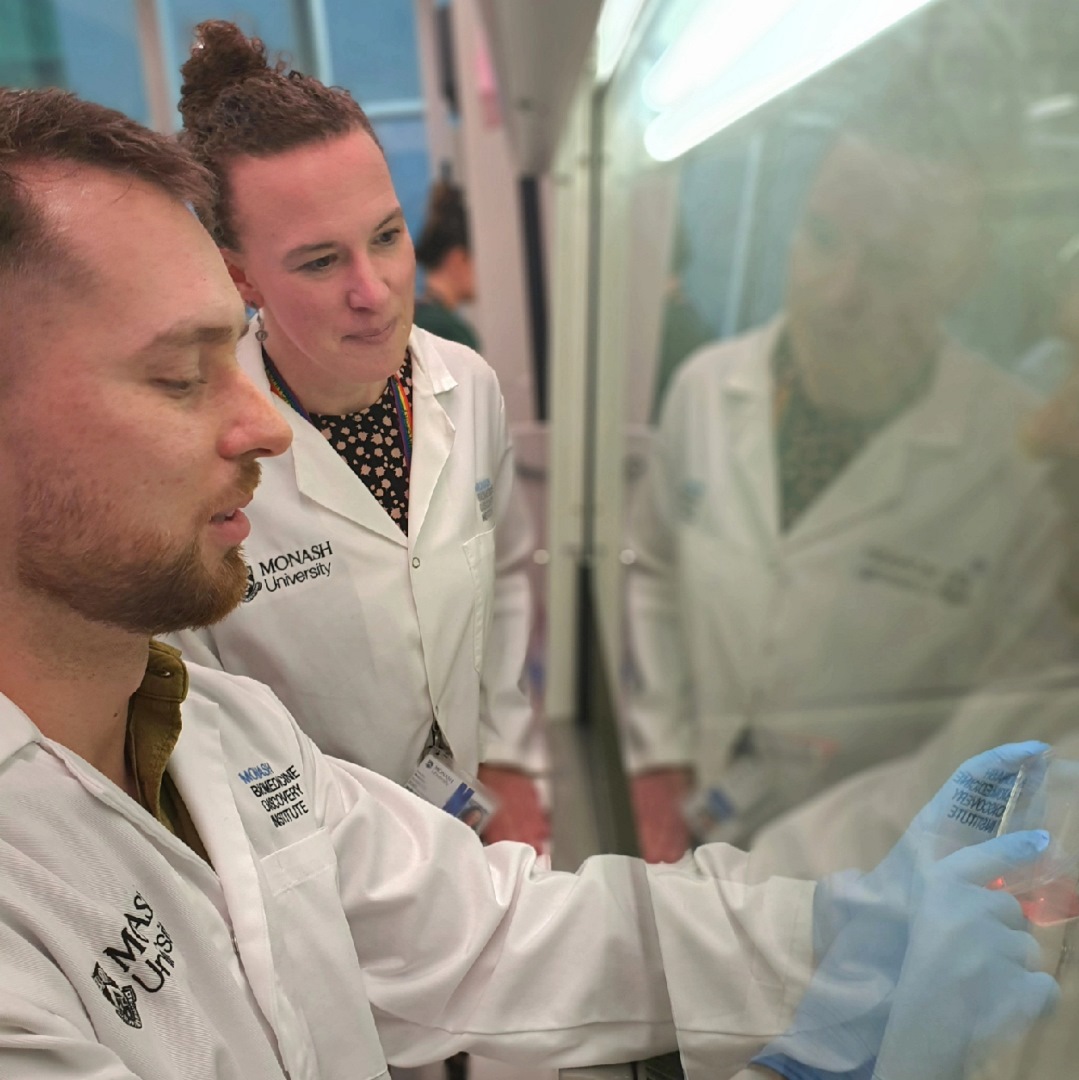
L-R: Dr Robson Kriiger Loterio and Professor Hayley Newton in the lab at Monash BDI
First author Dr Robson Kriiger Loterio completed his PhD under the co-supervision of Professor Newton and Professor Zamboni researching Coxiella burnetii. Dr Loterio discovered that the Coxiella MceF protein finds and uses an antioxidant from the host cell which stops the oxidising, or ‘rusting’, and ageing of cell components.
Dr Loterio said, “The human host cell’s own antioxidant, called GPX4, is directed by Coxiella’s protein MceF to the host cell’s mitochondria - the cell’s energy generator - where it works to detoxify the infected cell while allowing the replication of the bacterium. Thus, the host cell is able to stay healthy while tolerating a large burden of pathogenic bacteria.”
Professor Newton said, “Our study provides evidence that Coxiella has multiple, independent strategies to maintain host cell viability and effectively block host cell death. Coxiella has a large cohort of novel proteins that it injects into host cells.
“Very few of these proteins are well understood, and this study provides a new way to screen these proteins for function. Our screen identified several additional proteins that likely contribute to keeping infected cells viable.
“We’re excited because we can harness the cell biology skills of Coxiella to understand our own cellular function, which will throw light on the cellular processes involved in, and disordered by, cancer and auto-immune diseases,” Professor Newton said.
Professor Zamboni said, "We have much to learn with these fantastic intracellular bacteria. As scientists, we are usually looking for molecules that interfere with key biological aspects of eukaryotic cells, so we can use them to treat diseases. During millions of years of co-evolution with host cells, these bacteria have already developed very interesting molecules. We just have to learn with them, these molecules are already there."
The researchers are conducting further biochemical studies to understand how Coxiella's MceF protein influences our human antioxidant GPX4, which they believe will provide new insight into the signalling of human cell death.
Professor Newton said, “For our future planned research we intend to tease out the function of individual proteins in different host cell pathways, in order to get a global picture of cell control.”
Read the full paper 'Coxiella co-opts the Glutathione Peroxidase 4 (GPX4) to protect the host cell from oxidative stress-induced cell death' published in PNAS.
DOI: 10.1073/pnas.2308752120
About the Monash Biomedicine Discovery Institute
Committed to making the discoveries that will relieve the future burden of disease, the Monash Biomedicine Discovery Institute (BDI) at Monash University brings together more than 120 internationally-renowned research teams. Spanning seven discovery programs across Cancer, Cardiovascular Disease, Development and Stem Cells, Infection, Immunity, Metabolism, Diabetes and Obesity, and Neuroscience, Monash BDI is one of the largest biomedical research institutes in Australia. Our researchers are supported by world-class technology and infrastructure, and partner with industry, clinicians and researchers internationally to enhance lives through discovery.