
Celebrating outstanding achievements across Monash BDI in 2024
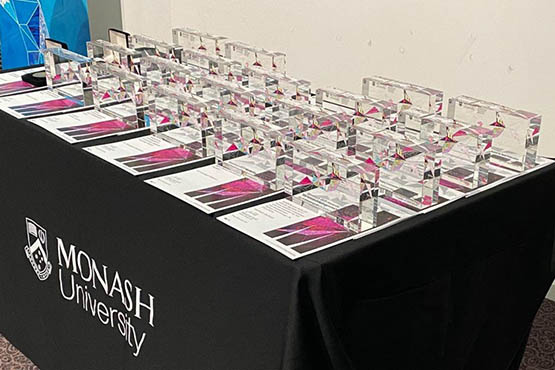
In a packed lecture theatre last Friday, researchers, educators, professional staff and students celebrated the end of another successful year at the Monash Biomedicine Discovery Institute (BDI) End of Year Address, incorporating the annual Awards for Outstanding Achievement.
The event began with a wrap up of the year’s milestones, triumphs, progress and priorities, with Professor Julia Choate, Director of Physiology Education and Biomedical Program Convenor, presenting some of the education highlights for the year. This included an overview of the flagship courses and new units and degrees, the awards won by both students and educators, and showcasing some of the incredible work done to improve the student experience, support the current student cohort and to inform prospective students about future study and career opportunities in biomedical science.
Monash BDI’s Director, Professor John Carroll, then spoke about the various research achievements and milestones reached in 2024, highlighting selected fellowships, distinguished achievements, awards, grants and funding, publications and more. The institute’s commercial successes, major collaborations and engagement with the wider public were also highlighted.
“2024 has been another outstanding year for Monash BDI. We've built on our significant national and international connections, carried out vital research, taught thousands of students, published great papers - representing years of work - and further enhanced our reputation as a leading biomedical research institute," Professor Carroll said.
“These many extraordinary achievements are only possible because of the amazing people we have at the institute,” he said.
Beate Lackmann presented the Christina Lackmann Honours Medal, in honour of her daughter - a talented and very high-achieving Biomedical Science student at Monash who tragically passed away in 2021. This award was established as part of Christina’s legacy, to recognise a student with outstanding potential in research. It is awarded each year to the top ranked Honours student undertaking a research project in one of Monash BDI’s Departments. The recipient of the award receives a commemorative medal, a certificate and an award of $1,000. There were two recipients this year, Adam Naorniakowski (Biochemistry and Molecular Biology) and Darcy Stenteford (Physiology).
The Monash BDI Awards for Outstanding Achievement recognise the achievements of members of the institute who have gone above and beyond each year.
The awards committee received more than 40 nominations across all categories, including both self and peer-nominated submissions. Each award category was judged by a selection committee.
Professor Dena Lyras, Deputy Director of the Monash BDI, presented the awards.
“All of the nominations were of an extremely high quality. It was very difficult for each of the selection committees to select a single winner,” Professor Lyras said.
Congratulations to the winners of the Monash BDI Awards for Outstanding Achievement:
Industry Partnership and Commercialisation Award
Professor Ian Smyth and Dr Denny Cottle. Their research on Polycystic Kidney Disease (PKD) led to the discovery of a therapeutic target that could slow or prevent the disease. Their work has not only resulted in the creation of a spin-out company, xCystence Bio, but also attracted significant industry interest and funding, showcasing the potential for real-world impact on PKD treatment. With kidney transplant being the only current cure for PKD, successful development of an efficacious drug treatment will not only improve the quality of life for patients but reduce the high financial burden on health care systems and have global reputational impact
Clinical Engagement and Translation Award
Dr Weranja Ranasinghe: For his contribution in establishing the ductal prostate cancer program. This collaborative program identified new combination therapies to improve treatment of aggressive prostate cancer.
Award for Fostering a Supportive Culture
Anatomy and Developmental Biology Social Committee: Dr Alistair Govier-Cole, Zaahida Abdul Jalil, Jordan Higgins, Associate Professor Craig Smith and Elizabeth Rowell. The ADB Social Committee promoted an inclusive and supportive culture through a series of well-organised and widely praised events. By hosting social activities, the club provided valuable opportunities for staff and students to connect and engage with one another. These events not only facilitated collaboration and a sense of community, but also played a significant role in promoting positive mental health and fostering a welcoming and inclusive environment.
Award for Enabling Success of Others
Dr Davina Dadley-Moore. Dr Dadley-Moore leads the BDI Research Office, supporting 120 research groups with strategic advice and funding navigation. She has significantly contributed to BDI by developing programs to attract fellowship funding and increase research capacity. Her work has been crucial to the BDI Research Accelerator Program and the BDI Early Career Committee, fostering the success of many researchers. Davina's invaluable contributions led to her unanimous selection for this award.
Science Communication and Community Engagement Award
Professor Michelle Lazarus. Professor Lazarus’ science communication initiatives effectively bridge the gap between AI capabilities and public perception, addressing misinformation spread by for-profit companies. Her work, which includes media articles, a book, and a documentary, uses contemporary and relatable examples to enhance AI literacy and highlight both the benefits and risks of AI. By valuing human expertise alongside technological advancements, Professor Lazarus’ efforts help society reflect on the ethical implementation and impact of AI.
Innovation in Learning and Teaching Award
BMS2011 Curriculum & Assessment Transformation Team: Dr Jack Mayhew, Professor John Bertram, Dr Yasith Mathangasinghe, Frances Broomhead, Renee Tsongas, Professor Michelle Lazarus, Dr David Gonsalvez, Dr Chantal Hoppe. The introduction of an oral viva voce assessment in the BMS2011 unit has been an inspired development that has transformed the student experience in learning of anatomy in biomedical science. Not only has this been a successful new form of assessment, it has been done at the scale of an enormous unit with well over 500 students, and garnered outstanding student evaluations.
Teaching Excellence Award
Dr Sonja McKeown. Dr McKeown has made sustained contributions over a long period in the teaching of developmental biology at many different year levels. In an age of disruption in teaching and learning, the innovation and creativity she has shown to develop new forms of assessment to engage students is outstanding.
Outstanding Contribution to Enhancing Student Learning Award (Two recipients)
Dr Georgina Stephens. Dr Stephens has made a sustained contribution to the teaching of anatomy to our medicine students. Over time she has generated an enormous suite of high quality education materials, and student evaluations consistently reflect their appreciation for her teaching.
Natalie Seng. Ms Seng has supported the student experience in biomedical sciences over a sustained period. Her leadership of the Biomedical Education Student Support Team ensures our thousands of students have a smooth journey during their time with us from ensuring they all have mentorship, access to extracurricular activities and receive the best academic course support. Ms Seng goes above and beyond to ensure a rich student life cycle and the incorporation of students into our decision-making and programs.
Outstanding Contribution by Professional Services & Support Staff (Two recipients)
BDI Facilities and Infrastructure Team: Bonnie Dopheide, Renae Hayle, Russell Paulin, Eddie Abkadir, Linda Mason, Dr Deepak Dange, Paul Payne. The team is highly collaborative, both internally and with other individuals and teams. They consistently go above and beyond their standard responsibilities, often working out of hours to comprehensively resolve a range of issues. Each member excels individually, contributing to the overall excellence of the team. They support every member of the BDI, including researchers, educators, and students, often undertaking processes 'under the radar.' Their persistence and follow-through on various projects and processes are commendable.
John Soccio: Mr Soccio goes above and beyond to secure research funding, handling last-minute issues, multiple stakeholders, and complex grant regulations. He provided crucial support for the potential procurement of over $40M in competitive grant revenue for the BDI, making submissions possible. He manages diverse stakeholder relationships with professionalism and collaborates on major international grant applications, often working after hours due to time zone differences.
Monash BDI Thesis Highly Commended Award
Dr Joanita D’Souza: For her PhD thesis titled: “Understanding how the laminar architecture of the posterior parietal cortex supports visual behaviour”
Dr D’Souza’s work reveals how spatial attention differentially influences activity in the brain, within the posterior parietal cortex - a pivotal region in the visual attentional network. These insights lay the foundation for untangling how connections between brain areas support cognition. Dr D’Souza is a first author of a Brain, Structure and Function publication that arose from her thesis. She has also presented her work at a number of national and international conferences.
Monash BDI Thesis Excellence Award
Dr Ashleigh Rogers: For her PhD thesis titled: “Understanding host colonic recovery following Clostridioides difficile infection”
In her thesis, Dr Rogers established and validated a model of infection that shows it can take ten times longer for the intestines to repair from infection compared to normal regeneration. Furthermore, a mechanism of repair is activated following infection that is similar to repair mechanisms used in other forms of intestinal injury, such as chemoradiotherapy. Dr Rogers is a first author on a Nature Reviews Microbiology publication that arose from her thesis. She has also been involved with several publications since the completion of her candidature. Dr Rogers has also presented her research at national and international conferences, and is now working as a postdoc in the Lyras Lab.
MCR Award for Outstanding Publication Outcomes (Two recipients)
Dr Claire Foldi: For her publication titled “Psilocybin restrains activity-based anorexia in female rats by enhancing cognitive flexibility: contributions from 5HT-1A and 5-HT2A receptor mechanisms,” published in the journal Molecular Psychiatry. This work is an example of a significant progress in understanding mechanisms of how drugs, specifically psilocybin works, opening ways for targeted therapies. Dr. Foldi led every aspect of the project along with building international collaborations.
Dr Amy Winship: For her publication titled “Conditional loss of Brca1 in oocytes causes reduced litter size, ovarian reserve depletion and impaired oocyte in vitro maturation with advanced reproductive age in mice,” published in the journal eBiomedicine(Lancet). This work, led by first and corresponding author Dr Winship, addresses the quality control mechanisms in female germline, with impacts to the fertility and health of female cancer survivors.
Director’s Highly Commended Publication Award (Three Awards)
Dr Emma Gail, Dr Evan Healy, Dr Qi Zhang & Professor Chen Davidovich: For their publication titled “Inseparable RNA binding and chromatin modification activities of a nucleosome-interacting surface in EZH2,” published in the journal Nature Genetics.
Harrison Sudholz, Dr Momeneh Foroutan, Dr Sebastian Scheer, Dr Aline Pfefferle & Professor Nicholas Huntington: For their publication titled “IKAROS and AIOLOS directly regulate AP-1 transcriptional complexes and are essential for NK cell development,” published in the journal Nature Immunology.
Dr Lucy Cooper & Professor Kim Good-Jacobson: For their publication titled “Type I interferons induce an epigenetically distinct memory B cell subset in chronic viral infection,” published in the journal Immunity.
Discovery Award for Best Publication (Two Awards)
Dr Benjamin Gully, Dr Sachith Gunasinghe & Professor Jamie Rossjohn: For their publication titled “Structure of a fully assembled γδT cell antigen receptor,” published in the journal Nature.
Professor Chris Greening, Dr Pok Man (Bob) Leung, Dr Rhys Grinter & Professor Jill Banfield: For their publication titled “Minimal and hybrid hydrogenases are active from archaea,” published in the journal Cell.
For those of you who weren’t able to attend the presentation, download the slides here (Monash login required).
GENERAL MEDIA ENQUIRIES
For more Monash media stories, visit our news and events site
Monash Media
E: media@monash.edu
T: +61 (0) 3 9903 4840
About the Monash Biomedicine Discovery Institute at Monash University
Committed to making discoveries that will relieve the future burden of disease, Monash Biomedicine Discovery Institute at Monash University brings together more than 120 internationally renowned research teams. Spanning seven discovery programs across Cancer, Cardiovascular Disease, Development and Stem Cells, Infection, Immunity, Metabolism, Diabetes and Obesity, and Neuroscience, Monash BDI is one of the largest biomedical research institutes in Australia. Our researchers are supported by world-class technology and infrastructure, and partner with industry, clinicians and researchers internationally to enhance lives through discovery.