
MRFF funds new RNA Mass Spectrometry Platform to advance therapeutics
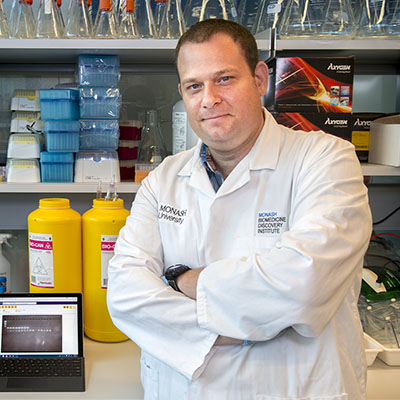
Professor Chen Davidovich will lead the setup of Australia’s first RNA Mass Spectrometry Platform
The Commonwealth Government’s Medical Research Future Fund (MRFF) has invested $4 million to establish an RNA mass spectrometry platform that will advance the local development of RNA therapeutics and enable the earlier detection of diseases, including cancer.
Professor Chen Davidovich, a Monash Biomedicine Discovery Institute (BDI) Lab Head and EMBL Australia Group Leader, will lead a team of 15 Chief Investigators to set up this Australian-first platform, designed to provide a suite of essential analytical services for the Australian RNA therapeutics sector. This will accelerate the on-shore development of mRNA-based vaccines and other emerging RNA technologies, such as miRNA, siRNA, ASO, tRNA and CRISPR RNA.
Mass spectrometry is a group of methods that detects a wide range of molecules and their chemical modifications, including RNA modifications – chemical groups added to RNA that are essential for enhancing the stability and activity of RNA therapeutics. However, Australia’s limited RNA mass spectrometry services leaves many biomedical teams unable to assess essential quality measures of RNA therapeutics under their development.
In recent years, mRNA vaccines have transformed the way we fight infectious disease such as COVID-19. Now, RNA therapeutics are showing significant promise in treating a wide range of conditions, including cancer, infectious diseases, auto-immune and metabolic diseases.
Professor Davidovich said the surge in RNA therapeutic development and investment since the COVID-19 pandemic has created a demand for domestic services for RNA mass spectrometry.
“Right now, if you really want to find a place that provides a full package of analytical services for people developing RNA therapeutics and studying RNA, you will most likely need to collaborate with someone outside of Australia,” Professor Davidovich said.
Professor Davidovich said the platform will enable quality assurance and biomarker detection services, benefiting both Australian researchers and the general public by facilitating access to new RNA therapeutics and early disease biomarkers.
The 15 Chief Investigators on the project come from six Australian universities and research institutes, and two hospitals and include Professor John Carroll, the Director Monash BDI, Professor Ralf Schittenhelm, Professor Anthony Purcell, Professor Jamie Rossjohn and Dr Gavin Knott, all research leaders at BDI, and Professor Mark Shackleton, a research leader in Monash’s School of Translational Medicine.
The MRFF National Critical Research Infrastructure initiative aims to fund research infrastructure of critical importance, supporting world-class health and medical research in areas with unmet medical needs.
Another funded project led by Monash University will establish Australia’s first National Centre for Biopharmaceutical Optimisation of mRNA Therapeutics (CORTx) to optimise mRNA therapeutic candidates and advance them toward clinical trials.
Read Minister Butler’s media release for more information about this round of MRFF grants.
MEDIA ENQUIRIES
Monash Media
E: media@monash.edu
T: +61 (0) 3 9903 4840
Monash is home to Australia's largest network of RNA and mRNA researchers. Keep up to date with our work on life-saving vaccines and therapeutic treatments on our Monash RNA webpage.
About the Monash Biomedicine Discovery Institute
Committed to making the discoveries that will relieve the future burden of disease, the Monash Biomedicine Discovery Institute (BDI) at Monash University brings together more than 120 internationally-renowned research teams. Spanning seven discovery programs across Cancer, Cardiovascular Disease, Development and Stem Cells, Infection, Immunity, Metabolism, Diabetes and Obesity, and Neuroscience, Monash BDI is one of the largest biomedical research institutes in Australia. Our researchers are supported by world-class technology and infrastructure, and partner with industry, clinicians and researchers internationally to enhance lives through discovery.
About EMBL Australia
EMBL Australia is a life science network that maximises the benefits of Australia’s associate membership of The European Molecular Biology Laboratory (EMBL). Officially launched in 2010, EMBL Australia aims to strengthen the nation’s global position in life sciences by creating opportunities for internationalising Australian research through the EMBL Australia Partner Laboratory Network, training the best students and early-career researchers and accessing key international infrastructure.