
New project uncovering the role of a molecular switch in Candida albicans infections receives Wellcome funding
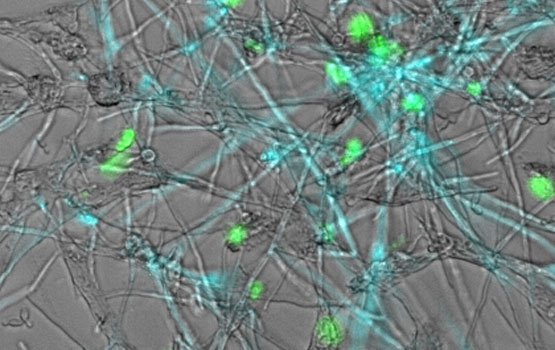
The fungal pathogen Candida albicans form elongated hyphal filaments inside immune cells, which escapes from the immune cells (cyan) and cause immune cell death (green). Credit: Françios Olivier.
Professor Ana Traven from the Monash Biomedicine Discovery Institute is part of a global team investigating how fungi adapt to life in the human gut, to address the growing global health challenge of fungal infections.
Supported by £2.7 million of funding from the Wellcome Biology of Fungal Adaptation program, the five-year research project aims to uncover what drives fungi to switch from harmless members of the gut microbiota to disease-causing pathogens. The research program is led by Professor Alessia Buscaino from the Quadram Institute, United Kingdom, in collaboration with Professor Traven and Professor Kevin Foster from the University of Oxford.
Candida yeasts are a familiar cause of fungal infections and cause thrush, which is irritating but mostly harmless. Candida albicans, the most prevalent of these yeasts, can live in harmony with humans. It is a common member of the gut microbiota, the population of microbes that live in our gut and contributes to good health.
But when the balance of those microbes, or our immune system are disrupted, Candida albicans can overgrow and escape into the bloodstream, which can lead to severe, life-threatening infections. Globally, there are around half a million life-threatening infections each year, so there is a need to better understand what triggers this change in yeasts.
A recent breakthrough from the Buscaino Lab discovered Candida albicans possesses an active molecular “switch” in the form of an RNA interference (RNAi) pathway, that enables cells to control which genes are active, fine-tuning their activity in response to environmental change.
This landmark discovery overturns decades of assumptions in fungal biology and was recognised as a finalist for the 2024 Cozzarelli Prize that recognises scientific excellence and originality.
Building directly on this, the new project - RNAi in Candida albicans: adaptation, commensalism and pathogenesis - will investigate how this RNAi pathway helps C. albicans adapt to the gut environment, interact with the immune system and other microbes in the microbiome, and determine whether it remains a benign resident or becomes a dangerous pathogen.
Professor Traven will explore how RNAi influences fungal interactions with host immune cells and contributes to infection dynamics. Professor Buscaino’s group will focus on dissecting the molecular and epigenetic mechanisms by which RNAi regulates fungal adaptation and gene expression. Professor Foster will also study how RNAi affects fungal relationships with gut bacteria using ecological approaches.
“We are excited to build this international research network for studying fungi in an interdisciplinary and comprehensive way,” said Professor Traven. “In addition to the discoveries that we hope to make, it will be a fabulous opportunity for research training and integrating researchers from the Global North with those from the Global South using Monash’s position in the Indo-Pacific region. This is important, as this region is significantly affected by fungal diseases.”
“It is exciting that Wellcome has recognised the importance of fungal organisms in health and disease through this funding call,” said Professor Buscaino.
“Over half of us live with a benign population of Candida albicans as part of our normal gut microbiome, yet we know that for many people something changes leading to life-threatening infections.
“This interdisciplinary project brings together world-leading expertise in fungal biology, infection, and microbial ecology, combining the complementary strengths of three outstanding research institutions — the Quadram Institute, Monash University, and the University of Oxford — to tackle one of the most fascinating questions in microbiome science.”
About the Monash Biomedicine Discovery Institute
Committed to making the discoveries that will relieve the future burden of disease, the Monash Biomedicine Discovery Institute (BDI) at Monash University brings together more than 120 internationally-renowned research teams. Spanning seven discovery programs across Cancer, Cardiovascular Disease, Development and Stem Cells, Infection, Immunity, Metabolism, Diabetes and Obesity, and Neuroscience, Monash BDI is one of the largest biomedical research institutes in Australia. Our researchers are supported by world-class technology and infrastructure, and partner with industry, clinicians and researchers internationally to enhance lives through discovery.