
The mitoHOPE Program begins pre-clinical research in mitochondrial donation
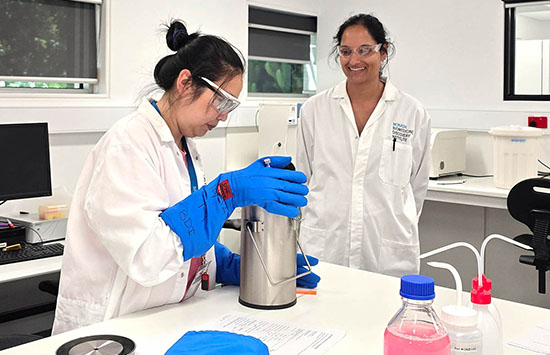
Work towards building mitochondrial donation (MD) expertise in Australia has begun under Monash University’s mitoHOPE Program. This milestone has been made possible through the Program’s pre-clinical research and training licence (PCRT), approved by the Embryo Research Licensing Committee (ERLC) in November last year, and enabled by Maeve’s Law in 2022.
The Program recently commenced Maternal Spindle Transfer (MST) at its Monash University laboratory using donated eggs. The team is also advancing through regulatory steps for the Program’s second licence, which will allow Pronuclear Transfer (PNT). It’s important to note at this stage, the Program remains pre-clinical, with mitoHOPE embryologists focussed on developing proficiency in MD techniques.
“It’s great to be underway with this important pre-clinical work, which represents an early step in building competence in mitochondrial donation in Australia,” said Professor John Carroll, lead of the mitoHOPE Program and a Lab Head at the Monash Biomedicine Discovery Institute (BDI). “It establishes the scientific foundation needed to inform the next phases of research.”
Professor Mary Herbert, lead of the mitoHOPE pre-clinical research and training program and also a Lab Head at the Monash BDI, acknowledged those who helped make the work achievable. “We are deeply grateful to the egg and sperm donors, without whom this research and training program could not progress,” she said.
Once the pre-clinical training benchmarks have been met, the team will apply to the Embryo Research Licensing Committee for further clinical trial research and training licences to demonstrate proficiency in the MD techniques within a clinical setting, before applying for a further licence to begin the clinical trial.
This project received grant funding from the Australian Government.