
Celebrating science during National Science Week

National Science Week offers the perfect opportunity to engage with the broader community about the work that our researchers do at the Monash Biomedicine Discovery Institute (BDI) and why they do it.
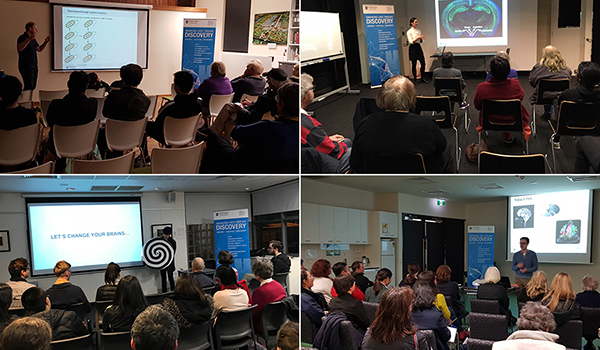
This year, National Science Week was filled with activities across the Monash BDI. Four young Monash BDI researchers went out to public libraries across the City of Monash to give talks on their areas of expertise, and secondary school students visited the institute to discover the wonders of biomedical research.
On Monday, PhD student Callum Vidor, from the Lyras lab, presented on ‘The battle against superbugs: the problem of antibiotic resistance and new therapies on the horizon’ at Mount Waverley Library. Callum engaged his audience with a fascinating talk on how antibiotic resistance can arise and what turns a normal bug into a ‘superbug’, conducted a spread of infection experiment – showing how quickly germs can spread when we shake hands with others – and brought in microscopes displaying bacteria, including the ‘superbug’ Golden Staph.
Rachel Clarke, a PhD student from the Andrews lab, gave a talk at Wheelers Hill Library. Her talk, titled ‘How does hunger influence our behaviour?’, covered the physiology of hunger, why we get ‘hangry’ (hungry + angry), and some of the genetic diseases which can impact on our weight.
In his talk, ‘Is your brain lying to you? Why you shouldn’t always believe what you think you’re seeing’, Brian Oakley – a PhD student from the Price lab – spoke about visual illusions and what is actually happening in our brains when we view them. His talk was at Glen Waverley Library on Thursday.
Dr Matt Sykes, an ECR from the Imlach lab, presented ‘The dynamic brain: how experience physically shapes us’ at Clayton Library on Friday. His talk focused on the amazing plasticity of the brain, which continuously learns, adapts and changes over time despite the fact that the cells in our brain are not continually replaced when they die, like those in the rest of the body.
The library talks were well received, with up to 35 people attending. Peter Head, Acting Coordinator Library Operations at the City of Monash, was pleased to facilitate the talks.
“The talks were a great way for the general public to hear about the current research that is happening at Monash University. The presenters were good at pitching their talks to the audience, translating jargon into layman’s terms and using humour to engage,” Mr Head said.
“It was wonderful to see the way the community reacted to these talks, both in terms of attendance and in feedback,” he said.
In the middle of National Science Week, students from five different secondary colleges, including two girls-only schools, visited the Monash BDI to immerse themselves in the world of biomedical research, get hands-on experiences of cutting-edge science and learn how our game-changing scientists are striving to relieve the future burden of disease.
The students were able to visit research labs, inspect the sensory scientific exhibition put on by the Infection and Immunity Program in the Monash BDI foyer, and engage with Dr Karla Hutt in a Q&A session.
A representative from each school joined Dr Hutt on the stage, with questions prepared by their fellow students. Questions ranged from “How does biomedical research benefit humanity?” to “What are your current goals?” and “What is the most rewarding thing about a career as a research scientist?”
The Q&A style forum was a first for a school visit to the Monash BDI, and the level of interest and interaction shown by all of the students heralded it a success.
Established in 1997, National Science Week provides an opportunity to acknowledge the contributions of Australian scientists to the world of knowledge. It also aims to encourage an interest in science pursuits among the general public, and to encourage younger people to be fascinated by the world we live in.
The Monash BDI is proud to join this initiative to engage with our local community and to inspire the next generation of scientists.
About the Monash Biomedicine Discovery Institute
Committed to making the discoveries that will relieve the future burden of disease, the newly established Monash Biomedicine Discovery Institute at Monash University brings together more than 120 internationally-renowned research teams. Our researchers are supported by world-class technology and infrastructure, and partner with industry, clinicians and researchers internationally to enhance lives through discovery.