
Myostatin discovery could lead to new treatments for ALS, muscular dystrophy
A team of international researchers have identified how the inactive or latent form of myostatin (also known as GDF8), a signalling protein responsible for limiting muscle, is activated.
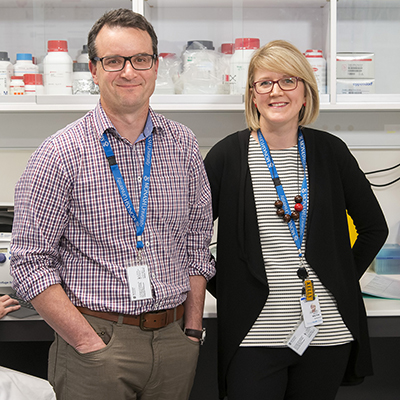
Monash Biomedicine Discovery Institute (BDI) group leader Associate Professor Craig Harrison was co-senior author, along with Professor Tom Thompson from the Department of Molecular Genetics, University of Cincinnati. Monash BDI Dr Kelly Walton (pictured) was also part of the research team.
This discovery could someday help in finding a better treatment to improve muscle function in diseases such as muscular dystrophy, amyotrophic lateral sclerosis (ALS) or Lou Gehrig’s disease, and cancer cachexia, a muscle wasting condition. Muscular dystrophy is a hereditary condition marked by weakness and progressive wasting of the muscles, while ALS impacts nerve cells that control voluntary muscle movement.
The research team’s findings were published in the Proceedings of the National Academy of Sciences of the United States of America.
“All animals have the protein molecule myostatin which limits the size of our muscle,” Professor Thompson said.
“Myostatin is being targeted therapeutically to boost muscle production in patients with muscle disorders. [It is] one member in this very large family of molecules that includes 33 ligands. They play very important roles in many aspects of the human body and often are wrongly regulated in many human diseases such as cancer. Some are used to develop bone while others play large roles during human reproduction.”
During synthesis, myostatin, is made as a precursor which remains in a dormant state with half of the molecule holding the section of myostatin responsible for signalling inactive. Activation involves slicing a section of the molecule responsible for dormancy, thus allowing myostatin signalling to occur and inhibition of muscle growth. The researchers were able to demonstrate that myostatin could be turned on with minor changes to the molecule’s dormant mechanism.
Associate Professor Harrison explained that the aim of the researcher team was to understand the details of how myostatin transitions from an inactive to an active state.
“By modifying single amino acids, we were able generate active myostatin, that is a molecule that no longer required enzyme cleavage for its function. Our study offers great opportunities for developing new means to regulate myostatin activity and, therefore, muscle growth,” Associate Professor Harrison said.
Researchers from Monash BDI include co-senior author Associate Professor Craig Harrison, Dr Paul Gregorevic, Dr Kelly Walton and Adam Hagg.
Funding for this research came from the Muscular Dystrophy Association, the National Institute of Health, the American Heart Association, the University of Cincinnati and Australia’s National Health and Medical Research Council.
Read the full paper titled Molecular Characterisation of Latent GDF8 Reveals Mechanisms of Activation.